|
|
Cove Fort: FREE ! |
|
A Mormon Tourist Trap
|
|
|
Page updated |
There was
no siege or shoot-out here... |

|
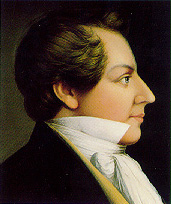 |
(1831 - 1844)
JOSEPH SMITH Discoverer of the Golden plates First Prophet and President and Founder of the Mormon Church:
|
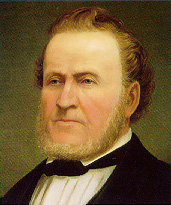 |
(1848 - 1877) BRIGHAM YOUNG 2nd Prophet and President
|
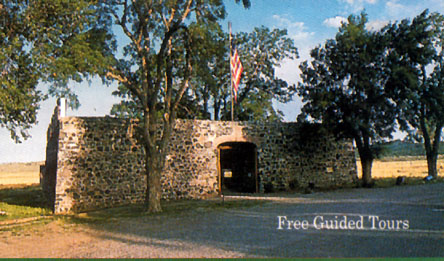
From the Cove Fort pamphlet...
In the fall of 1849, Brigham Young, President of the Church of Jesus Christ of Latter-day Saints, called fifty men to explore the regions south of the Salt Lake Valley under the leadership of Parley P. Pratt. This Southern Exploring Company passed through the Cove Creek area before returning home to recommend the settling of locations north and south of here. Within the next few years many of the familiar towns that now dot the map of southern Utah were established. The pioneers who built these towns traveled through the Cove Creek region, as did a growing number of travelers on Church and government business and immigrants traveling to further destinations such as California.
On 12 April 1867 President Brigham Young wrote a letter to Ira Hinckley asking him to "take charge" of building a fort on Cove Creek, located in central Utah a day's journey from the town of Fillmore on the north or the town of Beaver on the south. This Fort, built instead of a town because of the scarcity of water, was to be a way station for pioneers traveling along the "Mormon Corridor" - -settlements stretching from Idaho to Nevada connected by a network of roads, telegraph lines and postal routes. Being a man of action, Ira left his home in Coalville, Utah, on April 17th for his new assignment, his family to come later.
Between April and November 1867, quarrymen, stonemasons, and carpenters from central Utah settlements labored together to construct the Fort. Built of black volcanic rock and dark limestone quarried nearby, the walls are one hundred feet long and eighteen feet high. Lumber, mostly cedar and pine, was used for the roof, twelve interior rooms and the massive doors at the east and west ends of the fort.
For years the Fort bustled with activity. News of the great, growing West throbbed over the lines into the telegraph office at the Fort and postal riders delivered the news of the new western "empire" to the post office. Daily, two stage coaches with a variety of weary travelers rumbled up to the Fort. Travelers unhitched their teams from their heavily loaded wagons and led the horses to the barn. Cowboys tended the tithing herds and a blacksmith fashioned metal into horseshoes with his hammer. Evening conversation was lively around the long table where each night a new variety of visitors joined the Hinckley family for dinner.
For more than twenty years the Fort served an important function, but as times changed so did the need for the Fort. By 1890 the Church leased out the Fort and after the turn of the century, sold it to the William H. Kesler family. Nearly one hundred years later in 1988, the Hinckley family purchased the Fort from the Keslers and made a gift of it to the Church as a historic site. Shortly afterward, efforts to restore the Fort to its original condition were begun, and on 21 May 1994 President Gordon B. Hinckley, then First Counselor in the First Presidency, dedicated the Historic Cove Fort Complex.
"It is our hope that Cove Fort will serve as a modern way station--not as a shelter from physical fatigue or protection from the elements," said Elder Stephen D. Nadauld of the Seventy who also spoke at the dedication. "Rather, we hope it will serve as a spiritual way station where we can be reminded of the faith of our forefathers, where we can refresh our sense of sacrifice and obedience and our dedication to duty, where we can be reminded of the values of work, provident living, self-sufficiency and family unity."
The Fort contains 12 rooms, 6 on the north and 6 on the south. Each room has a fireplace.
Originally located in Coalville, Utah, this cabin was the home of Ira Hinckley and his family. Here they lived a life of simple devotion that included family prayer and scripture reading. While living in this cabin in April of 1867, Ira received a letter from Brigham Young asking him to leave Coalville in order to supervise the construction of a fort at Cove Creek. He was advised to leave his family in this home while the fort was being built. He then moved his family to the newly completed fort where he managed the fort's operations for the next decade. It is not known whether Ira built the cabin himself.
The barn was the second largest structure on the old Cove Fort complex site. It was built with heavy timber construction 60 feet square and 30 feet high.
The timber was squared and held together with hardwood oak pegs that were imported from outside the territory. Homemade pine shingles were hammered onto the roof with square nails.
The main purpose of the barn was to care for the stock and equipment used by the occupants of the fort and others who maintained operations at the site. However, the barn proved an excellent lookout post because of its height. The barn sheltered horses owned by the Hinckley family and also by visitors to the fort. Well cared for horses were essential to mail carriers and stage coach passengers. The barn was as necessary for nineteenth century travelers as gas stations and auto repair facilities are for the modern traveler. The barn was also indispensable in the day- to-day operations of the fort.
Ira Hinckley, who learned the trade of blacksmithing as a young man living in Nauvoo, established and ran a blacksmith shop at Cove Fort. His skills were essential in providing shoeing services for the horses of the stage coach lines and postal express riders. Freighters and settlers who passed through Cove Fort were also in need of the skills of a blacksmith for making wagon and equipment repairs. Ira was prepared and willing to help any and all who could benefit from his service. Because of the large demand for smithing work, Ira probably employed other blacksmiths at various times.
Mormon Temple
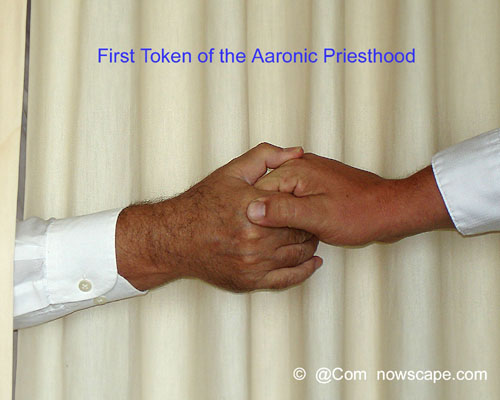
Secret HandshakeOff-site Links:
Door to Door Missionaries
Which Religion is Best?
Gay MormonsOff-site Links:
Mormonism, recovery
Mormon Genealogy
What Atheists think
Can I sue?Frank Zindler:
Lost A Steel Mill?
Chris Allen:
Religion Has Value?
George Carlin
On ReligionFaith-building References!
Non-Faith-promoting Literature
Other: Fundamentalist Millennialism
What are Memes - Momes ?
FREE! BOMWho is this... friend or foe?
"When our leaders speak, the THINKING has been done."
Trust us ... We know
Evolve Beyond Belief...
Pick one up for a friend!
BYU Professor Dr. Chris Foster
Comments / corrections welcome.
Emails received will be posted here, with or without name and email address -- you say.
Webmasters: If you have a related web page, please feel free to link to here.Cove Fort Please do not include my name or email address.
Monday, September 15, 2008 2:39 PM
From: ****@yahoo.com
I am writing on behalf of your article about Cove Fort. I grew up in Delta, UT which is just north of Cove Forge. I agree that it is a Mormon tourist trap geared toward recruiting new members into the Mormon Church.
One thing that I find amazing is that I cannot find articles concerning the murders, body parts and basic evil that surrounds that fort. When I was a teenager (back in the 80's) there were several murders in the fort or directly near the fort. My only explanation for this would be that maybe the "church" somehow hid those records so there would not be a bad light cast on their precious tourist trap. Anyway....
Shortly after I moved from Utah it was re-done by the Mormon church. On one of my visits home I decided to take the "tour". Because I told them that I had been a Mormon at one time my visit became a high-pressure sales pitch to re-join the church.... I would say it compared to going on vacation and ending up in one of those time share sales pitches.
Yes, the tour is free. Yes, it sucks to be pressured by a bunch of overzealous missionaries. If you still want to stop there I suggest you don't give your real name or address unless you are sincerely interested in seeing more missionaries.





Date: Sun, 11 Jan 2009 18:00:53
From: ***yahoo.com
... I also read some of the other 'sucks' pages, including the one about Cove Fort. I agree with what you said about it - I've visited there and felt trapped by the missionaries. I also followed links that led to something about George Carlin.
From: Loreta Whicker <loretawhicker@me.com>
Subject: Reply to Delta person
Date: August 1, 2011 2:29:00 PM MDT
First, anyone who won't put their name doesn't deserve comments but since you are slamming my turf I'll ignore my feelings about that.
So, if you are going to a historic Mormon site, what do you expect but Mormon missionaries. If you want to learn history and how people live 150 years ago, Cove Fort is a wonderful place.
Next, your alluding to the murders around Cove Fort. Yes, there were two of them and they had nothing to do with the fort except the proximity of their deaths. Both cases have long ago been solved and the guilty parties are now spending a long time at the state prison. Again, these cases had nothing to do with the Fort. The young lady was from Fillmore (a neighbor) who chose to hitchhike from Cedar with some very unsavory characters. The young man was from Delta and again chose to associate with some bad boys.
Lastly to all of you who have your nasty feelings about the Mormon Church - if you don't like us, stay away. We are not to harm you. What is your problem?
Loreta Whicker
Retired school teacher from Fillmore
RE: " - if you don't like us, stay away. We are not to harm you. What is your problem?"
My problem is that you, personally, and y'all as a group harm me and others by going from door to door, worldwide, explaining to your victims that they must have a religion, that it should be Mormonism and that if they don't have that then they will be damaged by suffering in hell forever. My problem is that churches don't pay their fair share of the taxes. My problem is that religion demonstrably lies to people about very important things. Your religion extracts money under false pretenses and delivers nothing except goofy promises of polygamy for men in the hereafter. In a nutshell that's my problem. Read a book; get an education. I hope I've answered your question!
Kindest regards,
O. LaMar Smith
Publisher's statement: Any inaccuracies will be corrected, if brought to publisher's attention. The content of this web page has been brought to the attention of its subject. Emails received will be posted here, with or without name and email address. Page updated 2013-11-03