Back
The 101+ Book Atheism LibraryAnd...
Math / Logic LibraryAnd...
A Science Library
Evolve Beyond Belief -
Pick one up for a friend!I have a feeling we're not in Kansas anymore
Customer reviews -
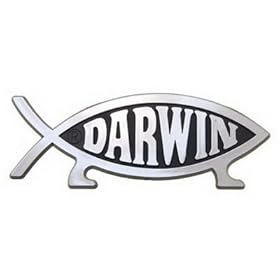
* Not only did I receive a fine product, but my mother now has a way to express her belief of the Evolutionist theory to drivers tailgating her on the 401. Very high quality, a must-have for any adamant evolutionist!* I was a little concerned how well it was going to stay on the car but that little adhesive strip does the job nicely. heavy rain, sleet, snow, car wash's, the occasional disgruntled southern protestant, this little guy is a trooper :) Screw you Intelligent Design, and see these cute little guys multiply, usually on college campus's near you.
Carl Sagen's Baloney Detection Kit
51. Atlas Shrugged, by Ayn Rand
This classic is the Only Book Available That Will Arm You To Fight Nonsense!
Do you ever listen to people discuss mystical things with reverie and
wonder why they believe all that crap? Do you ever wonder what belief
in all things irrational ultimately does to the world? Here is your chance
to find out. Atlas Shrugged is the most important book ever written,
and will provide you with all the tools necessary to understand how to
live a life of reason and see the law of cause and effect in action when
man tries to live with out his most important tool, his mind.
More about George Carlin
52. The Fountainhead, by Ayn Rand (Introduction), by Leonard Peikoff (Afterword)
"This can be a life changing book. If life has you wondering about
incompetence, hypocrisy and dishonesty, if you feel like you have
to compromise your beliefs just to get by, this is definitely a must
read book! Rand allows her characters to live and enjoy life without
guilt. Raises the complex question: At what price do you set your art,
your life, your soul? How unusual is it to find a person that will not
sell out at any cost? You won't be disappointed if you read this
book."
This is a very STUPID book -- not recommended ...a paper originally presented in the Summer of 1994 at the meeting of the C.S. Lewis Society, Cambridge University. Buy it here if you are a GOOFY person.
A review -- I suppose this, of Behe's conclusion, is the meat:Behe re-states what's known about molecules and infers the existence of a deity from that.
Behe is smarter than most religionist apologists who so glibly employ the old 'ad ignoratum' to trick us into believing his way. Usually the argument goes something like this: We don't know how life works, therefore there must be a creator who made living things. Of course, not knowing how "X" works says absolutely nothing about the existence of gods. Many find this convincing, though, when the "X" is a difficult question, like the cell, the Big Bang, or the particle-wave duality of matter. But this kind of argument should not fool anyone. Simply not knowing says nothing about the existence of creators. Behe prepares us for this trap, by cleverly telling us to ignore it. Here is the language in which he ensconced the trap: "We are not inferring design to account for a black box, but to account for an open box." To convince us further, he assumes that the so-called "primitive man", when confronted for the first time with an auto-mobile would immediately lift up the hood in order to discover its motive force. Why not the door or the trunk? Would it not seem that the wheels are the prime candidates of first inspection? How can this primitive skeptic "immediately realize" from looking at the engine that it was designed? I don't think Henry Ford or Gottlieb Daimler had this design in mind! The modern automobile is much more a product of evolution than of design, Mr. Behe. In fact, automobiles reproduce very much like some biological systems -- retroviruses, for example. Cars are made in places called factories, with organelles called parts, assembly lines, designers and salesmen. AIDS viruses are made in factories called T-cells whose reproductive machinery is employed to make more viruses. I don't think Gods made viruses. Self-assembling systems do not require designers. Molecules are the building blocks of self-assembling systems, and their environment "votes" whether they are allowed to self-assemble more of the same. Mr. Behe does not play fair in the exposition of his god-theory; here is a good example that shows to what lengths religionist apologists will go in order to avoid the great paradigm shift, for many, that god is not needed to explain how thing work. Fundamentalist religionists, however gravitate to this view in the faith that they have found a man of science who supports them.
Outside, Looking in
by Gil GaudiaPaperback
This is an atheist novel, not merely a secular novel. Many novels, including whodunits, science fiction and romance novel are secular, in that religion is not mentioned or does not play any role. But that merely means, the author does not bring up the topic of religion, as we mostly don't in everyday life. This book is about the main character having no religion and god being an illogical construct. This first-time novel, written by an Atheist, is about one man's struggle to find a sense of place in a religious society.
Grand Jury Prize at 2004 Sundance Film Festival An unexpected result in a process for traveling back several hours in time. The men initially use these rewind sessions to succeed in the stock market. But a dark consequence of their daily journeys eventually complicates matters. If this sounds like a very commercial, science fiction thriller, Primer is anything but that. The film has a tantalizing, sealed-in logic, akin to Memento, that forces viewers to see the fantastic with a certain dispassion. One may be tempted to sit through Primer again to more fully understand its paradoxes and ethical quandaries. --Tom Keogh The Holy Qur'an: Text,
Translation & CommentaryAbdullah Yusuf Ali (Editor)
53. The Doors of Perception and Heaven and Hell, by Aldous Huxley
"Exploration of the Mind at Large - One of the most fundamental
things to keep in mind when reading this work is that Huxley is not
telling the general populous to go find the nearest meth dealer but
rather to remain open to the possibilities of other perceptions.
Additionally, this book explores the various perceptions of the
mind asking the reader to be more open minded in his/her
experiences."
Mormon Polygamy Library: 53.1 The Jesus Puzzle: Was there no Historical Jesus? by Earl Doherty
53.2
54. Brave New World, by Aldous Huxley
"Community, Identity, Stability' is the motto of Aldous Huxley's
utopian World State. Here everyone consumes daily grams of soma,
to fight depression, babies are born in laboratories, and the most
popular form of entertainment is a "Feelie," a movie that stimulates
the senses of sight, hearing, and touch. Though there is no violence
and everyone is provided for, Bernard Marx feels something is
missing and senses his relationship with a young women has the
potential to be much more than the confines of their existence allow.
Huxley foreshadowed many of the practices and gadgets we take for
granted today--let's hope the sterility and absence of individuality he
predicted aren't yet to come."
Churches ad hoc:
A divine comedy
von Herman Krieger
Weiter...
Photo Essays
by Herman KriegerNew Encyclopedia of Hell From the INTRODUCTION...
The genesis of Churches ad hoc was the photograph I made of a cross that seemed to rise up out of a tree. The cross, located in a park overlooking Eugene, Oregon, created a controversy regarding the separation of church and state. Proponents of the cross called it a war monument Others saw it as a religious symbol I titled the photograph "Propagation on the Mount" Thus began the series of captioned photographs with a cross as the unifying element. The series was first exhibited at the PhotoZone Gallery in Eugene.Churches ad hoc was introduced on the Internet in 1996. Since then, references to it have appeared in a large number of Christian as well as atheist web sites. Each group seems to find a reflection of their own views in the captioned photographs. Excerpts from the series have appeared in places as diverse as the Internet edition of The New York Times, a Methodist church calendar, a rock band cassette cover, the religion page of the Stockholm Svenska Dagbladet newspaper, and a Cornell Law School poster for a national conference on The Constitution and Religion: Theory and Practice.
I take photographs to amuse myself as well as the occasional spectator. Exhibiting photographs for mutual pleasure is similar to a comedian telling jokes to an appreciative audience. But comedy is more serious than photography.
Herman Krieger, 1998.
55. The Perennial Philosophy, by Aldous Huxley
"Huxley was clearly a man with great vision, undoubtedly ahead of his
time. This book notes the crucial points of world religion/philosophy
in terms understandable to both Eastern and Western minds. It will
become essential reading to the student of philosophy/world religion
and a work valued for centuries to come. The author points out the
key elements of the human condition and the proper path to follow
for ultimate salvation. Huxley shows us the way, the burden is now
ours to understand. I highly recommend this book as a must reading
for anyone."
"This book is one of the markers of its time. It is amazingly horrifying in
its portrayal of our future. There is so much to be learned and feared from
this book that it can give you nightmares. This is one of the best books I
have ever read and chewed on in discussion. The ideas and theories - the
concept of 'Big Brother' definitely gives me the feeling that this is what
a Nazi rule would have been like."
"Dr. Thompson is the only man, the only human, on this earth who has
given me hope. Obviously a genius, despite the massive quantities of
chemicals consumed, he leads me to believe there is hope yet for one
such as myself. I may still have functional brain cells. He's a doctor of
journalism, dammit, and if you want the real behind the story from that
era or the era of the present, this is the one to read. This story is real,
from page 3 to 204, and I could die happy should I ever write anything
as real and raw as this."
58. Electric Kool Aid Acid Test, by Tom Wolfe
"The book that made me re-think the 60's and my life - this has to be
the greatest book ever written. not only does it give you a look from
the inside out of the sixties, but it changes how you think, for the
better. Tom Wolfe is a genius and this is not a book to be forgotten.
It is about The Merry pranksters and their "Non-navigator" (informal
leader) Ken Kesey and their search for higher conciseness though
psychedelic drugs and communal living."
"The ultimate Star Trek reference guide is now updated and expanded
with new material and over 2,000 spectacular full-color photographs.
Exhaustively researched and cross-referenced, the "Star Trek
Encyclopedia" features information on main and supporting characters,
alien races, and weapons and tools, plus a starship recognition chart,
Starfleet uniform chart, inside jokes, and much more online publicity."
Prejudices:
A Selection
Treatise on the Gods
The Vintage
Mencken
Mencken
Chrestomathy
American
Language
60. Star Wars: Episode 1 - The Phantom Menace, by Terry Brooks
"Phantom does illuminate in ways the other installments didn't. For
the first time, we get a glimpse at the whys and wherefores behind
the curtain; at times the book reads almost like a sociopolitical thriller
as the emerging Federation shuffles for power with the waning
democracy of the Republic. The Force is also further illuminated.
Turns out it has something to do with 'midi-chlorians'--microscopic
life forms that live in the cells of all creatures."
61. Atheistic Humanism (The Prometheus Lectures), by Antony Flew
"This collection of essays by one of the world's best-known philosophers
directly addresses the many and diverse aspects of this branch of humanist
philosophy. Included in the author's theses are 'Fundamentals of Unbelief,'
'Defending Knowledge and Responsibility,' 'Scientific Socialism,' and
'Freedom and Human Nature.'"
62. A Celebration of Humanism and Freethought, by David Allen Williams
"A unique reference work, this book is a remarkable collection of
quotations, aphorisms, and epigrams that demonstrates the reverence with which freedom
of expression, tolerance, and pluralistic ideas are held. This timeless
collection of art and philosophy is of universal interest and deserves a place in every
library."
"This book, by bringing together the best thinkers, skeptics, and critics or
religion, shows how rich is the tradition from which modern humanism
derives. Its aim is to remove some misconceptions -- particularly the
illusion that love and human brotherhood are purely Christian concepts that were
unknown to the ancient world. The enlightening and stimulating readings in
this volume provide ample ammunition for those engaged in arguments with
religionists as well as a sustenance for those wishing to reconsider their
own attitudes toward life."
64. Humanism: Finding Meaning in the Word, by Nicolas Walter, Nicohas Walter, Nicholas Walter
"What is a humanist? After an introduction to the earliest ideas of, and
terms for, humanism in the ancient world, noted humanist Nicolas Walter
explores the history of humanism and its evolving definitions from the
time of the original appearance and first meanings of "humanist" in the
Italian Renaissance, concluding with a manifesto of modern humanism.
Drawing on personal experience and information from more than 400
sources, this is the first full-length treatment of the subject."
Natioanl Gepgraphic The Gospel of Judas
by Bart D. Ehrman (Commentary)
Rodolphe Kasser (Editor),
Marvin Meyer (Editor)
Gregor Wurst (Editor)Hardcover
During the first centuries A.D. Christianity grew from humble origins to become the official religion of the Roman Empire. The newly discovered Gospel of Judas gives a different view of the relationship between Jesus and Judas, offering new insights into the disciple who betrayed Jesus. Unlike the accounts in the canonical Gospels of Matthew, Mark, Luke, and John, in which Judas is portrayed as a reviled traitor, this newly discovered Gospel portrays Judas as acting at Jesus' request when he hands Jesus over to the authorities.
by Dan Brown With The Da Vinci Code, Dan Brown masterfully concocts an intelligent and lucid thriller that marries the gusto of an international murder mystery with a collection of fascinating esoteria culled from 2,000 years of Western history.
A murder in the silent after-hour halls of the Louvre museum reveals a sinister plot to uncover a secret that has been protected by a clandestine society since the days of Christ. The victim is a high-ranking agent...
65. An Intimate History of Humanity, by Theodore Zeldin
"I thoroughly enjoyed this superb work of scholarship. The collection of
biographical vignettes serves as a springboard for the author's remarkably
far-ranging inquiries. His writing is simple, elegant, and right to the
point, e.g., 'The noble savage was seldom sober.' There is so much wisdom here,
so many rich historical threads, reading it is like eating a chocolate cake:
each chapter is entirely enough to savor for a while, but you can't wait to
go back for more."
66. The Cartoon History of the Universe/Volumes 1-7, by Larry Gonick
"In seven wild and witty chapters, cartoonist Larry Gonick takes us on an
uproarious joyride through the ancient world. Gonick's brilliant insights,
exuberant humor, and delightful drawings combine to make a truly unique
work that is sure to be a valuable resource as well as a great escape for
all ages. Black-and-white illustrations."
"I have read this book twice and I can't wait to read it again. Larry's
writing is funny but yet at the same time, you actually learn something. Nowadays,
when high schools don't offer world history, and you don't have the time to
read 1000 page books, Larry Gonick's works are a utter joy. I've been
waiting for a few years for his third volume to come out. I plan on ordering
his book on American History because I know it will be just as good as his
books on world history."
68. First Civilizations (Cultural Atlas for Young People), by Erica C.D., Ph.D. Hunter
"This book focuses on the Ancient Near East, particularly Mesopotamia,
the area between the Tigris and Euphrates rivers. Part One covers the
transition of early hunters and gatherers to village and then to urban life.
Part Two chronicles the succession of mighty empires that dominated
the Ancient Near East."
69. Hammond Concise Atlas of World History, by Geoffrey Barraclough (Editor)
"Combining original maps with lucid texts, this book offers a compre-
hensive view of the story of humanity. From the emergence of our
first ancestors five million years ago to the collapse of the Soviet Union
and beyond, the full sweep of human history is covered."
"An illustrated exploration of the ancient world looks at the cultures of
Mesopotamia, the Near East, Egypt, Persia, prehistoric Europe, Greece,
the Roman world, India, China, and the Americas. An intriguing look at
ancient civilizations - A beautiful book with excellent photography. It
summarizes the world's ancient civilizations and gives the armchair
traveler a look at how our world developed. Very fascinating accounts."
71. The Formation of Christendom, by Judith Herrin
"It is the binding together of distant past and immediate present
which makes Judith Herrin's scholarship so exciting: she can convince
the reader that the roots of Western distinctiveness really do lead
all the way to forgotten episcopal meetings in small towns in Asia
Minor in the fourth century."
72. Christianizing the Roman Empire (A.D. 100-400), by Ramsay MacMullen
"In the overall, Macmullen usually argues his case well, and give a lot of evidence, brushing a convincing explanation, for example:
- showing how Christians would refrain from '(publicly) evangelizing' because of the persecutions - rejecting the role of Christian love and support; this was also present within the pagan cults (for their members) -showing the key role of apologetics and the conversion of the intellectuals and philosophers, and of influential people, until the conversion of Constantine, which resulted in the conversion of the empire."
73. Encyclopedia of Invasions and Conquests: From Ancient Times to the Present, by Paul K. Davis
"Paul Davis has written and edited a superb treatment of invasions
throughout history. This book reads like a novel, not an encyclopedia.
I could not put it down!! Each subject is dealt with in a fashion that
both the academic and general reader will find useful and even exciting.
This book belongs on the shelf of every person who loves military
history, or just history in general."
74. A History of Warfare, by John Keegan
"War's complementary attractiveness and repulsiveness summon legions
of religious, rational, and anthropological justifications, and historian
Keegan here audaciously attempts to unify them. He can fairly be named
the foremost contemporary writer on the subject, and his sharp ideas
and easeful prose have prepared a wide audience for this, certainly his
magnum opus."
75. The Pessimist's Guide to History, by Stuart Flexner, Doris Flexner (Contributor)
"Here is an irresistible, tongue-in-cheek compendium of barbarities,
catastrophes, massacres, and mayhem that will appeal to the pessimist
in all of us. This history book takes readers on a warped tour of the
less than stellar moments in world events--from the death of the
dinosaurs to the Spanish Inquisition to the Exxon Valdez oil spill."
76. The Optimist's Guide to History, by Doris Flexner
"From the evolution of mankind to the origin of ice cream, this refreshing
and upbeat complement to the bestselling The Pessimist's Guide to History
provides dozens of stories of success and triumph from which optimists
can draw strength."
Why I Am Not a Muslim,
by Ibn Warraq
Raised in the Muslim faith,
Warraq came to reject religion
and now spends his time
lecturing and writing. He
recently authored a "Islam,
The Middle East and Fascism"
which critiques the Islamic
Holy Book, the Qur'an.The Quest for the
Historical Muhammad
by Ibn Warraq
Publishers Weekly: "...
Warraq has provided a
highly readable critical
survey of the
literature of this quest..."The Origins of the Koran:
Classic Essays on Islam's
Holy Book
by Ibn Warraq
Book: "Why I am not a Christian" "Was there really a valiant little Dutch boy, a protesting Lady Godiva,
a fiddling Nero, or a prudish Queen Victoria? No, says Shenkman in
his latest debunking effort. The historian roams the globe and the pages
of history, calling up popular images and replacing them with more
prosaic accounts and the reasons the mythic versions evolved in the
first place. No person, event, or thing is safe from Shenkman's
corrections; among his topics are Cleopatra, Scottish kilts, Copernicus,
the Middle Ages, World War II, marriage, and Frankenstein."
78. Extraordinary Popular Delusions & the Madness of Crowds, by Charles MacKay, Andrew Tobias
"A complete repackaging of the classic work about grand-scale madness,
major schemes and bamboozlement--and the universal human susceptibility
to all three--this informative, funny collection encompasses a broad range
of manias and deceptions, from witch burnings to the Great Crusades to
the prophecies of Nostradamus. This book describes the major historical
crowd delusions up to 1841 when the book was first published. The
forward by Bernard Baruch, written in 1932, is alone worth the price of
the book. MacKay does not analyze crowd psychology nor attempt to
explain why these events occurred - so don't look here for predictions
of the next stock market crash. The events are revealed from a purely
historical perspective and in great detail. Overall the book is a
fascinating journey into the mind of humanity."
79. Connections, by James Burke
"Says Burke, 'My purpose is to acquaint the reader with some of
the forces that have caused change in the past, looking in particular
at eight innovations - the computer, the production line, telecommun-
ications, the airplane, the atomic bomb, plastics, the guided rocket,
and television - which may be most influential in structuring our own
futures.... Each one of these is part of a family of similar devices,
and is the result of a sequence of closely connected events extending
from the ancient world until the present day. Each has enormous
potential for humankind's benefit - or destruction."
80. The Running Press Cyclopedia: The Portable, Visual Encyclopedia, by The Diagram Group
"Replace those cumbersome multi-volume encyclopedias with this
convenient, portable reference guide. Newly revised in full color,
Cyclopedia is still the easiest way to have more than 20,000 facts
at your fingertips, with topics ranging from biographies to historical
figures to scientific theories, geographical data, timelines of major
events, and more. More than 800 color diagrams, maps, charts, and
symbols."
81. The Origin of Species, by Charles Darwin, Greg Suriano (Editor)
"Perhaps the most readable and accessible of the great works of scientific
imagination, The Origin of Species sold out on the day it was published in
1859. Theologians quickly labeled Charles Darwin the most dangerous
man in England, and, as the Saturday Review noted, the uproar over the
book quickly 'passed beyond the bounds of the study and lecture-room
into the drawing-room and the public street.' Yet, after reading it,
Darwin's friend and colleague T. H. Huxley had a different reaction: 'How extremely
stupid not to have thought of that.'"
"A Walk Through Time is a landmark book, gorgeously illustrating the
remarkable drama of the history of the universe, from the furious blast
of the Big Bang to the first pulse of life on Earth and on through the rich
pageant of life's evolution from primordial microbes to the rise of Homo
sapiens. 130 color illustrations."
83. Imagining the Universe; A Visual Journey, by Edward Packard
"A comprehensive explanation of the human body and the galaxy enables
readers to visualize difficult-to-perceive concepts, defines confusing
terms, and chronicles time from the 'Big Bang' to the end of the universe.
Using startling images instead of mind-numbing math (or astronomical
terms that leave us dumbfounded), Imagining the Universe allows readers
to visualize space and time as never before. As the book progresses, the
words and pictures take readers to the farthest reaches of outer space and
into the confines of the infinitesimal world of the microuniverse."
84. Powers of Ten: A Flipbook, by Charles Eames, Ray Eames
"A fun and compact visual odyssey, this flipbook shows readers not only
the relative size of things in the known world, but our own place in it.
This magnificent journey begins millions of light years away, with every two
pages representing a view ten times larger than the view two pages earlier.
Full color."
Christians may find this quite disturbing.
But you'll understand Mormonism.A "must have" for every collection!
The God Makersby Ed Decker, Dave Hunt
No Man Knows My History:
The Life of Joseph Smith, The Mormon Prophet
by Fawn Brodie
85. A Brief History of Science, John Gribbin (Editor)
"From Galileo to Newton, Copernicus to Darwin, Faraday to Einstein, here is the inspiring story of the men and women who removed the mysteries of the world from the hands of alchemists, philosophers, and frauds, sweeping away the accumulated clutter of myth and magic. Essays from a gallery of distinguished scientific writers explain the emergence of the theories behind such world-shattering ideas as wave theory, natural selection, DNA the Big Bang, and quantum physics-- celebrating the sheer genius of pioneers who created a foundation of experimentally verified laws to explain the complex and dazzlingly beautiful reality around us. 9" x 11". Color & b&w illus."
86. The Dragons of Eden: Speculations on the Evolution of Human Intelligence, by Carl Sagan
"Dr. Carl Sagan takes us on a great reading adventure, offering his vivid
and startling insight into the brain of man and beast, the origin of human
intelligence, the function of our most haunting legends--and their amazing
links to recent discoveries. A history of the human brain from the big
bang, fifteen billion years ago, to the day before yesterday...It's a
delight."
"The best-selling science book ever published in the England language,
Cosmos is a magnificent overview of the past, present, and future of
science. Brilliant and provocative, it traces today's knowledge and scientific
methods to their historical roots, blending science and philosophy in a wholly
energetic and irresistible way. A companion volume to a popular television series and
seventy-week New York Times bestseller places fifteen billion years of
evolution in an accessible format."
88. Shadows of Forgotten Ancestors: A Search for Who We Are, by Carl Sagan, Ann Druyan (Contributor)
"Dazzling...a feast. Absorbing and elegantly written, it tells of the
origins of life on earth, describes its variety and character, and culminates in a
discussion of human nature and the complex traces of humankind's
evolutionary past...it is an amazing story masterfully told."
89. The Demon-Haunted World: Science As a Candle in the Dark, by Carl Sagan
"Carl Sagan muses on the current state of scientific thought, which offers
him marvelous opportunities to entertain us with his own childhood
experiences, the newspaper morgues, UFO stories, and the assorted
flotsam and jetsam of pseudoscience. Along the way he debunks alien
abduction, faith-healing, and channeling; refutes the arguments that
science destroys spirituality, and provides a 'baloney detection kit'
for thinking through political, social, religious, and other issues."
"Carl Sagan's last work seems to be the most powerful yet. He takes an
unabashed look at virtually every aspect of human existence and its impact
on the home planet. It a philosophical work that transcends the paradigms
of the past, dropping the excuses for excess such as patriotism, progress,
and religion."
91. The Selfish Gene, by Richard Dawkins More
"Inheriting the mantle of revolutionary biologist from Darwin, Watson,
and Crick, Richard Dawkins forced an enormous change in the way we
see ourselves and the world with the publication of The Selfish Gene.
Suppose, instead of thinking about organisms using genes to reproduce
themselves, as we had since Mendel's work was rediscovered, we turn
it around and imagine that 'our' genes build and maintain us in order to
make more genes. That simple reversal seems to answer many puzzlers
which had stumped scientists for years, and we haven't thought of
evolution in the same way since."
"Patiently and lucidly, this Los Angeles Times Book Award and Royal
Society of Literature Heinemann Prize winner identifies the aspects of
the theory of evolution that people find hard to believe and removes the
barriers to credibility one by one. As readable and vigorous a defense
of Darwinism as has been published since 1859. A vigorous and readable
defense of Darwinism which leaps effortlessly from the primeval soup to
long rows of taxonomy. Deep enough to be valuable to biologists, yet
simple and well-written so as to appeal to a mass audience."
The Jesus the Jews Never Knew:
Sepher Toldoth Yeshu
and the
Quest of the Historical Jesus
in Jewish Sources
by Frank R. Zindler Essays
Sleeping With
Extra-Terrestrials :
The
Rise of Irrationalism
and Perils of Piety
93. The Third Chimpanzee: The Evolution and Future of the Human Animal, by Jared Diamond
"A provocative look at mankind's evolution from the ape into the
complex creature we call human. By standards of other animals, our
powerful civilization appears unique. So do many of our behaviors,
including our sexual habits and the ways we select mates. Yet in many
respects we are merely another species of ape--our genes are more
than 98% identical to those of chimpanzees. 25 line drawings and
halftones."
94. Becoming Human; Evolution and Human Uniqueness, by Ian Tattersall
"Since Darwin wrote The Descent of Man in 1871, many evolutionary
constructions have been conceived, usually bearing the features of their
cultural and social contexts. With Ian Tattersall's smoothly developed
argument about the evolution of distinctively human nature, cultural belief
plays a decisive role. There is no more literate anthropologist writing on
human evolution today than Ian Tattersall.... Becoming Human is at once
absorbing in its details, provocative in its thoughtful speculations and
delightfully informal in its style."
95. The Meme Machine, by Susan J. Blackmore, Richard Dawkins
"A must-read for anyone seriously interested in who we are. Incredible.
Life really is possible without hope. The message is more shocking than
Darwin's discovery that there is no designer. More shocking than Dawkins'
'selfish genes' who we are here to serve. The message is: 'To live honestly,
I must just get out of the way and allow decisions to make themselves.'
There is no need for rebellion. There is no need to fight the memes. Life
can still be a wonderful experience. And it is. Thank you Susan Blackmore
for bringing hope. And a new religion..."
96. Intimate Universe: The Human Body (TLC Adventures for Your Mind), by Anthony Smith
"Enthralling and informative, this book traces the extraordinary journey
of human life from the miracle of conception and the shock of birth
through childhood, adolescence, old age, and death, exploring at
each stage the incredible physical workings of the body. For the first
time, a TLC program -- Intimate Universe -- won a prestigious
Peabody Award, given in recognition of 'good science and good fun.'
Discovery Networks has won five awards in previous years, but this
award is a testament to the quality of the TLC program and this book.
This book is a wonderful resource for every family."
97. The Cartoon Guide to Genetics, by Larry Gonick, Mark Wheelis (Contributor)
"This book is a very insightful peek into the world of genetics and
microbiology. It's a great place to start understanding the science.
It's also a great 'view from 50,000 feet' for someone who just wants
an overview of the mechanics of genetics. Highly recommended.
An easy way to understand genetics. This book is a great introduction
for beginners or just interested people without a big knowledge in
genetics. I shows the basic genetic mechanisms, whose understanding
is essential for continuing literature and by the way...who does not
like reading comics? "
98. Cartoon Guide to Physics, by Larry Gonick, Art Huffman (Contributor)
"I have a degree in Physics from 37 years ago and picked this book
up after browsing for a few minutes. The book is GREAT,
OUTSTANDING, FUN TO READ, WELL ORGANIZED and
EXPLAINS a lot about the every day physics we live in. This book
is a must for students interested in learning more about physics.
I am going to buy a couple of other titles by this author for my
library."
"In addition to acquainting the general public with the facts about
capital punishment, opponents of the death penalty should, despite
present rebuffs, as a matter of conscience, appeal to people's moral
sensitivities."
"The best philosophical treatment of decriminalization available. Among
the most commonly argued legal questions are those involving 'victimless'crimes--consensual adult sexual relations (including homosexuality and
prostitution), the use of drugs, and the right to die. How can they be
distinguished from proper crimes, and how can we, as citizens, judge
the complex moral and legal issues that such questions entail?"
101. The Big Bang Never Happened by Eric J. Lerner May 1992 edition; 466 pages
Lerner lays bare some painful and embarrassing features of the Big Bang Theory.
He covers the history of science in a nutshell, and ventures into other fields related to the
human condition, fields that may yet be accessible to inquiry by the scientific method -- the
nature of life and other self-organizing systems, Quantum Mechanics and the idea of free
will, and the role of echo systems in filtering energy in a cooperative and
competitive-cooperative, game-of-life, Gaia world.
MORE... Library of Atheism Books.. Wikipedia book sources Please take a look at some of these MAGAZINES... Most are 'PRIME - #1' quality
WIRED, for example is quite inexpensive but informative of current ...um... trends, products, happenings and IDEAS.
Return to NowScape.Com
100 + Library
Wikipedia God's Debris / txt
Evolve Beyond Belief
Pick one up for a friend!
Ancestor Link The Gospel of Judas A Universe With No Beginning or End Born Atheist The Limits of Science & the Science... The Kama Sutra Really free things, no strings. Search for sources by
ISBN : Wikipedia book sources