|
Atheist soldier says Army punished him
By J O H N M I L B U R N, Associated Press
A soldier claimed Wednesday that his promotion
was blocked because he had claimed in a lawsuit that the Army was violating his
right to be an atheist.
Attorneys for Spc. Jeremy Hall and the Military Religious Freedom Foundation
refiled the federal lawsuit Wednesday in Kansas City, Kan., and added a
complaint alleging that the blocked promotion was in response to the legal
action.
The suit was filed in September but dropped last month so the new allegations
could be included. Among the defendants are Defense Secretary Robert Gates.
Hall alleges he was denied his constitutional right to hold a meeting to discuss
atheism while he was deployed in Iraq with his military police unit. He says in
the new complaint that his promotion was blocked after the commander of the 1st
Infantry Division and Fort Riley sent an e-mail post-wide saying Hall had sued.
Fort Riley spokeswoman Alison Kohler said the post "can't comment on ongoing
legal matters" and offered no further statement.
According to the lawsuit, Hall was counseled by his platoon sergeant after being
informed that his promotion was blocked. He says the sergeant explained that
Hall would be "unable to put aside his personal convictions and pray with his
troops" and would have trouble bonding with them if promoted to a leadership
position.
Hall responded that religion is not a requirement of leadership, even though the
sergeant wondered how he had rights if atheism wasn't a religion. Hall said
atheism is protected under the Army's chaplain's manual.
"It shouldn't matter if one is Christian, Jewish, Muslim, Buddhist or atheist,"
said Pedro Irigonegaray, an attorney whose firm filed the lawsuit. "In the
military, all are equal and to be considered equal."
Maj. Freddy J. Welborn was named in the lawsuit as the officer who prevented
Hall from holding a meeting of atheists and non-Christians. It alleges that
Welborn threatened to file military charges against Hall and to block his
re-enlistment. Welborn has denied the allegations.
The lawsuit alleges that Gates permits a military culture in which officers are
encouraged to pressure soldiers to adopt and espouse fundamentalist Christian
beliefs, and in which activities by Christian organizations are sanctioned.
Hall's attorneys say Fort Riley has permitted a culture promoting Christianity
and anti-Islamic sentiment, including posters quoting conservative columnist Ann
Coulter and sale of a book, "A Politically Incorrect Guide to Islam," at the
post exchange.
The Pentagon has said that the military values and respects religious freedoms,
but that accommodating religious practices should not interfere with unit
cohesion, readiness, standards or discipline.
Mikey Weinstein, president and founder of the religious freedom foundation, said
the lawsuit would show the "almost incomprehensible national security risks to
America" posed by the military's pattern of violating the religious freedom of
those in uniform.
"It is beyond despicable, indeed wholly unlawful, that the United States Army is
actively attempting to destroy the professional career of one of its decorated
young fighting soldiers, with two completed combat tours in Iraq, simply because
he had the rare courage to stand up for his constitutional rights," Weinstein
said in a statement.
Weinstein previously sued the Air Force for acts he said illegally imposed
Christianity on its students at the academy. A federal judge threw out that
lawsuit in 2006.
Source:
news.yahoo.com/s/ap/20080306/ap_on_re_us/military_religion_lawsuit
Supreme Court Agrees
To Hear Controversy Over Religious Symbols On Public Property
Monday, March 31, 2008
Utah Religious Group Seeks To Place Its
'Seven Aphorisms' Beside The Ten Commandments
The U.S. Supreme Court announced today that it will hear a Utah dispute that
centers on the display of religious symbols on public property.
Americans United for Separation of Church and State said the case brings the
high court back into a confusing and controversial area of constitutional law.
Pleasant Grove City v.
Summum deals with a religious group
called Summum, which sought to erect its “Seven Aphorisms” alongside a Ten
Commandments monument in a public park in Pleasant Grove, Utah. The group said
city officials cannot constitutionally approve the Commandment display while
excluding other monuments.
A federal appeals court agreed, holding that it violates freedom of speech for
government to allow one group’s message on public property and exclude another.
“If government creates an open forum, it can’t pick and choose among religions,”
said the Rev. Barry W. Lynn, Americans United executive director. “Government
officials could have avoided this controversy by refusing to put up the Ten
Commandments in the first place.”
Source:
au.org/site/News2
Three Things About Islam
Non-Muslims Deserve to Be Punished
A report posted on Islam Watch, a site run
by Muslims who oppose intolerant teachings and hatred for unbelievers, exposes a
prominent Islamic cleric and lawyer who support extreme punishment for
non-Muslims — including killing and rape.
A question-and-answer session with Imam Abdul Makin in an East London mosque
asks why Allah would tell Muslims to kill and rape innocent non-Muslims,
including their wives and daughters, according to Islam Watch.
"Because non-Muslims are never innocent, they are guilty of denying Allah and
his prophet," the Imam says, according to the report. "If you don't believe me,
here is the legal authority, the top Muslim lawyer of Britain."
The lawyer, Anjem Choudary, backs up the Imam's position, saying that all
Muslims are innocent.
Click here to watch the interview with Islamic lawyer Anjem Choudary.
"You are innocent if you are a Muslim," Choudary tells the BBC. "Then you are
innocent in the eyes of God. If you are not a Muslim, then you are guilty of not
believing in God."
Source:
foxnews.com/story/0,2933,344409,00.html
They should have seen this coming...
Row over spiritualist regulations
Mediums and spiritualists fear changes to
laws regulating the industry could leave them open to malicious civil action by
sceptics.
The union representing spiritual workers is to lobby the government over changes
to the industry's regulation.
The Fraudulent Mediums Act is due to be repealed next month and replaced by new
EU consumer protection regulations.
The British Humanist Association said the change offered vulnerable people
greater protection against fraud.
Under the 1951 Fraudulent Mediums Act, prosecutors have to prove the medium or
healer had intended to be fraudulent in order to secure a conviction.
But under the EU Unfair Commercial Practices Directive, which comes into force
in the UK on 26 May, it will be the medium's responsibility to prove they did
not mislead or coerce vulnerable consumers.
'Religion'
The Spiritual Workers' Association says making mediums subject to the
consumer-protection regulations does not recognise spiritualism is a religion.
It plans to lobby the government over the issue on Friday.
Its founder Carole McEntee-Taylor, told BBC News: "The problem is that it's
turning spiritualism the religion into a consumer product, which it is not."
She said the change in law left mediums more
vulnerable to prosecution.
She said: "The Fraudulent Mediums Act protected
the medium
because it meant person receiving the
information was taking personal responsibility.
|
"We
hope that the new regulations will make real changes to the current
situation, where psychic practitioners are permitted to make completely
unsubstantiated claims "
Hanne Stinson
British Humanist Association
|
"They would have to prove the medium was
fraudulent or giving them
advice which make them make a decision which would cost them money."
The British Humanist Association's chief executive Hanne Stinson, said the
current law was not fit for purpose.
He said: "We hope that the new regulations will make real changes to the current
situation, where psychic practitioners are permitted to make completely
unsubstantiated claims and to take payment for their services, without fear of
legal action.
"It is high time that this industry is
better regulated, with adequate protections for consumers."
Susie Collings, of the College of Psychic Studies welcomed the new rules, saying
they would tighten standards, discourage "less than ethical" practitioners and
make it easier for the public to understand what to expect from a reading.
However, she said: "There is always the possibility that mediums will be
targeted by people intent on making money by suing what they see as easy targets
and that is a big concern for the individual."
Source:
news.bbc.co.uk/go/pr/fr/-/2/hi/uk_news/7351199.stm

By B r o o k e A d a m s
a n d M a r k H a v n e s 05-09-08
ST. GEORGE - Attorney General Mark Shurtleff
called a raid on a polygamous sect's ranch in Texas no surprise given the
group's resistant, secretive practices but said Thursday he would never
authorize such a move in Utah.
"I know you are worried about that. We're not going to do it," said Shurtleff,
drawing applause from a crowd at the Dixie Center packed with fundamentalist
Mormons. "We don't believe that is the answer."
It's been more than a month since Texas authorities took more than 400 children
from the ranch, home to members of the Fundamentalist Church of Jesus Christ of
Latter Day Saints, because of abuse allegations.
But aftershocks of the event continue to reverberate through fundamentalist
Mormon communities thousands of miles away, as shown during the fourth annual
town hall meeting on polygamy at the Dixie Center.
At the back of the hall, a caution-yellow banner advertised the sect's Web site
and thanked the public for its support.
About 500 people packed two ballrooms to listen to and question Shurtleff,
Arizona Attorney General Terry Goddard, Arizona lawmaker David Lujan, Safety Net
Coordinator Paul Murphy and Don Timpson, a member of the fundamentalist group
known as The Work of Jesus Christ.
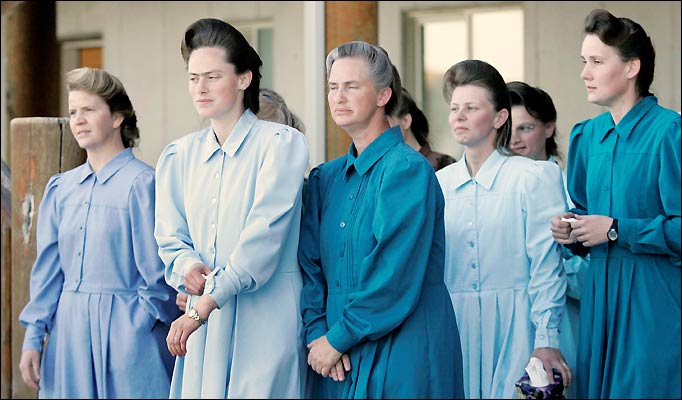 Goddard
called the Safety Net Committee, which brings together polygamous communities,
law enforcement and service providers, a "movement" that would forestall a
Texas-style raid. Goddard
called the Safety Net Committee, which brings together polygamous communities,
law enforcement and service providers, a "movement" that would forestall a
Texas-style raid.
"I think that action was in part because that fundamentalist discussion was not
taking place," he said. "The feeling was if there were children in distress
there was no way they could get their voices heard. That's not true of Arizona
any more."
Shurtleff tried to quell some fears, even as he made it clear that Utah will
continue to prosecute crimes that hurt women and children and said in particular
that the "religious principle" of incest, practiced by a couple groups that
allow close relatives to marry, was "something we will not stand for."
He said that Utah Gov. Jon Huntsman has asked FLDS leaders for a list of
children and parents who are Utah residents as the first step in working to
protect their interests in the Texas action.
He also asked for a show of hands of those related to children in custody. As
many as 50 hands shot up. His office is looking into helping Utah relatives
become foster parents to the FLDS children.
As in previous years, some audience members asked the attorneys general for help
in pushing for decriminalization of polygamy, which they said would do more to
open the closed communities than any prosecutorial action.
Shurtleff's advice: "Wait until after the election" to bring up any such
proposals.
Timpson said removal of FLDS children in Texas could be tied back historically
to Utah's move in 1935 to elevate polygamy from misdemeanor to felony status.
That caused polygamists to seek isolated locales safe from scrutiny.
"My belief is that the somewhat ill-conceived bigamy statute needs to be
revised," he said. "It is outmoded [and] I doubt it would stand constitutional
scrutiny at this time."
Lujan, an Arizona lawmaker, came under fire for proposed legislation that would
bar men who married underage girls to get custody of their children in domestic
disputes.
Earlier in the day, three panels spoke about media coverage of polygamous
communities.
One panel, comprised of plural wives from all but the FLDS community, said media
tend to miss the diversity of the various groups, which collectively have about
35,000 members.
Speakers from nonprofit social ser vice groups said that many children they deal
with have little or no education and suffer emotional problems.
Michelle Benward, whose organization New Frontiers for Families began working
with FLDS teens two years ago, said many of the children she helps have been
torn by watching images of the raid on the FLDS ranch in Texas. The raid has
"broken many hearts, she said.
Source: Salt
Lake Tribune
LINK:
Polygamy
LDS says: Wikileaks web site violated its policy handbook
copyrights
by Lisa Carricaburu
A Web site that publishes anonymous submissions
of
difficult-to-obtain or private documents describes the LDS Church Handbook
of Instructions a source sent it as significant because "the book is strictly
confidential among the Mormon . . . bishops and stake presidents and it reveals
the procedure of handling confidential matters related to tithing payment,
excommunication, baptism and doctrine teaching [indoctrination]."
The Church of Jesus Christ of Latter-day Saints doesn't see anything
particularly secretive or sinister about the handbook used as a reference by
church leaders, but that doesn't mean it wants it to remain available on
Wikileaks or Web sites operated by the Wikimedia Foundation.
On Wednesday, spokesman Scott Trotter confirmed the church has sent a letter
alleging copyright infringement and requesting that material be immediately
removed from Web sites that have published it.
A church statement said it doesn't believe there's anything "particularly
newsworthy" in the handbook. "The church regularly quotes from the handbook when
giving policy positions to journalists," the statement said. "However, the
material is copyrighted. . . . In this case we have simply notified a particular
Web site that they have posted copyrighted material illegally and asked them to
remove it."
A Tuesday article on Wikinews, a Wikimedia Foundation-operated site put together
by volunteer editors, said the Wikimedia Foundation had received a copyright
infringement claim from the LDS Church after Wikinews published an April 19
article describing material in the church handbook obtained by Wikileaks, an
independent site not associated with Wikimedia.
Wikimedia spokesman Jay Walsh said Wednesday he knew of no letter from the LDS
Church, but added that Wikinews has removed from its articles all descriptions
from the handbook in qu estion.
Attempts to reach a Wikileaks representative Wednesday were unsuccessful.
However, the Tuesday Wikinews article quoted a Wikileaks spokesman as saying the
material will not be removed.
"Wikileaks will not remove the handbooks [the Church Handbook of Instructions is
a two-volume set], which are of substantial interest to current and former
Mormons," according to the article. "Wikileaks will remain a place where people
from around the world can safely reveal the truth."
It was unclear Wednesday how the LDS Church will react if Wikileaks does not
remove the handbook. "We'll cross that bridge when we come to it," Trotter said.
Source:
sltrib.com/news/ci_9264235
Government May Not Play Favorites
Among Religions, Says AU's Lynn
Americans United for Separation of Church and State
today urged the U.S. Supreme Court to overturn a lower court decision dealing
with a controversy over the display of religious monuments in a Utah public
park.
The case, Pleasant Grove City v.
Summum, concerns an effort by a
religious group called Summum to have its “Seven Aphorisms” displayed in a
public park in Pleasant Grove, Utah. Summum argues that it should have the right
to permanently display its religious code in Pleasant Grove City’s Pioneer Park
because the public land already contains a Ten Commandments monument and other
items.
The 10th U.S. Circuit Court of Appeals ruled in favor of
Summum on free-speech grounds.
But Americans United and its allies argue that the case should really be looked
at as a church-state controversy.
The Rev. Barry W. Lynn, Americans United executive director, said the case
raises an important conflict over the value of religious neutrality.
“It’s not the government’s job to display the symbols of any faith,” Lynn said.
“When government officials allow religious groups to place permanent monuments
on public land, the government is accountable for the message.
“Our government,” he continued, “should not -- and, under our Constitution, may
not -- pick-and-choose among religions. This principle stands at the very heart
of church-state separation.”
The AU brief asserts that government cannot play favorites among religions and
deny a minority religious request because of discomfort with the less-known
religious views.
“Religion plays so central a role in civic as well as personal identity in
American society that when government associates itself with, or expresses a
preference for, any denomination, it marks those of other faiths with a badge of
inferiority just as insidious as when government prefers one race to another,”
asserts the brief.
The brief was prepared by Americans United Legal Director Ayesha Khan, AU
Assistant Legal Director Richard Katskee and AU Madison Fellow Jessica Wolland,
in consultation with attorneys affiliated with allied religious and civil
liberties groups.
Joining Americans United on the brief are the American Jewish Committee, the
Baptist Joint Committee for Religious Liberty, People For the American Way
Foundation and the Anti-Defamation League.
* * *
Americans
United is a religious liberty watchdog group based in Washington, D.C. Founded
in 1947, the organization educates Americans about the importance of
church-state separation in safeguarding religious freedom
New twist in tablets case:
U.S. anti-bias group wants focus to be church-state
By E t h a n T h o m a s
June 25, 2008
The Anti-Defamation League announced Tuesday
that it has joined in a coalition brief, urging the U.S. Supreme Court to
consider the church-state aspects of the case involving a religious group's
desire to display a monument in a Pleasant Grove park.
A request by the religious group Summum asking
Pleasant Grove to display a monument depicting the group's Seven Aphorisms was
denied by the city, which has an existing Ten Commandments monument in the park.
In April of last year, the U.S. 10th Circuit Court of Appeals upheld a Utah
federal judge's decision that the city must open its park to other such
monuments or remove them altogether for reasons of free speech. However, the ADL
strongly feels that the case has been presented incorrectly as a free-speech
case only.
"The case was presented in a strange way to the Supreme Court," said Steve
Freeman, ADL director of legal affairs. "It involves a religious display on
public property, which should naturally raise issues of church and state
separation, but up until now it has been framed as only a free-speech issue."
The brief was filed this week to the court, and rather than take sides on the
issue, the brief suggests that the issue is being looked at through the wrong
lens.
"We make a point in the brief that if the court looked at the issue through a
church-state lens, then the law prohibits government from discriminating against
minority religions," said Freeman. "In essence the city should not be taking
preference on certain denominations."
The ADL, which was founded in 1913, is the world's leading organization
dedicated to fighting anti-Semitism. The ADL is also a strong advocate for
church-state separation. In the coalition brief they joined with the American
Jewish Committee, Americans United for Separation of Church and State, Baptist
Joint Committee for Religious Liberty and People For the American Way
Foundation.
"We hope they read it and take it into consideration; the justice system
oftentimes looks at these types of briefs to aid in the case background," said
Freeman. "We feel this is an extremely important aspect of the case, which is
why we have taken the time to tell the court about this."
Source:deseretnews.com/article/1,5143,700237681,00.html
|
 The power of prayer
:
The power of prayer
:
Qaeda wants Republicans,
Bush "humiliated"
Libi,
a top al Qaeda commander
believed to be living in
Afghanistan or Pakistan, called for God's wrath to be
brought against Bush equating him with past tyrants in
history.
"O God, humiliate Bush and his party, O Lord of the
Worlds,
degrade and defy him," Abu Yahya al-Libi said at the end
of sermon marking the Muslim feast of Eid al-Fitr, in a
video posted on the Internet.
~
yahoo.com/news/nm/20081031/
|
Alaska Gov. Palin
violated state-church separation
By G a r a n c e B u r
k e Associated Press October 12,
2008
WASILLA, Alaska —
The camera closes in on Sarah Palin speaking to
young missionaries, vowing from the pulpit to do her part to implement God's
will from the governor's office.
What she didn't tell worshippers gathered at the
Wasilla Assembly of God church in her hometown was that her appearance that day
came courtesy of Alaskan taxpayers, who picked up the $639 tab for her airplane
tickets and per diem fees.
An Associated Press review of the Republican vice presidential candidate's
record as mayor and governor reveals her use of elected office to promote
religious causes, sometimes at taxpayer expense and in ways that blur the line
between church and state.
Since she took state office in late 2006, the governor and her family have spent
more than $13,000 in taxpayer funds to attend at least 10 religious events and
meetings with Christian pastors, including Franklin Graham, the son of
evangelical preacher Billy Graham, records show.
Palin was baptized Roman Catholic as a newborn and baptized again in a
Pentecostal Assemblies of God church when she was a teenager. She has worshipped
at a nondenominational Bible church since 2002, opposes abortion even in cases
of rape and incest, and supports classroom discussions about creationism.
Since she was named as John McCain's running mate, Palin's deep faith and
support for traditional moral values have rallied conservative voters who
initially appeared reluctant to back his campaign.
On a weekend trip from the capital in June, a minister from the Wasilla Assembly
of God blessed Palin and Lt. Gov Sean Parnell before a crowd gathered for the
"One Lord Sunday" event at the town's hockey rink. Later in the day, she
addressed the budding missionaries at her former church.
"As I'm doing my job, let's strike this deal. Your job is going to be out there,
reaching the people — (the) hurting people — throughout Alaska," she told
students graduating from the church's Masters Commission program. "We can work
together to make sure God's will be done here."
A spokeswoman for the McCain-Palin campaign, Maria Comella, said the state paid
for Palin's travel and meals on that trip, and for other meetings with Christian
groups, because she and her family were invited in their official capacity as
Alaska's first family. Parnell did not charge the state a per diem or ask to be
reimbursed for travel expenses that day.
"I understand the per diem policy is, I can claim it if I am away from my
residence for 12 hours or more. And Anchorage is where my residence is and I'm
based from. And this trip took about four hours of driving time and time at the
event, so I did not claim per diem for this one," Parnell told the AP.
Palin and her family billed the state $3,022 for the cost of attending Christian
gatherings exclusively, including visits to the Assembly of God here and to the
congregation they attend in Juneau, according to expense reports reviewed by the
AP.
Experts say those trips fall into an ethically gray area, since Democrats and
Republicans alike often visit religious venues for personal and official
reasons.
J. Brent Walker, who runs a group based in Washington, D.C., that advocates for
church-state separation, said based on a reporter's account, Palin's June
excursion raised questions.
"Politicians are entitled to freely exercise their religion while in office, but
ethically if not legally that part of her trip ought to not be charged to
taxpayers," said Walker, executive director of the Baptist Joint Committee for
Religious Liberty. "It's still fundamentally a religious and spiritual
experience she is having."
The Palins billed the state an additional $10,094 in expenses for other
multi-day trips that included worship services or religiously themed events, but
also involved substantial state business, including the governor's inaugural
ball and an oil and gas conference in New Orleans.
Palin also submitted $998 in expenses for a June trip to Anchorage that included
a bill signing at Congregation Beth Shalom synagogue, the only non-Christian
house of worship she has visited since taking office, according to the McCain
campaign.
In response to an AP request, Comella provided a list showing that since January
2007 the governor had attended 25 "faith-based events," including funerals and
community meetings held at churches. Many did not appear on the governor's
schedule or her travel records.
Palin has said publicly her personal opinions don't "bleed on over into
policies."
Still, after the AP reported the governor had accepted tainted donations during
her 2006 campaign, she announced she would donate the $2,100 to three charities,
including an Anchorage nonprofit aimed at "sharing God's love" to dissuade young
women from having abortions.
An AP review of her time as mayor, from late 1996 to 2002, also reveals a
commingling of church and state.
Records of her mayoral correspondence show that Palin worked arduously to
organize a day of prayer at city hall. She said that with local ministers' help,
Wasilla — a city of 7,000 an hour's drive north of Anchorage — could become "a
light, or a refuge for others in Alaska and America."
"What a blessing that the Lord has already put into place the Christian leaders,
even though I know it's all through the grace of God," she wrote in March 2000
to her former pastor. She thanked him for the loan of a video featuring a Kenyan
preacher who later would pray for her protection from witchcraft as she sought
higher office.
In that same period, she also joined a grass-roots, faith-based movement to stop
the local hospital from performing abortions, a fight that ultimately lost
before the Alaska Supreme Court.
Palin's former church and other evangelical denominations were instrumental in
ousting members of Valley Hospital's board who supported abortion rights —
including the governor's mother-in-law, Faye Palin.
Alaska Right to Life Director Karen Lewis, who led the campaign, said Palin
wasn't a leader in the movement initially. But by 1997, after she had been
elected mayor, Palin joined a hospital board to make sure the abortion ban held
while the courts considered whether the ban was legal, Lewis said.
"We kept pro-life people like Sarah on the association board to ensure children
of the womb would be protected," Lewis said. "She's made up of this great fiber
of high morals and godly character, and yet she's fearless. She's someone you
can depend on to carry the water."
In November 2007, the Alaska Supreme Court ruled that because the hospital
received more than $10 million in public funds it was "quasi-public" and
couldn't forbid legal abortions.
Comella said Palin joined the hospital's broader association in the mid-1990s.
Records show she was elected to the nonprofit's board in 2000.
Ties among those active at the time still run deep: In November, Palin was a
keynote speaker at Lewis' "Proudly Pro-Life Dinner" in Anchorage, and the
governor billed taxpayers a $60 per diem fee for her work that day.
Palin also is one of just two governors who channeled federal money to support
religious groups through a state agency, Alaska's Office of Faith-Based and
Community Initiatives. Palin has made it a priority to unite faith communities,
local nonprofits and government to serve the needy, bringing her high marks —
and $500,000 — from the Bush administration.
In fiscal year 2008, Alaska was one of only four states to receive $500,000 in
federal grant money from the national initiative.
"The governor has a healthy appreciation for faith-based groups that serve
Alaskans in need," said Jay Hein, who until recently directed national
faith-based initiatives at the White House. "The grant speaks to their
organizational strength, and the dynamism of Alaska's operation."
Several Catholic and Christian charities received funding, including $20,000 for
a Fairbanks homeless shelter that views itself as a "stable door of evangelism
and Christian service" and $36,000 for a drop-in center at an Anchorage mall
that seeks to demonstrate "the unconditional love of Jesus to teenagers."
The state ensures all faith-based groups keep a strict separation between their
work in the community and their prayer services to ensure recipients don't feel
coerced, said Tara Horton, a special assistant to the Alaska Department of
Health and Social Services. Though staffers reached out to nonprofits and
religious groups of many faiths, mostly Christian organizations applied for
funding, she said.
In June, when Alaska legislators decided to cut $712,000 in state support for
the office, Parnell sent lawmakers an urgent letter asking them to put it back
in the budget. A small portion of state funding was later restored.
"Gov. Palin is motivated by the needs out there, and faith-based and community
initiatives are a great way to do that," Parnell said. "It matters not to state
government what religion people belong to, so long as they are serving the
public and the money they receive is used appropriately."
Still, a state worker who directs an Anchorage-based group that advocates for
church-state separation, Lloyd Eggan, said Palin's administration hasn't done
enough to assure voters that government money doesn't support ministry.
"That sort of thing is exactly what courts have said is barred by the First
Amendment," Eggan said.
source:
deseretnews.com/article/1,5143,705254723,00.html
Atheists Criticize Court Ruling allowing Sectarian Prayer
American Atheists today criticized a ruling
by the 11th U.S. Circuit
Court of Appeals allowing sectarian prayers before government meetings
in Cobb County, Ga.
The court ruled 2-1 that Cobb County's practice of opening meetings with
prayers that include references to specific deities is constitutional.
Edwin Kagin, American Atheists Legal Director, said "This is a major
change toward establishing a theocracy. Government-sponsored prayer is
clearly unconstitutional, and this point had been established and
re-affirmed several times before this terribly misguided decision"
David Silverman, National Communications Director, explained "The whole
point of the separation of church and state is the requirement that
government treat all citizens equally. This ruling gives government the
power to do the exact opposite as of now, some people in Cobb County
have a right that others do not, simply because of their beliefs. Some
are recognized, acknowledged, and welcomed, and some are not. A
two-class system has been imposed, and it's ludicrous that
any court or any citizen would think this is a good idea. "
For more information contact:
Ed Buckner, President (770) 432-3049
Edwin Kagin, National Legal Director (859) 384-7000
Tel.: (908) 276-7300 Fax: (908) 276-7402
SMALKOWSKI FOUND NOT GUILTY ON ALL COUNTS
Web Posted: June 26, 2006 American Atheists Magazine
Chester (Chuck) Smalkowski, a member of American
Atheists living in
Hardesty, Oklahoma, has been found Not Guilty on all counts by a
twelve person jury in Guymon, Texas County, Oklahoma.
Chuck, together with his family, is featured on the cover of the
current issue of American Atheist Magazine. At the 2006 Annual
Convention, the Smalkowski Family was presented the American Atheists
Award for Valor, now prominently displayed on the wall of their home.
The Smalkowski case attracted national attention after Nicole
Smalkowski was kicked off of the girls' basketball team after refusing
to stand in a circle with her teammates on the gymnasium floor of the
Hardesty public High School and recite the "Lord's Prayer." After
school officials learned that she and her family were Atheists, lies
were created about her as grounds to take her off of the team.
When her father Chuck discovered conclusively that public school and
law enforcement officials had lied to him about his 15 year old
daughter, he and Nicole and her mother Nadia went to the home of
principal Lloyd Buckley to attempt to discuss the matter with him.
Outside of his front fence, the principal struck Chuck, who blocked
the blow. Both men fell to the ground and Buckley sustained minor
injuries, the provable origins of which were strikingly contrary to
his under oath trial testimony. Buckley then took out misdemeanor
criminal assault charges against Chuck. After Smalkowski rejected the
offer to drop the charges if he and his Atheist family left the state,
the charges were raised to a felony. Chuck called American Atheists
for help.
On June 22, 2006, after only a little over two and a half hours of
deliberation, a span of time that included dinner, the jury found
Chuck "Not Guilty" of the felony charge of assault and of two lesser
included misdemeanor assault charges.
Edwin Kagin, National Legal Director for American Atheists and his
wife Helen drove from Kentucky to Guymon, Oklahoma for the five day
trial. Edwin had become registered as an attorney in Oklahoma for the
purpose of assisting Tim Gungoll, Chuck's attorney from Enid,
Oklahoma. Mr. Kagin conducted the voir dire of the prospective jury,
gave the opening and closing statements in the case, cross examined
the Superintendent of the Hardesty public schools, David Davidson, and
conducted the direct examination of the defendant Chuck Smalkowski.
Tim cross examined the other prosecution witnesses and conducted the
direct examination of Nicole and Nadia Smalkowski.
The Atheist and Christian attorneys worked
together effectively for
the cause of justice and to vindicate an Atheist falsely accused.
The true significance of this trial is that this is the first case we
know of in American jurisprudence where Atheism has been directly used
in as a defense in a criminal trial.
Edwin introduced himself to the jury as National Legal Director for
American Atheists and asked the prospective jury in the Oklahoma
panhandle if they could accept the testimony of an Atheist over that
of a professed Christian. When the jury looked at him blankly, the
judge asked the prospects if they understood the question. One woman
spoke for many in the group by asking "What is an Atheist?"
Edwin explained that an Atheist was a person who did not believe in a
god or gods or in a supernatural world, and that the defendant and his
entire family were such persons. Many of the prospects said they
could not believe such a person over a Christian and were struck for
cause. To their credit, many members of the jury panel, including two
ministers' wives, told the judge they could not be fair to an Atheist
in such a situation and were excused.
Edwin also told the prospective jurors that his co-counsel Tim Gungoll
believed Jesus Christ to be his personal savior and that Tim was a
practicing Roman Catholic who asked if the jury might feel him a
hypocrite to his faith for defending Chuck. Ultimately a jury of
twelve was seated who had sworn that they could believe the testimony
of an Atheist over that of a Christian.
In closing argument, Edwin told the jury that it really should not be
necessary for an Atheist to tell them it is wrong to lie under oath,
as he reminded them the Christian school officials and the police had
done in their sworn trial testimony. "Thou shall not bare false
witness against thy neighbor. Ninth Commandment. Eight if you are
Roman Catholic," Kagin said.
The jury believed the Atheists. Unanimously.
The night of the verdict, tornados of unusual violence descended on
the panhandle of Oklahoma. The home of the Principal who had brought
the false charges against Chuck Smalkowski was severely damaged.
This fact has no relationship whatsoever to the verdict.
A civil lawsuit in Federal Court, with the Smalkowski Family and
American Atheists as Plaintiffs, is contemplated.
JUST ANOTHER SALEM
by Chester Smalkowski
Web Posted: July 8, 2006 American Atheists Magazine
From the AANEWS atheists.org/aanews Editor:
Below, we are
reproducing, "as is" and un-edited, the account circulating on the internet
and the democraticunderground.com web site penned by Chester Smalkowski and
aptly titled "Just Another Salem."
It is his personal story about the ordeal he
and has family have been swept
up in after their daughter, Nadia, refused to join a prayer circle during a
basketball game at
their local high school. Nadia, instead, recited the "godless" Pledge of
Allegiance.
From there, events went out of control. Chester
Smalkowski and family
members attempted to hold a conversation with the high school principal.
That turned into a physical altercation, Mr. Smalkowski was arrested under a
battery of charges, and the authorities offered to dismiss the case if the
Atheist family fled the state.
American Atheists joined in the subsequent
criminal case, and Chester Smalkowski --
battling incredible "Bible Belt" odds in the courtroom -- was found innocent of
the charges.
News of that can be found on the American Atheists web site.
Edwin Kagin National Legal Director for American Atheists, is preparing a
federal
action which will touch on a number of issues in the Smalkowski case including
violations
of this Atheist family's civil rights.
Chester Smalkowski vented his thoughts about this experience on a blog.
AANEWS is reproducing this story for the benefit of our readers, unedited
and in its original format. This conveys the honest, emotional, "from the
heart" sentiments of Mr. Smalkowski, and constitutes one man's recollection
of an agonizing experience due to religious intolerance and fanaticism.
American Atheists welcomes support so that we may continue our efforts on
behalf of Chester Smalkowski and his family.
There are lessons to be learned. Perhaps the most important, though, is that
"it can happen here," in America, in the year 2006.
-- Conrad Goeringer,
AANEWS - American Atheists
JUST ANOTHER SALEM
The bailiff took the piece of paper from the
foreman of the jury and handed
it to the Judge. He opened the paper and while staring at it he nodded. The
courtroom was silent and the jury stared straight ahead.
I have been in many situations where my life or limb were on the
line but
I was still in the game and had a hand to play. But not here, here I just
sat waiting for the verdict.
Though I worried about being sent away for five years on bogus
charges,
my dread was the Christian mob. They knew I must be found guilty in order to
slow or stop the civil case being filed in Federal court. Since the start of
my daughter's stand against the public schools disregard for the law of the
land, it was imperative to run us out of the county to make any civil action
non valid. With me in jail for five years running my family out would be a
whole lot easier, or so they might have thought.
The courtroom was packed for it is the Bible belt. There was no
love in
this courtroom.
The loving Christians brought their children to hear the verdict.
They
brought the town. They brought ministers. I even saw another Judge in the
back of the room. The Judge who in an earlier hearing while slapping an inch
thick stack of papers on his bench saying with a list of witnesses this big
you had better be a good boy. It was lies then, it was lies now and the DA
knew it! (She was later forced to hand over a written statement she denied
for over a year existed!) People prayed openly for a conviction. Many
holding their bibles. During the trial the Prosecutions side of the
courtroom was packed. Only my son and Edwin Kagin's wife, Helen sat behind
me, but now there was not enough room in the whole courtroom.
Yet now the so-called victim, the 325 lbs victim, the ex Marine,
hurrahs,
was nowhere to be found. Neither was the woman assistant district attorney
anywhere to be found. Whose vindictive, bogus case this was from the start.
What sort of place is this?
Well this is not the place for a little debate in a coffee shop
with the
sweet salt air rolling up from San Francisco bay. This is a place where the
children write on their schoolbooks the south will rise again. This is a
place where they say that black people caused slavery! Where they burn rock
CD's.
Mormons are the tools of Satan. That my daughter is gay cause only
homosexuals vote for Kerry and Christians vote for Bush. Atheists worship
Satan! Where religious fanaticism is fused with political rhetoric and
political leaders pander to this madness. This place has a sickness, a
malignant disease and it is spreading. Edwin saw it first hand.
There has not been many a trial with a Not Guilty verdict in this
county
for years. The head DA is good friends with the self-righteous in the
courtroom and greets them all by name. You know the type.
Many old women in the courtroom are taking notes. Others have been
taking
notes at every hearing for the past year and a half! They strain to listen
not wanting to miss one juicy word. With the pens and pads they write
continuously. The pads shaking with every push of the pen. Even writing down
what my children spoke amongst themselves.
Blue gray haired old Christian spinsters bitter for wasting all
those
fruitful years now just waiting for those pearly gates. These are truly the
wicked. You have seen them before. With their bogus self-righteousness they
strut and sneer. How far we have not come.
Others had walked out into the hall and warned a police witness
saying
that justice must be served, that justice better be served. The judge called
a hearing on the threat.
He warned the crowd that if it happens one more time he would have
no
choice but to throw out the case. He was between a rock and a hard place. He
knows my lawyers are watching and the loving Christians are out for my
blood, and they are watching too. The law, elections and politics were all
in play. The Judge left the court for his chambers and stayed away for a
quite awhile.
The Christians, the loving Christians! Praying to a God whose wings
are
dripping in the blood of innocent men, woman and children down through the
ages. Truly hypocrisy is one of their commandments and the blood of the
innocence one of their sacraments!
Christian against Christian, Christian against Moslem, Christian
against
Mormon. Basically Christian against anyone or anything that challenges their
pathetic little fairy tale.
Go to any Indian reservation and see the lies and broken promises
by a
country with "Under God" in their pledge.
I assume I need not have to explain about the loving hymns sung in
church
on Sunday and beatings of black slaves on Monday. But on Monday night the
good old Master has a little tippy toe over to slave huts for a little brown
sugar. While the queen of the manor is in the master bedroom past out on an
opium tonic. Praise the Lord!
Well that was then but now the court was about to hear the verdict.
There
was a feeding frenzy about to begin with the dirty little atheist and his
family put in their place with him in jail and the family run out of town.
Like the teacher told my daughter "This is a Christian country and if you
don't like it get out!"
I could hear my heart beat in my ears and I dreaded the cheers from
the
righteous mob that were about to begin. The pain of having my family being
in the front row to witness this swirling cesspool of hatred come to its
inevitable end with my head on a pike, sucked the air right out of my lungs.
It was truly just another Salem. Different time and place. Same
characters with new names. Oh, no gallows or big oak tree this time. But if
they could they surely would. How far we have not come. I know, I already
said that but do you really understand what a tragedy it means? The whole
universe is ours if we want it but instead we must gravel in the dirt having
to debate the obvious.
I have been standing against injustice most of my life. It is my
nature.
I am a child of the 60's and proud of it. But what of my poor family? They
stood so proud and strong. They are tougher than I will ever be. I had told
them do not cry. Do not give these bastards any satisfaction. I told my wife
if I see you cry I will surely loose it. I said it is in the Federal courts
we will set things right and send that wall higher than it has ever been. On
the wall behind us was a painting of the signing of the Declaration.
The judge handed the verdict to the clerk. The only sound was the
paper.
The paper in the clerk's hands with the hand written words that spelled my
doom, my family's fate and the inevitable cheers from the Christian mob.
With my guts in my throat and no air to breathe. The court clerk
read the
decision of the jury.
We the jury find the defendant:
On the charge of Aggravated Assault and Battery:
Not Guilty!
On the charge of Assault and Battery:
Not Guilty!
On the charge of Assault:
Not Guilty!
On the charge of Battery:
Not Guilty!
Not a word, not a sound. The lynching had been cancelled. I took my
first
free breath in almost two years. I looked at the jury and mouth the words
thank you. I gazed at the floor as floodgates opened, I dared not move my
head that others might see. Charley don't cry, but free air has its effects.
With all their praying, lies, crooked cops, warning that justice
better
be done, packing the courthouse with their followers, Even a teacher on the
jury who had taught at the Hardesty School. (Our motion to take her off the
jury denied.) Not guilty was still the outcome. The evidence was obvious.
This was a bad case. And 12 men and women had the guts.
From the start of this legal fight my lawyers said Atheism must be
kept
out. That it was a no go in the Bible belt. I was just adamant that Atheism
be brought in. For it is the reason. It was the motive for all the lies and
hate. I felt it was about time that this dirty little secret of hate,
persecution, Christian madness and hypocrisy is brought out into the light
of day. When I told my lawyers this they all gave me the same bewildered
stare.
So one by one, I dropped one lawyer then two. Then I had a hard
time in
finding another one. My third lawyer was still trying to convince me to keep
my atheism out even up till the day of the trial. I still said no. Somewhere
along the line I talk to the ACLU out of San Francisco. Who let me know my
first civil lawyer was not telling me the whole story. I was advised by them
and many others to complain to the Bar about him.
You see he never told me that the prayer in itself is illegal. That
the
schools in this area were not following the state and federal funding
guidelines. When I asked him after finding out from the ACLU. He said yes it
is against the law.
I told him I want to have it stopped. He told me he would not for
he was
a Christian and he believed there should be school prayer. His statement
floored me for it bordered on madness. I said what you believe and what you
do for a client is two different things and that you took an oath. He still
refused.
It did not matter to him that I had already given him $10,000
dollars. He
knows we are not rich. So I wrote a letter to him to complain about his
refusing to take my daughters civil case where it should have gone from the
start. And I asked for my money back. He sent me a bill for another $5000
saying it was the charge for reading my letter and wasting his time.
In my search for a civil attorney it became clear that no one would
touch
this case. In all of Oklahoma I could not find an attorney. My criminal
attorney said he would look at it but only after I paid him his $15000 for
the criminal case. He sent me a letter that the funds for the criminal were
coming too slow and suggested that I seek other counsel for the civil
matter. But even after he got his $15000 he would only take it if I paid him
more. (Now that I have won the criminal case he wants on the civil. Suffice
to say he is off the civil!)
Eventually I contacted the American Atheist, which was referred to
me by
Edward Tabash, who was referred to me by a Mr. Robert Tierman. I told them
my problem in finding an attorney willing to take church and state case in
which the people are blatantly breaking the law. Yet no one will take it.
American Atheist, being out of another state, could not refer me to anyone.
But they said they would try to help. The ACLU out of Oklahoma City refused.
They sent me some standard letter. It really hurt that I did not even rate a
return call or a reason. I felt betrayed, lost and confused.
Was this the United States? Where freedom reigns?
The whole family was under constant stress. Police trying to get
search
warrants to the property by having ex-employees file false statements. Other
cops trying to hire ex-cons to beat me up. The whole town knows of it! The
Sheriff trying to have my bond pulled by the bail bondsman when there was no
legal way to do it. My kids have been out of school since November.
Principal's son saying should he get a gun when he sees my daughter and my
son. DA has yet to reply to our concerns. The Department of Human Services
comes to my place saying they received a complaint that I starve my kids. It
was even obvious to them the charge was bogus.
We have become very good at using back roads. The police follow us
around. Traffic tickets that when challenged were dropped in court. Not to
mention the stares and whispers, the betrayal from employees, one of my
healthy dogs dying. Brush fires starting up upwind.
An FBI agent even said, "You aren't kidding". When it was obvious
someone
followed us and was watching our meeting out in the middle of nowhere. I was
told about a few things. All I can say is that some of the crooks out here
now charged with crimes wore badges and guns! But he could not help my
family and me. Not without witnesses willing to come forward. One scared
witness left the state. The last words she spoke to me were, Chuck I don't
want to end up dead in a ditch!
Just what you would expect life to be like out here in the Bible
belt!
The roller coaster of emotions we went through every minute, every
day.
It was truly a hell. There were days we spoke little. Other days we spoke
late into the night. You get to a point you become numb, but it doesn't
last. For it is all aboard and you are on the roller coaster again.
My poor family. They were standing tall. But they would not even be
in
this place if it were not for me and my bright idea about centralizing our
business. We all missed the desert. The free open Mojave Desert. My family
did not ask for this. They deserved better. I saw them all suffering.
Many a night I would sit in the barn alone with a pint of scotch
and look
at the high beams and the rope on the wall.
Then out of the blue my wife received a call from Ellen Johnson who
said
they had a lawyer that can help us, an Edwin Kagin who is their legal
director. Well I called him up, and our civil case is up and running.
Edwin Kagin also by my request came to my criminal case for the two
cases
are obviously interrelated. There were also other reasons.
Simply stated without Edwin Kagin, Ellen Johnson and American
Atheist I
would be in jail now, or worse. Without them, we would have no federal case
on separation of church and state. The only group, the only lawyer that
would stand with my family and me to protect the wall and not cringe at me
wanting to put atheism as part of my defense.
In Edwin's opening statement American Atheist magazine was shown.
The
crowd almost rioted. He explained that Atheism was not a dirty word and that
it was a conclusion. That my family and I are not devil worshippers. We just
have no Gods. It was the basis of the case. It was the danger. It was the
truth. Yet the only lawyer to go there freely was Edwin Kagin.
In a world where superstition is the norm and those who seek
another path
are ridiculed or worse. Being an atheist takes guts. Freedom is never freely
given. The good fight is always there.
Oh you can hide yourself in the latest sitcom or have one or two
more
scotch and waters but the good fight is still there. You can run to your
malls and buy yourself crazy with credit card frenzy. But the good fight is
still there. You can look away and deny allegiance. But the good fight is
still there. These are the times that try men's courage. You can debate till
you're blue in the face. It will not change a damn thing.
Our forefathers are on our side in this fight. Trust me. From Adams
to
Madison to Jefferson and Paine they all knew the dangers of a Theocracy.
They wrote the Constitution to assure it. And within the federal courts we
can protect this nation from a Theocracy.
The wall between the church and state must stand. But the wall is
being
battered and cracks now appear. The Christians are at the gate attempting to
breach the wall and send us back down the road to an age of darkness,
bloodshed and fear. My family and myself are willing to stand and fight the
good fight. If we lose some skin, so be it. We have no more else to give. We
are financially done. Thanks to American Atheist, Ellen Johnson and Edwin
Kagin for the first time we do not fight alone.
Please stand together with us and fight the good fight. The fight
that
our forefathers began. Lets make the wall so high between Church and State
that they who wish to tear it down will know better and be content with
staying in their churches.
For freedom has never been free! There can be no freedom for all if
the
wall does not stand.
The wall must stand.
Chuck, Nadia, Nicole, Czeslaw and Bridgette Smalkowski
Copyright (c) 2008 American Atheists, Inc.
atheists.org
All rights reserved.
Reprinted by permission
Ky. atheists want God out of homeland
security
State law requires office to acknowledge
divine help in anti-terror efforts
FRANKFORT, Ky. — A group of atheists filed a lawsuit Tuesday seeking to remove
part of a state anti-terrorism law that requires Kentucky's Office of Homeland
Security to acknowledge it can't keep the state safe without God's help.
American Atheists Inc. sued in state court over a 2002 law that stresses God's
role in Kentucky's homeland security alongside the military, police agencies and
health departments.
Of particular concern is a 2006 clause requiring the Office of Homeland Security
to post a plaque that says the safety and security of the state "cannot be
achieved apart from reliance upon almighty God" and to stress that fact through
training and educational materials.
The plaque, posted at the Kentucky Emergency Operations Center in Frankfort,
includes the Bible verse: "Except the Lord keep the city, the watchman waketh
but in vain."
"It is one of the most egregiously and breathtakingly unconstitutional actions
by a state legislature that I've ever seen," said Edwin F. Kagin, national legal
director of Parsippany, N.J.-based American Atheists Inc. The group claims the
law violates both the state and U.S. constitutions.
But Democratic state Rep. Tom Riner, a Baptist minister from Louisville, said he
considers it vitally important to acknowledge God's role in protecting Kentucky
and the nation.
"No government by itself can guarantee perfect security," Riner said. "There
will always be this opposition to the acknowledgment of divine providence, but
this is a foundational understanding of what America is."
Center of legal battles
Kentucky has been at the center of a series
of legal battles involving religious issues in recent years, most involving
displays of the Ten Commandments in public buildings. One case went to the U.S.
Supreme Court, which ruled in 2005 that such displays inside courthouses in two
counties were unconstitutional.
Kentucky isn't the only state dealing with religious issues, but Ed Buckner,
president of American Atheists, said it's alone in officially enlisting God in
homeland security.
"I'm not aware of any other state or commonwealth that is attempting to dump
their clear responsibility for protecting their citizens onto God or any other
mythological creature," Buckner said.
State Rep. David Floyd, R-Bardstown, said the preamble to the Kentucky
constitution references a people "grateful to almighty God," so he said he sees
no constitutional violation in enlisting God in the state's homeland security
efforts.
"God help us if we don't," he said.
Source: msnbc.msn.com/id/28029857/
WA. Atheists add Sign to Capitol X-mas
Display in 2008
 Saturday,
November 29, 2008 – updated: 12:22 pm PST December 1, 2008 Saturday,
November 29, 2008 – updated: 12:22 pm PST December 1, 2008
OLYMPIA, Wash.
-- An atheistic sign is included in the state
Capitol's holiday display that includes a holiday tree and a Christian nativity
scene.
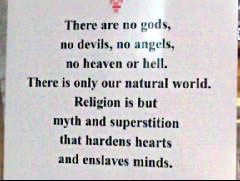
The sign, a new addition this year, is sponsored by the Freedom from Religion
Foundation. The sign reads, "Religion is but myth and superstition that hardens
hearts and enslaves minds."
Annie Laurie Gaylor, foundation co-president, said in a prepared statement that
the sign is a reminder of the "real reason for the season, the winter solstice."
The solstice, on Dec. 21 this year, is the shortest day of the year.
The Capitol has had a holiday tree, provided by the Association of Washington
Business, for 19 years.
In 2006, it was joined by a menorah sponsored by a Seattle Jewish group. A
menorah is a candelabrum that recognizes Hanukkah.
That prompted a lawmaker from Spokane to stage a protest at the Capitol,
demanding the holiday tree be called a "Christmas tree." It also led a local
real estate agent to sue the state to allow the nativity display depicting the
birth of Jesus.
There have been no requests for a menorah display this year.
The tree -- officially called the "Capitol Holiday Kids Tree" -- is part of a
charity drive for rural fire departments.
A lighting ceremony for the tree -- up to 30 feet tall -- is scheduled for 6
p.m. Friday.
Source:
k i r o t v . c o m
Washington Atheists' Sign Stolen From
Capitol
B y M a l l o r y S i m o n CNN Dec 2008
An atheist sign criticizing Christianity that was erected alongside a Nativity
scene was taken from the Legislative Building in Olympia, Washington, on Friday
and later found in a ditch.
An employee from country radio station KMPS-FM in Seattle told CNN the sign was
dropped off at the station by someone who found it in a ditch.
"I thought it would be safe," Freedom From Religion Foundation co-founder Annie
Laurie Gaylor told CNN earlier Friday. "It's always a shock when your sign is
censored or stolen or mutilated. It's not something you get used to."
The sign, which celebrates the winter solstice, has had some residents and
Christian organizations calling atheists Scrooges because they said it was
attacking the celebration of Jesus Christ's birth.
"Religion is but myth and superstition that hardens hearts and enslaves minds,"
the sign from the Freedom From Religion Foundation says in part.
The sign, which was at the Legislative Building at 6:30 a.m. PT, was gone by
7:30 a.m., Gaylor said.
The incident will not stifle the group's message, Gaylor said. Before reports of
the placard's recovery, she said a temporary sign with the same message would be
placed in the building's Rotunda. Gaylor said a note would be attached saying,
"Thou shalt not steal."
"I guess they don't follow their own commandments," Gaylor said. "There's
nothing out there with the atheist point of view, and now there is such a
firestorm that we have the audacity to exist. And then [whoever took the sign]
stifles our speech."
Gaylor said that police are checking security cameras pointed at the building's
entrances and exits to see if they can see anyone stealing the sign.
"It's probably about 50 pounds, " Gaylor said. "My brother-in-law was huffing
and puffing carrying it up the stairs. It's definitely not something you can
stick under your arm or conceal."
The Washington State Patrol, which is handling the incident, could not be
reached for comment.
Dan Barker, a former evangelical preacher and co-founder of the group, said it
was important for atheists to see their viewpoints validated alongside everyone
else's.
Barker said the display is especially important given that 25 percent of
Washington state residents are unaffiliated with religion or do not believe in
God. (A recent survey by the Pew Forum on Religion and Public Life found 23
percent of Washingtonians said they were unaffiliated with a religion and 7
percent said they didn't believe in God.)
"It's not that we are trying to coerce anyone; in a way our sign is a signal of
protest," Barker said. "If there can be a Nativity scene saying that we are all
going to hell if we don't bow down to Jesus, we should be at the table to share
our views."
He said if anything, it's the Nativity scene that is the intrusion.
"Most people think December is for Christians and view our signs as an
intrusion, when actually it's the other way around," he said. "People have been
celebrating the winter solstice long before Christmas. We see Christianity as
the intruder, trying to steal the holiday from all of us humans."
The scene in Washington state is not unfamiliar. Barker has had signs in
Madison, Wisconsin, for 13 years. The placard is often turned around so the
message can't be seen, and one year, someone threw acid on it, forcing the group
to encase it in Plexiglas.
In Washington, D.C., the American Humanist Association began a bus ad campaign
this month questioning belief in God.
"Why believe in a God?" the advertisement asks. "Just be good for goodness
sake."
That ad has caused the Washington Metropolitan Area Transit Authority to field
hundreds of complaints, the group said, but it has heard just as much positive
feedback, said Fred Edwords, the association's spokesman.
Edwords said the ad campaign, which features a shrugging Santa Claus, was not
meant to attack Christmas but rather to reach out to an untapped audience.
Edwords maintains the campaign began in December mostly because the group had
extra money left over for the year. The connection to Christmas is a
coincidence, he said.
"There are a lot of people out there who don't know there are organizations like
ours to serve their needs," Edwords said. "The thing is, to reach a minority
group, in order to be heard, everyone in the room has to hear you, even when
they don't want to."
The ad campaign, Edwords said, is to make people think. He said he doesn't
expect to "convert" anyone.
But the Christian Coalition of America is urging members to oppose the
advertisements.
"Although a number of humanists and atheists continue to attempt to rid God and
Christmas from the public square, the American people are overwhelmingly opposed
to such efforts," Roberta Combs, the group's president said in a press release.
"We will ask our millions of supporters to call the city of Washington, D.C.,
and Congress to stop this un-Godly campaign."
As far as the criticism goes, Edwords said there are far more controversial
placards in Washington.
"That's D.C. -- this is a political center," he said. "If I can see a placard
with dead fetuses on it, I think someone can look at our question and just think
about it."
The anger over the display in Olympia began after it was assembled Monday. The
sentiment grew after some national media personalities called upon viewers to
flood the phone lines of the governor's office.
The governor's office told The Seattle Times it received more than 200 calls an
hour afterward.
"I happen to be a Christian, and I don't agree with the display that is up
there," Washington Gov. Christine Gregoire told The Olympian newspaper. "But
that doesn't mean that as governor, I have the right to deny their ability to
express their free speech."
For some, the issue isn't even that the atheists are putting their thoughts on
display, but rather the way in which they are doing it.
"They are shooting themselves in the foot," said iReport contributor Rich
Phillips, who describes himself as an atheist. "Everyone's out there for the
holidays, trying to represent their religion, their beliefs, and it's a time to
be positive."
The atheist message was never intended to attack anyone, Barker said.
"When people ask us, 'Why are you hateful? Why are you putting up something
critical of people's holidays? -- we respond that we kind of feel that the
Christian message is the hate message," he said. "On that Nativity scene, there
is this threat of internal violence if we don't submit to that master. Hate
speech goes both ways."
Source:
cnn.com/2008/LIVING/12/05/atheists.christmas/index.html
Robert Tilton: From downfall to windfall:
Living on a prayer
Tilton's ministry reaching out again, raking in millions
Tulsa World / May 4, 2003
B y Z i v a B r a n s t e t t e r
More than 10 years after his ministry collapsed in scandal, Robert Tilton is
reaching millions of television viewers with his pitches for money, living
comfortably in south Florida and maintaining a connection with Tulsa.
Far from shrinking into obscurity, Tilton is reaping millions from his mailing
list and daily shows on Black Entertainment Television. He has formed two
companies, bought a 50-foot yacht and purchased a $1.3 million piece of
oceanfront property in Miami Beach through his company, records show.
And although Tilton's downfall began when prayer requests sent to him were
thrown away in Tulsa trash Dumpsters, prayer requests sent to his Tulsa post
office box two years ago were apparently still being discarded. A woman who
spent two days opening mail to Tilton told the Tulsa World that she and other
workers were instructed to remove the cash and checks and throw away the letters
and prayer requests written to Tilton.
Tilton did not return calls seeking comment. In a letter to the Tulsa World, he
wrote: "For years, we have taken great care to assure that all prayer requests
are delivered to me personally and prayed over by me. Written instructions are
always given with each communication by this ministry to ensure that prayer
requests are to come to me personally."
James Ferris, a Tulsa attorney who has helped Tilton set up several business
ventures, declined to answer questions regarding Tilton:
"I'm not a very good PR person, and you know how lawyers are about
confidentialities. I'm not sure how much I could tell you. Everything I would
have to say about the ministry would be good, of course."
A longtime business partner, Dan Moroso, also refused to discuss Tilton. Moroso
said he had not done business with Tilton "in a long, long time."
Moroso is listed as the vice president of Liberator Productions, a Miami, Fla.,
company, in a filing dated May 29, 2002, and Tilton is listed as the president
of the for-profit company. Property records show Moroso lives several blocks
away from the home Tilton is building in Miami Beach.
Tulsa attorney Gary Richardson filed several lawsuits against Tilton on behalf
of people who had filmed testimonials or donated money to Tilton. One of the
suits resulted in a $1.5 million verdict against Tilton but was reversed on
appeal.
"He's a great communicator and very effective at touching people in their
emotions and motivating them," Richardson said. "He's an enjoyable person to be
around, but you just want to keep your hands on your pocketbook."
Richardson said Tilton's followers are often in desperate situations.
"The people that these guys so often attract are people that are going under for
the third time. If you looked up and saw a straw on the surface of that water,
you would still reach for the straw."
Brain-eating rats
In 1991, ABC-TV's "PrimeTime Live" program reported that Tilton's Word of Faith
World Outreach Center Church, then based in Dallas, was making $80 million a
year from followers through its direct mail campaign. At the time, Tilton's
television show, "Success-N-Life," was broadcast by 200 stations nationwide and
his church claimed 10,000 members. "PrimeTime Live" suggested Tilton's ministry
engaged in mail fraud and showed contributors' letters, many of them requests
for help, in a trash Dumpster outside Commercial Bank of Tulsa. A Tulsa recycler
said he also found thousands of prayer requests for Tilton's ministry among the
waste sent to him by a company that handled Tilton's mail.
The program sparked an investigation by the Texas attorney general and numerous
lawsuits. Stations canceled Tilton's television program until it eventually went
off the air.
He divorced his first wife, Marte Tilton, in 1993, and married evangelist and
former beauty queen Leigh Valentine the following year.
Two years later, his first wife sued for more than $1 million and his marriage
to Valentine ended in a bitter public feud. Valentine alleged Tilton, in a
drunken rage, verbally abused her, claimed he was the pope and thought rats were
eating his brain. She eventually lost her claim to church assets.
Tilton has since married a Florida woman, Maria Rodriguez.
Tilton sold his Dallas church in 1999 for $6.1 million. At the time, headlines
dubbed Tilton a "beleaguered TV preacher" and news coverage portrayed a man
beset by marital and financial problems. But he was already well into his
comeback.
During testimony in his divorce from Valentine, Tilton testified that he was
bringing in about $800,000 per month and living aboard a $450,000 yacht in Fort
Lauderdale, Fla. Records show the 50-foot yacht, named the Liberty Leigh, was
registered to Tilton.
Tilton returned to the air in 1997, buying time on independent television
stations in several large cities. The following year, his program began airing
on Black Entertainment Television.
Tilton's show airs on the network for one hour each morning at 3 a.m, as well as
6:30 a.m. on Mondays and 10 p.m. Sundays. The network said it has a potential
audience of 74 million homes, although it had no figures on individual
viewership of Tilton's show.
Ole Anthony, the founder of the religious watchdog group the Trinity Foundation,
said Tilton pays $50,000 per month for the air time. The foundation, based in
Dallas, was largely responsible for exposing Tilton's practices in 1991.
Anthony estimates that Tilton's ministry is grossing $24 million a year and that
most of his shows are reruns or repackaged versions of older shows.
"With no production costs, a fraction of his former TV time budget, his net must
rival that of the good old days with absolutely no effort on his part," Anthony
said.
"The purpose of all of it, including the prayer line, is to get names and
addresses, which are the key to successful direct mail."
Tilton's Miami, Fla., studio has an ancient Rome theme, complete with faux stone
pillars and vine-covered walls, piles of faux boulders, urns and other
artifacts.
The shows feature testimonials from working-class people who say they
experienced a financial turnaround after giving hundreds or even thousands to
Tilton. During one recently aired show, Tilton, clad in a tailored brown suit,
urges viewers to make a financial "vow" to his ministry even if they are in
debt.
"Anyone can give when things look good, but when you give out of want, when
things don't look good . . . it releases faith," he says.
Tilton exhorts viewers toward the end of his show to make a $1,000 vow because
"my God is going to supply your need.
"Thank God we have freedom of religion in America, that I can boldly proclaim
these powerful truths to you."
As the show continues, Tilton reads the names and hometowns of viewers who have
called to pledge money. At the end of the program, a gospel singer performs
while Tilton sits at an imposing stone desk nearby. Tilton gleefully claps his
hands as an assistant hands him stacks of yellow pledge sheets.
Those who call a toll-free number broadcast on his show and give their address
are placed on the ministry's mailing list. They receive two or three mailings
from Tilton each month.
Tilton's mailings promise a financial windfall from God if the recipient will
only donate to his ministry. Some letters request specific amounts, such as
$200. Many mailings contain trinkets such as packets of anointing oil, miracle
bracelets, prayer cloths and large posters of Tilton grimacing in prayer.
The mailings request that do nations and prayer requests be sent to a Tulsa post
office box.
Two years ago, employees who opened the mail were instructed to remove the money
and throw out the letters and prayer requests, according to a Tulsa woman.
Patricia Morrow said she worked for Mail Services Inc. for two days in 2001,
opening letters addressed to "Rev. Tilton" and taking out the cash.
Morrow, 63, said she got the job through an employment agency. Morrow said she
worked for two days in the basement of the Kennedy Building in an old bank vault
opening hundreds of letters. The building at 321 S. Boston Ave. is the same
address where Tilton prayer requests were found in Dumpsters in 1991.
"They were all addressed to this Rev. Tilton," Morrow said of the letters she
opened.
"You're sat down in a cubicle and given a letter opener. You have bundles and
bundles of mail and a trash bin beside you. You slice open the envelope, take
the money out and throw the letter away in the bin."
She said another employee came by to empty the trash bins regularly and a
manager collected the cash and checks from employees who opened the letters.
"The bins are picked up and emptied into trash sacks and put into a special
room. They weren't there the next day."
Morrow said there was no attempt to keep the letters together and it was
apparent that no one planned to read them. But Morrow read many of them during
her two days with Mail Services Inc.
"You cannot help but read them," she said. "All these letters were like, 'Pray
for me,' because they were terminal or their son is terminal or there was no
money for food . . . desperate situations."
She said nearly all of the letters she opened were from rural Florida or rural
Georgia and they often contained cash in odd amounts.
"There would be like $17, and the letter would say, 'I realize I have to give $2
more than I usually give.' "
She described the letter writers as lonely homebound people in rural areas
wanting help from God.
Morrow said there were about a dozen other women opening mail and several told
her that employees were expected to open enough letters to produce $1,000 per
hour.
"It was an unstated criteria that you open enough envelopes to generate $1,000
an hour. It was unbelievable, literally unbelievable."
After opening the letters for two days, Morrow said she told a manager at her
employment agency that she had concerns about what was going on there.
"I told her that it was getting to me about these letters and could she find me
another job?"
Morrow said she was then told to leave Mail Services' office immediately and not
finish the work day.
Officials at the Kennedy Building would not comment on whether Tilton's mail was
still being opened there.
Tilton is still listed as pastor of a small church, Church Triumphant, that
meets in an office building in Farmers Branch, Texas. During worship services
last Sunday, about 70 people attended and sang for an hour while a four-member
church band played.
Bob Wright preached a sermon focusing on prosperity. Wright, who also operates a
used-car dealership in Dallas, said that he had faith that God would send people
to Wright's car lot.
A woman who attended the service said Tilton preached at the church about one
year ago and she was unsure when he would return.
Property records list the owner as Church Triumphant and list the same Tulsa
post office box used by Tilton for several for-profit corporations. Wright did
not return calls seeking comment.
Anthony said Tilton maintains an affiliation with the church so that he can
maintain his organization's tax-exempt status as a church and avoid filing
financial returns.
"Their moral code is not the Bible. Their moral code is the IRS code," Anthony
said.
Miami Beach property
In addition to operating his ministry, Tilton has formed several for-profit
companies in Florida and Oklahoma, records show. Tilton formed Venetian Way
Holdings Inc. three years ago. The company lists its address as 320 S. Boston
Ave., the address of Ferris, Tilton's Tulsa attorney. According to its
incorporation papers, the company exists to hold title to property for a
tax-exempt organization.
Records show Venetian Way Holdings paid $1.39 million for a 12,000-square-foot
lot on an island fronting the Biscayne Bay in Miami Beach two years ago.
Building permits have been issued for a two-story, single-family home with a
tile roof, pool, spa and terraced deck. The holding company takes its name from
the street on which the home sits: Venetian Way.
Tilton listed himself as owner of the property in a building permit request for
a burglar alarm.
Tilton also formed Liberator Productions Inc. three years ago, with Moroso as
vice president and Barbara Miller of Tulsa, as secretary-treasurer. The company
lists a Tulsa post office box as its address.
Mail-order faith comes with accessories
Trinkets -- including oil, a bracelet and the "Green Financial Prayer Cloth" --
are supposed to bring wealth. God wants to make you rich, promises "Pastor Bob"
Tilton, and Tilton will send you financial prayer cloths, posters of himself,
packets of oil and other trinkets to make it happen.
Those who send money to Tilton's ministry through his daily shows on Black
Entertainment Television wind up on his massive mailing list. His mailings,
several each month, urge recipients to send money to Tilton's Tulsa post office
box.
Letters are personalized, with the recipient's first name and hometown sprinkled
throughout. All are signed "Bob" in handwriting and "Pastor Bob Tilton"
underneath.
Here are excerpts from several recent mailings:
Feb. 22: "I've sent you this packet of oil to help you release your faith for
your emergency miracle," states the letter. "Use it to anoint whatever
represents your Emergency Crisis. If it's a financial crisis, anoint your wallet
or billfold or checkbook."
The letter ends by asking for a "sacrificial gift of $20 or the largest gift you
can possibly give even if you have to scrape the bottom of your meal barrel."
March 1: A thick mailing includes a large poster of Tilton with one hand raised
and his eyes closed tightly, surrounded by 21 squares marking a calendar. The
mailing includes 21 stickers that recipients are to peel off and affix each day
to the poster. It also includes a red "prayer of agreement miracle cloth" and
three forms that recipients can return along with financial donations during
each week of the 21-day prayer "campaign."
Tilton is pictured throughout the mailing grimacing in prayer, on his knees
praying and clutching a red cloth and praying.
"Take the enclosed poster of me and my hand and put it up on your refrigerator
or a mirror . . . somewhere so that you'll see it every day. Then every day for
the next 21 days . . . lay your hand on top of mine and agree with me for your
miracle," the letter states.
The letter also directs recipients to trace their hand on a "miracle request"
form and return it with the red prayer cloth. Tilton promises to take the
requests and cloths "to my prayer room or my prayer altar on my daily TV
program, Success-N-Life."
The letter ends by requesting "your best financial gift as an expression of
appreciation."
"You don't buy God but all throughout the Bible, when people came to God with
prayer requests, they always brought a quality offering."
March 28: A four-page letter includes a fluorescent pink cotton cord, which
Tilton calls an "Ezekiel 16:11 bracelet." The letter instructs recipients to
"place this miracle faith bracelet around your right wrist right now.
"I am coming against the spirit of poverty that is trying to cut off your money
supply. . . . Get out your largest bill and lay it under this miracle bracelet
that I have given you. . . . Give God your biggest and best."
The letter includes a form on which recipients can check off a list of ailments
or financial problems and return it to Tilton with their largest bills.
It also includes testimonials from people such as "Earl," who claims his family
income jumped from $9,000 per year to more than $94,000 two weeks after his wife
began sending money to Tilton.
April 8: "In Jesus' name, I am sending you this Green Financial Prayer Cloth for
you to defeat Satan's plan," states the letter, which contains a strip of thin,
green fabric.
Recipients are directed to write the date, time and their name on the cloth.
"Place this Green Financial Cloth under your pillow and allow God's spirit to
rest upon you as you sleep tonight. Tomorrow, remove the Green Financial Prayer
Cloth, touch it to your heart, your forehead and your pocketbook."
The letter suggests a financial donation to Tilton of $107, $177 or an amount
decided by the recipient. It contains a wish list of items that recipients can
check off, including: "a better job," "new clothes," 'a loan" and "a newer car."
April 14: "I must tell you boldly: God wants to make you rich. . . . God wants
to make a millionaire out of certain ones who receive this letter. Is it you?"
The letter includes a large slip of paper fashioned into a $1 million bill and a
penny glued to the reverse side. The bill includes a checklist of desires,
including a new home, new car, a piece of real estate or money for vacation.
"I want you to put a checkmark on the back of the Million Dollar Bill of what
you need or desire, and send it back to me, along with a Seed Faith Gift of
$200. . . . This ministry has given you spiritual food, so it's time to pay your
tithes."
Source:
rickross.com -- TV preachers
Robert
Tilton on Wikipedia
Robert Tilton video
Pope praises Galileo's astronomy
Pope Benedict had been accused of condoning the heresy charge
Pope Benedict XVI has paid tribute to 17th-Century astronomer Galileo Galilei,
whose scientific theories once drew the wrath of the Catholic Church.
The Pope was speaking at events marking the 400th anniversary of Galileo's
earliest observations with a telescope.
He said an understanding of the laws of nature could stimulate appreciation of
God's work.
In 1992, Pope John Paul said the church's denunciation of Galileo's work had
been a tragic error.
Galileo used his scientific methods to demonstrate that the Earth revolved
around the Sun and not the other way around.
His view directly challenged the church's view at the time - that the Earth was
static and at the centre of the universe.
Galileo was accused of heresy in 1633 and forced to publicly recant his
theories.
He lived the rest of his life under house arrest at his villa in the hills
outside Florence.
Pope Benedict had been criticised in the past for appearing to condone the
heresy verdict against Galileo.
Source:
news.bbc.co.uk
Bush Aides Say Religious Hiring Doesn’t Bar
Aid
By C H A R L I E S A V A G E
October 17, 2008
WASHINGTON — In a newly disclosed legal memorandum, the Bush administration says
it can bypass laws that forbid giving taxpayer money to religious groups that
hire only staff members who share their faith.
The administration, which has sought to lower barriers between church and state
through its religion-based initiative offices, made the claim in a 2007 Justice
Department memorandum from the Office of Legal Counsel. It was quietly posted on
the department’s Web site this week.
The statutes for some grant programs do not impose antidiscrimination conditions
on their financing, and the administration had previously allowed such programs
to give taxpayer money to groups that hire only people of a particular religion.
|
“It’s
really the church-state equivalent of the torture
memos... that allows
religious organizations to get federal funds without
complying with anything.” |
But the memorandum
goes further, drawing a sweeping conclusion that even federal programs subject
to antidiscrimination laws can give money to groups that discriminate.
The document signed off on a $1.5 million grant to World Vision, a group that
hires only Christians, for salaries of staff members running a program that
helps “at-risk youth” avoid gangs. The grant was from a Justice Department
program created by a statute that forbids discriminatory hiring for the
positions it is financing.
But the memorandum said the government could bypass those provisions because of
the 1993 Religious Freedom Restoration Act. It sometimes permits exceptions to a
federal law if obeying it would impose a “substantial burden” on people’s
ability to freely exercise their religion. The opinion concluded that requiring
World Vision to hire non-Christians as a condition of the grant would create
such a burden.
But several law professors who specialize in religious issues called the
argument legally dubious. Ira C. Lupu, a co-director of the Project on Law and
Religious Institutions at George Washington University Law School, said the
opinion’s reasoning was “a very big stretch.”
And Marty Lederman, a Georgetown University law professor who worked in the
Office of Legal Counsel from 1994 to 2002, said the memorandum’s reasoning was
incompatible with Supreme Court precedent. He pointed to a 2004 case, in which
the court said government scholarships that could not be used to study religion
did not substantially burden recipients’ right to practice their religion
because they could still study theology with their own money.
In the same way, Mr. Lederman said, World Vision is free to have an anti-gang
program that hires by faith without using taxpayer money.
The Justice Department “stands strongly behind the opinion, which is narrowly
drawn and carefully reasoned,” Erik Ablin, an agency spokesman, said in an
e-mail message. “Most of the criticisms that have been outlined against the
opinion are thoroughly addressed in the opinion itself. Each of them lacks
merit.”
Carl H. Esbeck, a University of Missouri law professor and architect of the
religion-based initiative movement, also defended the opinion, saying the
Religious Freedom Restoration Act compelled the department’s conclusion. “I
understand that liberal law professors don’t like this,” he said. Why, he asked,
should World Vision “be denied the opportunity that everyone else has to compete
for funding simply because of their religion?”
The Office of Legal Counsel issues interpretations of the law that are binding
on the executive branch and often rules on matters that are difficult to get
before a court. Under the Bush administration, it has drawn sharp criticism for
issuing opinions that provide legal cover for controversial policies preferred
by administration officials.
 In
2002, for example, the office secretly signed off on the use of harsh
interrogation techniques despite a statute and treaties forbidding torture. The
memorandum’s legal reasoning was strongly criticized by legal scholars after it
was leaked to the public, and the Justice Department rescinded it. In
2002, for example, the office secretly signed off on the use of harsh
interrogation techniques despite a statute and treaties forbidding torture. The
memorandum’s legal reasoning was strongly criticized by legal scholars after it
was leaked to the public, and the Justice Department rescinded it.
Christopher E. Anders, senior legislative counsel to the American Civil
Liberties Union, said he was alarmed by the 2007 memorandum’s conclusion that
the government does not have a “compelling interest” in enforcing a federal
civil rights statute.
“It’s really the church-state equivalent of the torture memos,” Mr. Anders said.
“It takes a view of the Religious Freedom Restoration Act that allows religious
organizations to get federal funds without complying with anything.”
Professor Lupu did not go that far, but said the opinion made “an aggressive
reading of ‘substantial burden’ in a way that is not consistent with what courts
and other agencies have done in the past, and it is designed to serve the
president’s political agenda.”
Mr. Bush, whose strongest political base has been religious conservatives, has
made lowering barriers to government financing of such groups a priority.
In January 2001, Mr. Bush’s first two executive orders created an Office of
Faith-Based and Community Initiatives in the White House and in five federal
agencies, telling them to ease the way for church groups to win grants for
social work, like homeless shelters.
Mr. Bush also asked Congress to make it legal for religious groups to win grants
even if they discriminate against people of other faiths when hiring for
taxpayer-financed posts. He said it was not fair to force them to give up their
identities in order to compete for grants. When Congress failed to pass such a
bill, Mr. Bush issued an executive order that made the changes on his own for
most federal programs.
But statutes trump executive orders, and a few grant programs — including the
one involving World Vision — had independent antidiscrimination requirements.
Since then, some social conservatives have advanced the view that the Religious
Freedom Restoration Act might be used to nullify such restrictions.
In 2003, Mr. Lupu said, the Department of Health and Human Services issued a
regulation for substance abuse and mental health program grants that advanced
such a view, and in 2007 — several months after the Office of Legal Counsel memo
was
 secretly
completed — the Justice Department quietly changed its grant application rules
to reflect that view. secretly
completed — the Justice Department quietly changed its grant application rules
to reflect that view.
But the release of the 25-page opinion this week is the “most elaborate and
carefully reasoned effort by the Bush administration to justify its conclusion”
that such grant conditions are legally obsolete, Mr. Lupu said.
The next administration would be free to rescind the memorandum. Both major
party nominees for president, Senators John McCain and Barack Obama, have said
they would continue allowing religion-based groups to participate in federal
grant programs. But Mr. Obama has also said taxpayer money should not go to
programs that discriminate by faith in hiring, a condition Mr. McCain has not
embraced.
Barry Lynn, president of Americans United for Separation of Church and State,
said he hoped the opinion would not stand. “The Bush administration has been
trying to allow religious recipients of tax dollars to discriminate in hiring,”
he said. “No Congress intended that. The Constitution does not permit it. And
this memo is just one more example of this administration subverting
Congressional and constitutional intent in pursuit of a forbidden goal:
discrimination in hiring.”
Source:
nytimes.com/2008/10/18/
Bush
-
MUSEUM O' FARTS
- FAITH-BASED
Scholars Doubt Truth of
Exodus
Did Moses Exist ?
Did Mohammed Exist ?
Logan politician
doesn't have a prayer
January 8, 2009
It was obvious why Logan Councilwoman
Laraine Swenson complained about being misquoted in a Herald Journal story,
“Logan council puts prayer aside.” It's never a good idea to separate church and
state in Utah, and Swenson would have hell to pay for eliminating the so-called
opening ceremony that includes a prayer or "thought."
Unfortunately for Swenson, Herald Journal reporter Karen Lambert taped the
interview and the paper put the
transcript [.pdf ] on line to defend itself. Here's an exerpt:
Laraine Swenson: . . . the
policy changed a couple of years ago. So, to comply with state law we’ve
called it an opening ceremony. You can’t call it an opening prayer.
Karen Lambert: Right, but are you still going to be doing a prayer
and so on and so forth?
LS: Um, as of now, we’re going to try a different format and leave
the ceremony off.
KL: What does that mean? Does that mean there won’t be different
religious leaders invited to come and give a thought, or a prayer, or—
LS: It does. Uh huh.
KL: OK, and what’s the reason for that?
LS: Um, just because it’s difficult to get people to come. Some
people are uncomfortable with it. It’s not required by law. Um, it cuts into
the time of our meeting and so I just thought that I would try just going
with the Pledge of Allegiance rather than a ceremony.
KL: And who’s uncomfortable with it?
LS: Um, I don’t really want to say. It’s not me. (Laughs.) I’m always
happy to say the prayer. But, I
have just been told that some people are, you know, not uncomfortable with
the ceremony itself, but
participating in it. And I don’t — Does the county do it?
KL: Um, I don’t know. I don’t cover the county.
LS: I’m thinking they don’t.*
KL: I know some other entities do and some don’t. So, I’m not sure.
LS: Well, and you know, it used to be that when I first started it
was called the opening prayer and
everyone gave their prayer and then when they changed it to a ceremony, um,
probably the majority of
the time — other than when religious leaders have been invited — it hasn’t
been a prayer, it’s been just
kind of a patriotic thought and my thinking was that we could dispense with
the patriotic thought and
do the Pledge of Allegiance.
KL: Right. OK. And I’ve noticed there are quite a few different
religious leaders from different
congregations that have been there, though, and been invited, so—
LS: Uh, huh. If someone would like to volunteer, I would certainly
put them on the agenda.
( See
Tom Snyder's MURRAY
CITY OPENING PRAYER
)
It’s not that I’m trying to shut anything down. I’m happy to have that, but,
and if people would like to volunteer
I would be happy to have them come and I’ve enjoyed that, having the Cache
Community Connections
participate. But generally they come, they do the ceremony, and then they
leave.
Now, not only does Swenson look like
a godless Bolshevik, but her pants seem to be on fire.*
* Rule 13 of politics: Never call someone a liar.
Source:
blogs.sltrib.com/slcrawler/2009/01/
Richard Dawkins launches 'There is no God' signs
on buses across Britain
By R u t h G l e d h i l l
The archsceptic
professor Richard Dawkins today launched Britain's first atheist campaign
posting the message: "There's probably no God. Now stop worrying and enjoy your
life" on the side of 800 British buses.
The posters – launched in conditions cold enough to freeze a presumably
non-existent hell over – coincided with the Christian feast of the Epiphany,
when according to tradition three magi from the East presented the baby Jesus
with gifts of gold, frankincense and myrrh.
Dr. Dawkins, speaking at the launch in Central London, said he would have rather
not had the word "probably" in the advertisement. He said the existence of
God was about as likely as that of the tooth fairy.
 Organizers
of the four-week campaign said they had included the word "probably" because
they did not want to be dogmatic in the way that so many religious leaders are. Organizers
of the four-week campaign said they had included the word "probably" because
they did not want to be dogmatic in the way that so many religious leaders are.
The campaign was conceived by
Ariane Sherine, a
comedy writer who dreamed of just one bus going around London with an atheist
slogan after she saw a similar advertisement for Christianity on the back of a
bus.
She was upset to click on the web link it suggested and be directed to a site
prophesying a future of hellfire and brimstone for all non-Christians. She
determined to do what she could to offer non-believers a more life-affirming
message and wrote about it in an online forum.
Her campaign sparked a massive and instant response and was taken up by the
British Humanist Association and the scientist and Professor Dawkins,
who pledged £5,500 of his own cash.
The organisers were astounded when with 24 hours of launching a fundraising
campaign to get one bus on the road, their target of £5,000 was exceeded by
thousands.
Within four days more than £100,000 had poured in, mainly in small amounts such
as £5 and £10 from individuals. To date the campaign has raised £135,000 and
Britain's atheists and agnostics are still contributing, in spite of the
recession.
This means the number of buses and the length of the campaign were both
increased beyond the organisers' most ambitious prayers.
Ms Sherine said she had been amazed and delighted by the response which had been
totally unexpected. She said: "You wait for ages for an atheist bus, then 800
come along at once. I hope they'll brighten people's days and make them smile on
their way to work."
Hanne Stinson, chief executive of the British Humanist Association, said: "The
incredible response to the Atheist Campaign shows just how many atheists out
there have been looking for a voice. Now that the buses are rolling out across
the country, I feel sure that everyone with non-religious beliefs who spots one
of these buses on the streets will be delighted to see what this amazing appeal
has achieved."
The buses will run in cities
including London, Manchester, Birmingham, Glasgow, Edinburgh, York, Leeds and
elsewhere, as well as parts of Devon.
In London they will coincide with a poster campaign on the London Underground
with statements such as Emily Dickinson's: "That it will never come again is
what makes life so sweet," and Albert Einstein's: "I do not believe in a
personal God and have never denied this but have expressed it clearly."
Many Christian groups and churches welcomed the campaign for putting God into
such a prominent position in the public eye.
Paul Woolley, director of the religious think tank Director of Theos,
said: "We think that the campaign is a great way to get people thinking about
God. The posters will encourage people to consider the most important question
we will ever face in our lives.
"The slogan itself is a great discussion starter. Telling someone 'there's
probably no God' is a bit like telling them they've probably remembered to lock
their door. It creates the doubt that they might not have.
"A new Theos research study, to be published next month, shows that there
are as many people finding God in Britain today as losing their faith, so this
campaign is speaking into a very live debate."
Mike Elms, a Fellow of The Marketing Society and former Chief Executive of ad
agency Ogilvy and Mather, said that the campaign could play a role in the
revival of Christianity.
Mr Elms said: "For too long, the British public has been able to dodge the 'God
choice' - is there or isn't there? - by scribbling C of E on their
hospital admission form. But now atheists are challenging us to make that choice
one way or another. The atheist campaign opens the door toward a very public
debate on the existence and nature of God."
The Methodist Church also welcomed the campaign. The Rev Jenny Ellis,
spirituality and discipleship officer, said: "We are grateful to Richard for his
continued interest in God and for encouraging people to think about these
issues. This campaign will be a good thing if it gets people to engage with the
deepest questions of life."
She disputed that thinking was anathema to religion. "As Christians, we respond
to Jesus' call to love God with our minds as well as our hearts, souls and
strength. Christianity is for people who aren’t afraid to think about life and
meaning. John Wesley, the founder of Methodism believed that no one should be
saved from the trouble of thinking, because that is the path to understanding
God."
Other campaigns by the British Humanist Association include the abolition of
faith schools and of the 26 bishops in the House of Lords.
Perhaps reflecting this as much as the weather, the established Church of
England was frostier than its fellow Christians.
A spokesman said: "We would defend the right of any group representing a
religious or philosophical position to be able to promote that view through
appropriate channels. However, Christian belief is not about worrying or not
enjoying life. Quite the opposite: our faith liberates us to put this life into
a proper perspective. Seven in ten people in this country describe themselves as
Christian and know the joy that faith can bring."
The campaign has also been picked up internationally by Spain's Union of
Atheists and Freethinkers, Italy's Union of Atheists, Agnostics and Rationalists
and the American Humanist Association.
Source:
timesonline.co.uk
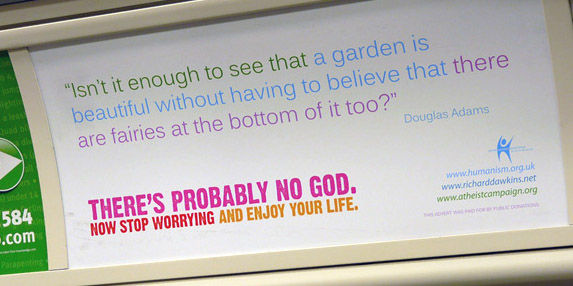
LINK
AtheistCampaign.org
Dawkins at Amaz!ng Randi convention
Illinois 'moment of silence' is law ruled
unconstitutional
By M I K E R O B I N S O N | AP Legal
Affairs Writer
January 21, 2009
CHICAGO - A federal judge ruled Wednesday that the state law requiring a moment
of silence in public schools across Illinois is unconstitutional, saying it
crosses the line separating church and state.
"The statute is a subtle effort to force students at impressionable ages to
contemplate religion," U.S. District Judge Robert W. Gettleman said in his
ruling.
The ruling came in a lawsuit designed to bar schools from enforcing the Illinois
Silent Reflection and Student Prayer Act. It was filed by talk show host Rob
Sherman, an outspoken atheist, and his daughter, Dawn, a student at Buffalo
Grove High School in suburban Chicago.
Gettleman's ruling was not a surprise. He had already ruled in favor of Sherman
in two previous decisions.
As passed by the Illinois General Assembly, the law allows students to reflect
on the day's activities rather than pray if that is their choice and defenders
have said it therefore doesn't force religion on anyone.
But Gettleman upheld critics such as the American Civil Liberties Union, who say
the law is a thinly disguised effort to bring religion into the schools.
The "teacher is required to instruct her pupils, especially in the lower grades,
about prayer and its meaning as well as the limitations on their 'reflection,"'
Gettleman ruled.
"The plain language of the statute, therefore, suggests and intent to force the
introduction of the concept of prayer into the schools," he said.
It remained unclear if Gettleman's decision would end the dispute or merely
signal a fresh battle in a federal appeals court.
State Sen. Kimberly Lightford, D-Chicago, the chief sponsor of the legislation,
said she hoped Illinois Attorney General Lisa Madigan would appeal.
"I strongly feel and I still believe that children should have a moment of
silence at the beginning of the school day," she said in a telephone interview
from Washington where she celebrated the inauguration of President Obama.
Sherman said that "at last year's gay pride parade, I personally asked Lisa
Madigan to not appeal this decision."
"Because if she appeals it to the right-wing 7th Circuit I'll lose, just because
they make decisions based on politics, not the facts of the law," Sherman said.
Madigan spokeswoman Robin Ziegler said the attorney general was reviewing
Gettleman's decision and would have no immediate further comment.
Adam Schwartz, senior staff counsel of the American Civil Liberties Union, said
the organization was pleased with the decision "to strike down a statewide law
that coerced children to pray as part of an organized activity in our public
schools."
He noted that students remain free to pray on their own in a non-disruptive
manner throughout the school day.
Defense asks for No Mormons on murder trial jury
Rico Perea is accused of killing two people at a wedding party in OGDEN, Utah
(AP) - An attorney for a man charged with aggravated murder have filed a motion
to keep off the jury any members of the Mormon church who might believe that the
only way for him to be forgiven by God is to be executed.
Sharon Sipes, a public defender for Riqo Perea, filed the motion in 2nd District
Court. She says a belief among members of The Church of Jesus Christ of
Latter-day Saints is that the only way to receive true forgiveness from God
after committing a serious offense is to shed one's own blood.
Sipes says that although the church has indicated blood atonement isn't part of
official doctrine, members widely believe it.
Perea, 21, is charged with two counts of aggravated murder in a gang-related
2007 shooting. Perea could face the death penalty.
Source:
kutv.com
Italy's Anti-cross judge cleared
Luigi Tosti vows to continue battle
(ANSA) - L'Aquila, February 17 - 2009
An
Italian judge campaigning against the presence of crosses in public buildings on
Tuesday got a jail conviction quashed for refusing to enter courtrooms unless
crucifixes were removed.
Italy's supreme court overturned judge Luigi Tosti's May 2007 seven-month
sentence for refusing to carry out his official duties.
Tosti called the sentence ''an important one'' and vowed to carry on his battle.
''It's either me in the courtroom, or crosses''.
The court prosecutor had argued for leniency, saying that since Tosti was
replaced by another judge, he should get a new trial on the minor charge of
disrupting judicial activity.
But the Cassation Court judges went further and issued a full acquittal, saying
that ''no crime was committed''. Tuesday's hearing took place with no crosses in
the room.
Tosti, 60, has already had one ban and is currently serving another for refusing
to sit in a courtroom in the Marche town of Camerino.
He has repeatedly refused to take part in proceedings unless the cross in the
courtroom was taken down and ''the secular nature of the assembly restored''.
The Italian judiciary's self-governing body, the Supreme Council of Magistrates,
removed Tosti from his post in February 2006 and cut off his pay because of his
''unjustifiable behaviour''.
The decision, which reignited debate on crucifixes in public buildings, came
after Tosti was convicted by a criminal court a month before.
SEPARATION OF CHURCH AND STATE AT STAKE, JUDGE SAYS.
Crucifixes are not mandatory but customary in
Italy's public buildings.
Catholicism is not Italy's state religion and the
separation of Church and State is set down by the postwar Constitution and
mandated by a 1984 Concordat that ended most of the Catholic Church's
privileges.
In practice, with Catholicism being such a part of Italy's cultural identity,
local bodies decide whether they want crosses in the courthouse.
Similar arrangements are in place in other public buildings - most notably
schools, where there have been a raft of polemics.
Judge Tosti first made headlines in April 2004 when he threatened to place
symbols of his own Jewish faith, like the menorah candle-holder, in his Camerino
court.
He later changed his mind after the Union of Italian Muslims (UMI) went to
Camerino to demonstrate their support for his initiative.
The UMI is headed by Adel Smith who for some time has been in the public
spotlight for his campaign to have crosses removed from schools and hospitals.
In 2003 Smith won a court order for the removal of crosses at the school his
children attended. The order was later reversed after a nationwide protest.
Judge Tosti insists that defendants have the constitutional right to refuse to
be tried under the symbol of the cross.
The Constitution, he says, establishes the separation of Church and State and
gives equal status to all religions.
This means that judges and lawyers can refuse to perform their duties under the
symbol of the cross which would violate a defendant's right to a fair trial and
counsel, he argues.
However, the Constitutional Court ruled in December 2004 that crosses should
stay in courts and classrooms.
The Court did not give a juridical explanation for its ruling, and many felt it
had washed its hands of a political hot potato.
If it had upheld the separation of Church and State, the high court would have
sparked outraged reactions from conservatives who were already incensed when
some schools dropped Christmas plays and creches to avoid hurting the feelings
of Muslim children.
The row even prompted a reaction from Pope John Paul II, who stressed that
Christmas cribs were a part of Italy's Catholic heritage.
photo: a reluctant Tosti pictured in 2004
Deseret News reporters protest...
B y P a u l B e e b e
Salt Lake Tribune www.sltrib.com
Nine Deseret News reporters and an intern removed their names from stories
they'd written Tuesday to protest the demotion of two editors and policies they
believe are reshaping the paper into a specialized publication catering only to
Mormons.
The action came after editor Joe Cannon and managing editor Rick Hall announced
Chuck Gates, deputy managing editor, would become a special writer and Julianne
Basinger, business editor, would become a copy editor.
Gates and Basinger reportedly are critics of the LDS Church-owned paper's
increasing embrace of topics thought to please its mostly LDS readership. Cannon
has said the strategy makes financial sense at a time when most U.S. papers are
struggling. The News and The Salt Lake Tribune , which is owned by MediaNews
Group, are partners in a joint operating venture that sells advertising for,
prints and distributes both papers.
Cannon and Hall also announced Tad Walch, a Utah County reporter, would become
city editor. All changes were effective immediately.
Gates did not return calls seeking comment. Basinger declined to discuss her
reassignment.
Most of the reporters who pulled their names cover state government and
politics. They were Lee Davidson, Bob Bernick, Lisa Riley Roche, Art Raymond,
Amy Joi O'Donohue, Wendy Leonard and James Thalman. Police reporters Ben Winslow
and Pat Reavy and legislative intern David Servatius also took part.
The boycott was meant "as a show of support for Chuck and Julianne, and also a
protest about how the decision was made and also the fact that the decision was
made," said Josh Loftin, state government editor and grandson of Glen Snarr,
former chairman of the News .
Loftin said he suggested to his reporters that they withhold their bylines. He
said he informed Hall, who did not object.
"If they want to express themselves that way, they certainly can," Hall said.
He said no one who took part will be punished. He said he did not know whether
the paper has a policy that forbids reporters from removing their names from
stories.
Cannon has been controversial since he was named editor of the News in December
2006. An attorney, lobbyist and former head of the Utah Republican Party, he had
no journalism experience before assuming the top editorial job at Utah's
second-largest paper.
Source -- unverified -- this arrived
via email
High court's
Summum
ruling not all bad, says attorney
By K r i s t e n M o u l t o n The Salt Lake
Tribune
Summum, a small Salt Lake City religious group
that wants to place a granite marker in a Pleasant Grove park, may have lost its
first battle before the highest court in the land.
 But
Summum attorney
Brian Barnard said the U.S. Supreme Court's
ruling Wednesday opens the door to a new constitutional challenge as the case
returns to U.S. District Court in Salt Lake City. But
Summum attorney
Brian Barnard said the U.S. Supreme Court's
ruling Wednesday opens the door to a new constitutional challenge as the case
returns to U.S. District Court in Salt Lake City.
"It's like they are handing it to me on a silver platter," said
Barnard, who intends to amend the lawsuit, adding church-state separation
claims.
Likewise, the American Humanist Association cheered the court's decision, saying
it provides a path to getting all Ten Commandments monuments off public property
in America.
The Supreme Court ruled unanimously Wednesday that Pleasant Grove did not
violate Summum's free-speech rights when the city refused permission for Summum
to place a marker listing its Seven Aphorisms in Pioneer Park.
The 10 Commandments monument that is already in Pioneer Park is clearly
government speech, not private speech protected by the First Amendment's Free
Speech Clause, said the court in an opinion written by Justice Samuel Alito.
Cities and other government entities have a right to select monuments that
reflect the local aesthetics, history or culture, the opinion said.
"City parks, ranging from those in small towns, like Pioneer Park in Pleasant
Grove City, to those in major metropolises, like Central Park in New York City,
commonly play an important role in defining the identity that a city projects to
its own residents and to the outside world," the opinion said.
A public park can provide a "soapbox" for a range of orators, "but it is hard to
imagine how a public park could be opened up for the installation of permanent
monuments by every person or group wishing to engage in that form of
expression," the opinion said.
Pleasant Grove Mayor Mike Daniels, who was in the courtroom when the case was
argued last November, said the decision affirms what the city believed all
along: The park reflects the city's identity and culture.
"[The decision] means the city can continue to collect and display artifacts
relevant to its history in its outdoor park," Daniels said Wednesday.
He said the fact that the court was unanimous in its decision was reassuring,
although he acknowledged the case is not over.
The attorney who argued the case for the city called it a "landmark" decision
that will act as a bookend on years of litigation about display of the Ten
Commandments around the country.
"This decision represents a resounding victory for government speech," said Jay
Sekulow, chief counsel for the American Center for Law and Justice. "The
decision gives government the right to speak for itself and the ability to
communicate on behalf of its citizens."
Now that the Supreme Court has determined that the Ten Commandments
monument in Pleasant Grove constitutes that city's speech, Barnard will
amend the Summum lawsuit to claim the city is blurring the church-state line, a
claim that has not been raised in the case. The U.S. Constitution's
Establishment Clause forbids government from favoring one religion over another.
The American Humanist Association announced in a news release that it will help
Summum pursue the claim -- or file its own.
"We humanists are ready to argue that Ten Commandments monuments in U.S.
public parks are unconstitutional government endorsements of religion,"
said Bob Ritter, legal coordinator for the Appignani Humanist Legal Center of
the American Humanist Association, in a news release.
The Becket Fund for Religious Liberty praised the court's conclusion that
governments can accept some monuments in public parks and reject others.
"The Court has carefully drawn a line between private speech and government
speech that protects both local governments from a wave of clutter and religious
speakers from government discrimination," said Eric Rassbach, national
litigation director of the Becket Fund, in a prepared statement.
Before the Pleasant Grove case, a number of Utah governments, facing lawsuits
and preliminary court losses, chose to move Ten Commandment monuments rather
than allow Summum to place markers of its Seven Aphorisms.
Ogden, Salt Lake County, Murray and Tooele City all removed Ten
Commandment monuments. Most ended up on private property.
Tribune reporter D o n a l d W. M
e y e r s contributed to this story.
Source: arrived via email, ostensibly Salt Lake Tribune article
Surprises pop up in new survey of U.S. Mormons
B y P e g g y
F l e t c h e r S t a c k 07/31/2009
On July 24, the Pew Forum on Religion and Public
Life released an extensive statistical portrait of
Mormons in the United States.
It drew on answers by self-identified members of The Church of Jesus Christ of
Latter-day Saints to Pew's U.S. Religious Landscape Survey in 2007.
Though it will come as no surprise to Utahns that most Mormons are
church-attending, Bible-believing Republicans, some of the other results may be
less predictable. For instance, Latter-day Saints are more likely to attend
church and less likely to home-school or attend religious schools than the
general population.
Here are some of the findings:
Comparative size Mormons make up 1.7 percent of the American adult
population, a proportion that is comparable in size to the U.S. Jewish
population but more than Jehovah's Witnesses (0.7 percent), Buddhists (0.7
percent), Muslims (0.6 percent) and Hindus (0.4 percent).
Age, gender and family Two-thirds (66 percent) of Latter-day Saints
are under age 50, compared with 59 percent of the public as a whole. Most
Mormons are women (56 percent).
Marriage Nearly three-quarters of Mormons (71 percent) are married,
compared with just more than half (54 percent) among the general population.
Only Hindus (78 percent) are more likely than Mormons to be married. Mormons (83
percent) and Hindus (90 percent) also are the most likely of all
Advertisement
the major religious traditions to be married to someone of the same faith.
Family size Latter-day Saints are widely known for having large
families and, indeed, about half the nation's Mormons (49 percent) have children
under age 18 living at home, with one in five (21 percent) saying they have
three or more children at home. Only Muslims are similarly likely to have large
families: 47 percent of Muslims have at least one child living at home and 15
percent have three or more.
Race Nearly nine in 10 U.S. Mormons (86 percent) are Anglo,
compared with 71 percent of the general population. Just 3 percent of Mormons
are African-American and 7 percent are Latino. Other predominantly Anglo
religious groups in the United States include Jews (95 percent), members of
mainline Protestant churches (91 percent) and Orthodox Christians (87 percent).
Education Six in 10 Mormons (61 percent) have at least some college
education, compared with half the overall population. However, the proportion of
Mormons who graduate from college (18 percent) or receive postgraduate education
(10 percent) mirrors the population as a whole (16 percent and 11 percent,
respectively).
Converts Nearly half the LDS converts (48 percent) are above age
50, compared with about three in 10 lifelong members (29 percent). Converts also
tend to be less educated than nonconverts (16 percent did not graduate from high
school, compared with just 6 percent of lifelong members), and they earn
decidedly lower incomes (40 percent pocket less than $30,000 a year, compared
with 21 percent among nonconverts).
Converts are more likely than lifelong Latter-day Saints to come from minority
racial and ethnic groups. They are less likely than lifelong members to be
married (64 percent vs. 74 percent).
A quarter of current Mormons (26 percent) are converts to the faith. This is a
much higher proportion than among Catholics (11 percent) and Jews (15 percent)
but significantly lower than among Buddhists (73 percent), Jehovah's Witnesses
(67 percent) and Protestants (45 percent, when those who have switched from one
Protestant family to another are included, such as Baptist to Methodist; if
changes within Protestantism are omitted, the figure is 16 percent). Of those
who have converted to Mormonism, roughly half (13 percent of Mormons overall)
were raised Protestant, one in four (7 percent of Mormons overall) were raised
Catholic and one in five (5 percent of Mormons overall) were raised without a
religious affiliation.
Retention Mormons boast a relatively high retention rate of
childhood members compared with other major religious traditions. Seven in 10 of
those raised LDS (70 percent) still identify as Mormon, a figure roughly
comparable to that seen among those raised Catholic (68 percent are still
Catholic) but somewhat lower than among those raised Protestant (80 percent are
still Protestant and 52 percent remain in the same Protestant family). Jehovah's
Witnesses have a lower retention rate (37 percent are still Jehovah's
Witnesses).
Of those who leave Mormonism after being raised in the faith, half (15 percent
of those raised LDS overall) convert to a new religion, while the other half (14
percent overall) become unaffiliated.
The Bible More than nine in 10 Mormons (91 percent) say the Bible
is the God's word, while a majority of Mormons (57 percent) say it should not be
taken literally.
Church attendance Mormons rank among the most active of the major
religious traditions in terms of attendance at religious services. Fully
three-quarters (76 percent) say they attend church at least once a week,
compared with 39 percent among the general population.
Home schooling Mormons are less likely than the public overall to
home-school or send their children to a religious school; 6 percent say they do
so, compared with 15 percent among the general population.
One true church Most Mormons (57 percent) say theirs is the one
true faith, with a sizable minority (39 percent) taking the opposite view. More
than six in 10 younger Mormons (62 percent) say theirs in the one true faith,
compared with roughly half (48 percent) of Mormons 50 and older. LDS men are
more likely than women (64 percent vs. 52 percent) to say theirs is the one true
faith.
Utahns and others Utahns are much less likely than Mormons from
other states to share their faith with others at least once a week (13 percent
vs. 37 percent), they are more likely to say theirs is the one true faith (63
percent vs. 51 percent) and they more heavily favor preserving traditional
beliefs and practices (77 percent vs. 63 percent).
Politics Nearly two-thirds (65 percent) of Mormons say they
identify with or lean toward the Republican Party, while a fifth (22 percent)
say they are Democrats. Mormons in the West are significantly more likely than
members from other regions to identify as Republican (68 percent vs. 55
percent).
Among the general public, two-thirds (62 percent) say the government should do
more for the needy, while only about half the Mormons (49 percent) say this.
More than four in 10 Latter-day Saints (42 percent) say government cannot afford
to do much more to help the needy, compared with 29 percent among the population
as a whole.
Most Mormons (55 percent) said in summer 2007 that strong environmental laws are
worth the cost. Half (51 percent) say it is best to be active in world affairs,
and 37 percent say the nation should focus more on problems at home. Jews are
the only other major religious tradition in which a majority leans toward
involvement in international affairs (53 percent).
Those who are married are significantly more likely than unmarried
Mormons to
identify as conservative (66 percent vs. 43 percent) and Republican (70 percent
vs. 52 percent) and to oppose legal abortion (73 percent vs. 63 percent).
pstack@sltrib.com
Source: sltrib.com/faith/ci_1294
More and More Americans Say They Have
No Religion
R A C H E L Z O L L |
March 2009
A wide-ranging study on American religious life found that the Roman Catholic
population has been shifting out o of the Northeast to the Southwest, the
percentage of Christians in the nation has declined and more people say they
have no religion at all.
Fifteen percent of respondents said they had no religion, an increase from 14.2
percent in 2001 and 8.2 percent in 1990, according to the American Religious
Identification Survey.
Northern New England surpassed the Pacific Northwest as the least religious
region, with Vermont reporting the highest share of those claiming no religion,
at 34 percent. Still, the study found that the numbers of Americans with no
religion rose in every state.
"No other religious bloc has kept such a pace in every state," the study's
authors said.
In the Northeast, self-identified Catholics made up 36 percent of adults last
year, down from 43 percent in 1990. At the same time, however, Catholics grew to
about one-third of the adult population in California and Texas, and one-quarter
of Floridians, largely due to Latino immigration, according to the research.
Nationally, Catholics remain the largest religious group, with 57 million people
saying they belong to the church. The tradition gained 11 million followers
since 1990, but its share of the population fell by about a percentage point to
25 percent.
Christians who aren't Catholic also are a declining segment of the country.
In 2008, Christians comprised 76 percent of U.S. adults, compared to about 77
percent in 2001 and about 86 percent in 1990. Researchers said the dwindling
ranks of mainline Protestants, including Methodists, Lutherans and
Episcopalians, largely explains the shift. Over the last seven years, mainline
Protestants dropped from just over 17 percent to 12.9 percent of the population.
The report from The Program on Public Values at Trinity College in Hartford,
Conn., surveyed 54,461 adults in English or Spanish from February through
November of last year. It has a margin of error of plus or minus 0.5 percentage
points. The findings are part of a series of studies on American religion by the
program that will later look more closely at reasons behind the trends.
The current survey, being released Monday, found traditional organized religion
playing less of a role in many lives. Thirty percent of married couples did not
have a religious wedding ceremony and 27 percent of respondents said they did
not want a religious funeral.
About 12 percent of Americans believe in a higher power but not the personal God
at the core of monotheistic faiths. And, since 1990, a slightly greater share of
respondents _ 1.2 percent _ said they were part of new religious movements,
including Scientology, Wicca and Santeria.
The study also found signs of a growing influence of churches that either don't
belong to a denomination or play down their membership in a religious group.
Respondents who called themselves "non-denominational Christian" grew from 0.1
percent in 1990 to 3.5 percent last year. Congregations that most often use the
term are megachurches considered "seeker sensitive." They use rock style music
and less structured prayer to attract people who don't usually attend church.
Researchers also found a small increase in those who prefer being called
evangelical or born-again, rather than claim membership in a denomination.
Evangelical or born-again Americans make up 34 percent of all American adults
and 45 percent of all Christians and Catholics, the study found. Researchers
found that 18 percent of Catholics consider themselves born-again or
evangelical, and nearly 39 percent of mainline Protestants prefer those labels.
Many mainline Protestant groups are riven by conflict over how they should
interpret what the Bible says about gay relationships, salvation and other
issues.
The percentage of Pentecostals remained mostly steady since 1990 at 3.5 percent,
a surprising finding considering the dramatic spread of the tradition worldwide.
Pentecostals are known for a spirited form of Christianity that includes
speaking in tongues and a belief in modern-day miracles.
Mormon numbers also held steady over the period at 1.4 percent of the
population, while the number of Jews who described themselves as religiously
observant continued to drop, from 1.8 percent in 1990 to 1.2 percent, or 2.7
million people, last year. Researchers plan a broader survey on people who
consider themselves culturally Jewish but aren't religious.
The study found that the percentage of Americans who identified themselves as
Muslim grew to 0.6 percent of the population, while growth in Eastern religions
such as Buddhism slightly slowed.
On the Net: Survey results:
americanreligionsurvey-aris.org/
Source:
huffingtonpost.com/2009/
Criticism not bigotry
Public Forum
Letter Salt Lake Tribune
In "Bigotry against
Mormons apparently acceptable in Utah" (Opinion, March 21, [ sltrib.com/ci_11960981]),
Dennis Clayson advocated a dangerous form of political correctness, sometimes
called "religious correctness" -- that religious beliefs are exempt from
criticism simply because they have a basis in faith.
Specifically, Clayson argues that we have "an obligation to treat the religious
beliefs of well-meaning people with restraint and respect" (emphasis
added). This is ridiculous.
Faith is a choice. It therefore makes no sense to insist that we respect silly,
ignorant or dangerous religious beliefs. Should we respect religious beliefs or
practices such as the fatwa against Salman Rushdie, honor killings or female
genital mutilation? Those who endorse them are "well meaning" -- they believe
they are doing the right thing -- even though we (may) disagree with them.
Religious beliefs are no different than any others in America's venerable
"marketplace of ideas." It is my obligation to challenge and perhaps oppose
ignorant, ridiculous and dangerous beliefs, no matter what their basis.
None of this is intended to condone disrespect or violence toward any
individual. But pretending that someone else's beliefs are worthy of respect,
when they're not, is a disservice to all.
Ken Roach
Salt Lake City
Source: Ken
Roach:
sltrib.com/opinion/
Oklahoma Legislature Investigates
Richard Dawkins' Free Speech
March 20, 2009
B y G r e g L u k i a n o f f
Well, it's official: Oklahoma's state legislature
is investigating the University of Oklahoma for hosting a speech by evolutionary
biologist Richard Dawkins.
As I noted in a post over the weekend at Dawkins' website, the legislature first
considered two resolutions condemning both Dawkins and the theory of evolution
as "an unproven and unpopular theory." (I highly recommend reading both of the
proposed resolutions.) Despite their efforts, the legislature failed to prevent
Dawkins from speaking on March 6 to an audience of thousands at the University
of Oklahoma.
Last week, however, I received multiple reports that the legislature was now
investigating the speech, and I wrote the University of Oklahoma President David
Boren directly asking to know if this was true.
Sure enough, I just received confirmation today in a letter from the Open
Records Office at the University of Oklahoma. The letter confirms that on the
day of Dawkins' speech, Oklahoma State Representative Rebecca Hamilton requested
substantial information relating to the speech from Vice President for
Governmental Relations Danny Hilliard. Representative Hamilton's exhaustive
request included demands for all e-mails and correspondence relating to the
speech; a list of all money paid to Dawkins and the entities, public or private,
responsible for this funding; and the total cost to the university, including,
among other things, security fees, advertising, and even "faculty time spent
promoting this event."
Rick Farmer, the director of committee staff for the Oklahoma House of
Representatives, also wrote the University on March 12, requesting confirmation
that Dawkins had indeed waived all compensation for the speech.
Now some of you--though I hope not too many--may wonder: "What's wrong with the
legislature investigating a speech by a famous evolutionary biologist at a
public university?" Well, a lot of things, actually. As I wrote in my post on
Dawkins' website:
If this
investigation is indeed taking place, what the state legislature needs
to understand is that in court cases dating back to the days of the
House Committee on Un-American Activities, even investigating clearly
protected speech on the basis of its viewpoint violates the First
Amendment.
Think about it: If every time a student or faculty member invited, say,
Rick Warren to speak on campus, they knew they would be subjected to a
thorough and time-consuming investigation by state officials, you can
all but guarantee that schools across the country would think twice
before inviting Rick Warren. This would be a great way for state
legislatures to chill speech they dislike without ever having to find
the speaker guilty of a single thing. Talk about your un-American
activities.
Given the fact the legislature clearly is concerned with nothing other
than Dawkins' viewpoint, such an investigation is improper and should
end immediately.
Now that we know
this investigation is going on, many questions still need to be answered: What
does the state legislature plan to do with this information? Does this mean that
any time Richard Dawkins or other evolutionary scientists give speeches about
evolution in Oklahoma, they too will be investigated? And perhaps most
importantly: Doesn't the Oklahoma legislature have anything better to do?
I think I know the
answer to the last question, but I think it's time the Oklahoma Legislature
answered the first two. Stay tuned.
Source:
huffingtonpost.com/greg-lukianoff
Richard Dawkins launches 'There is no God' signs on
buses across Britain
Pilot jailed for Sicily air crash
An Italian court has jailed a Tunisian pilot who paused to pray
instead of taking emergency measures before ditching his plane, killing 16
people.
A fuel gauge fault was partly to blame for the crash off Sicily in 2005 but
judges convicted Chafik Garbi of manslaughter, jailing him for 10 years.
Six others, including the co-pilot and head of the airline Tuninter, were jailed
for between eight and 10 years.
The accused will not spend time in jail until the appeals process is completed.
''This was an unprecedented sentence but we have always maintained that it was
an unprecedented incident,'' Niky Persico, a lawyer for one of the victims, told
Italy's Ansa news agency.
''Never before in the history of aviation disasters has there been such a chain
of events and counter-events.''
Fuel gauge
The twin-engined Tuninter ATR-72 turboprop aeroplane was flying from the Italian
city of Bari to the Tunisian island of Djerba on 6 August 2005, when it ran out
of fuel and came down in the sea some 13km (eight miles) off the northern coast
of Sicily.
Out of the total of 34 passengers and five crew on board, 23 survived. Many had
to swim for their lives, while others clung on to floating pieces of the
fuselage.
The Italian National Air Safety Board (ANSV) found in 2007 that the plane had
run out of fuel because it had failed to take on enough before leaving Bari.
It said this was the result of a faulty fuel gauge, which had been installed the
previous day by the maintenance arm of Tunisair, owner of Tuninter.
Ground crew had installed a fuel gauge designed for the ATR-42, which is similar
to the ATR-72 but has smaller fuel tanks, the ANSV found. The same conclusions
were reached by the manufacturer.
Prosecutors say that after both the plane's engines cut out, the pilot succumbed
to panic, praying out loud instead of following emergency procedures and
then opting to crash-land in the Mediterranean instead of trying to reach the
nearest airport
Source:news.bbc.co.uk
|
|
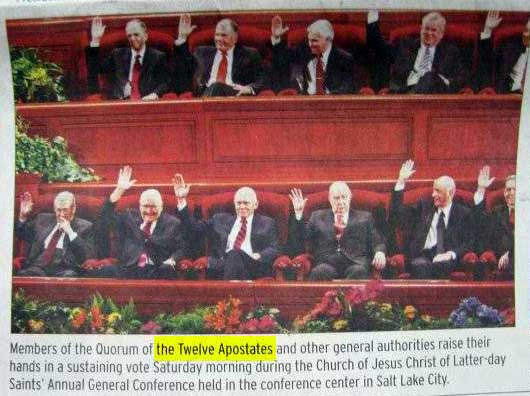
Members of the
Quorum of the Twelve Apostates...
Source SLTRIB.COM: BYU's Universe
reprints issues of The Daily Universe due to front page typo. |
"It would have been worse if it
were done intentionally, as some have thought. But after
talking to the people, we found it was an innocent mistake."
|
|
Evans said
one of the students involved
was in tears over it. A story on the Universe's Web site
stated this was the first time in more than 30 years that the
paper had to trash an edition.
[They take their truth seriously, these
Mormons
do -- Ed.] |
Utah GOP reject 'Satanic' resolution
By Donald W. Meyers The Salt
Lake Tribune Updated: 04/25/2009
Orem - Utah County Republicans defeated a resolution opposing well-heeled groups
that a delegate claims are pushing a satanic plan to encourage illegitimate
births and illegal immigration.
Don Larsen, a Springville delegate, offered the resolution, titled "Resolution
opposing the Hate America anti-Christian Open Borders cabal," warning delegates
that an "invisible government" comprised of left-wing foundations was pumping
money into the Democratic Party to push for looser immigration laws and
anti-family legislation.
Larsen said Democrats get most of the votes cast by illegal immigrants and
people in dysfunctional families.
But it's not the Democrats who are behind this strategy, Larsen said. It's the
devil.
"Satan's ultimate goal is to destroy the family," Larsen said, "and these people
are playing a leading part in it."
Larsen's resolution contained quotes from the New Testament on the battle
between good and evil. The copy of the resolution handed to delegates stated it
"fulfills scriptural prophecies about our times."
Larsen offered a similar resolution at the 2007 convention. That also was
defeated by delegates.
David Rodeback, a delegate from American Fork, urged delegates to forcefully
reject the resolution, as it would do the party more harm than good.
Rodeback said the religious language Larsen used would push people away from the
GOP.
Joel Wright, a Cedar Hills delegate, agreed. He said George W. Bush was able to
win the presidency because he had 40 percent of the Latino vote, while John
McCain was defeated when he only got 28 percent of Latino ballots.
"We are not going to be the majority party if we keep pushing the Latinos out,"
Wright said.
But Cameron Sevy, a Provo delegate, said the GOP shouldn't be ashamed to say
that America is a Christian nation.
Source: Salt Lake Tribune
3
Pizza Moslems get Life at Ft. Dix:
Dritan Duka, 30, and his brother, Shain Duka, 28, were sentenced to life
in prison plus 30 years and Eljvir Duka, 25, was sentenced to life in
prison. They plotted to kill soldiers at Fort Dix in New Jersey.
Three Brothers Get Life Sentences In Fort Dix Case
b y T h e A s s o c i a t e d
P r e s s
NPR.org, April 29, 2009. Three immigrant brothers involved in a plot
to kill military personnel, possibly on Fort Dix, were sentenced Tuesday to
spend the rest of their lives in prison.
The government had said the men were familiar with the Army post because their
father's pizza shop delivered there, and it presented the case as one of the
most startling examples of homegrown terrorism.
Dritan, Eljvir and Shain Duka professed their innocence in courtroom speeches
before U.S. District Judge Robert Kugler handed down their sentences. Two other
men were to be sentenced Wednesday.
|
They were
known for taking pizza to homeless people.
 3
Pizza Moslems get Life at Ft. Dix 3
Pizza Moslems get Life at Ft. Dix
"Being in prison and knowing you are innocent is
a great feeling in the sight of God,"
~ Eljvir Duka, 25.
~
Story
Source
NPR.org, April 29, 2009
|
All
five were convicted by a jury in December of conspiracy to kill
military personnel but were acquitted on attempted murder
charges. Four of them also were convicted on weapons offenses.
Two of the Duka brothers, Dritan and Shain, were given sentences
of life plus 30 years because of one of the weapons counts
against them.
Defense lawyers and the men's relatives said the sentences were expected,
but the relatives also said they were unjust.
The men also were ordered to pay a total of $125,000 in restitution to the
Army, which beefed up security at Fort Dix after hearing about the
investigation into the plot.
In meting out the sentences, the judge agreed with prosecutors that the case
was shocking.
"But for the intervention of the FBI, at some point in the future," he said,
"they would have killed people."
Early in the daylong court proceeding, the judge asked Deputy U.S. Attorney
William Fitzpatrick whether it made sense to sentence the conspirators to
life in prison with no chance of parole given that people convicted of
murder in most states at least have the possibility of parole.
"Yes it is," Fitzpatrick said. "The fact that they didn't have an
opportunity to carry it out should not be a benefit."
The men were arrested in May 2007. Prosecutors say they had taken training
trips to the Pocono Mountains in Pennsylvania and scouted out Fort Dix and
other military sites.
Five service members in uniform sat in the back of the courtroom as the
sentences were handed down Tuesday.
During the sentencing hearing, the Duka brothers told the judge they were
innocent and were convicted because of their unpopular political views. They
blamed the government's use of two convicted criminals as paid informants in
the case, claiming those informants cajoled them into saying they would take
up arms against the U.S.
"The innocent are in prison while the true criminals are being rewarded
heavily," lamented Shain Duka, 28.
"Being in prison and knowing you are innocent is a great feeling in the
sight of God," said Eljvir Duka, 25.
Relatives and a neighbor of the men also spoke in the hearing, laying out
how the brothers were brought to the United States illegally as boys from
the former Yugoslavia as their parents sought a better life.
Dritan Duka,
30, and his brother, Shain Duka, 28, were sentenced to life in prison
plus 30 years and Eljvir Duka, 25, was sentenced to life in prison.
|
The
brothers were raised for a time in Brooklyn, then moved to Cherry Hill, a
comfortable suburb of Philadelphia, a dozen years ago after Dritan Duka, now 30,
had gotten into legal trouble.
All three had criminal histories dating to their teenage years. Among them: drug
offenses, eluding police and driving with a suspended license.
Michael Huff, a lawyer for Dritan Duka, said that becoming more involved in the
Muslim faith turned them around.
The men, all school dropouts, owned a pizza shop together and later a roofing
company.
Their father, Ferik Duka, told how they supported the family when he was injured
in a car accident and were known for taking pizza to homeless people.
"I wish all the children of human beings," the elder Duka said, "are like my
sons."
Survey: Support for terror suspect torture
differs among the faithful
Story Highlights
* 742 American adults surveyed on use of torture against
suspected terrorists
* 54% of those who go to services at least once a week
say it's often or sometimes OK
* In survey, people unaffiliated with any religious
group were least likely to back torture
* President of National Association of Evangelicals yet
to comment on survey |
WASHINGTON (CNN) -- The more often Americans go to church, the more likely they
are to support the torture of suspected terrorists, according to a new survey.
More than half of people who attend services at least once a week -- 54 percent
-- said the use of torture against suspected terrorists is "often" or
"sometimes" justified. Only 42 percent of people who "seldom or never" go to
services agreed, according the analysis released Wednesday by the Pew Forum on
Religion & Public Life.
White evangelical Protestants were the religious group most likely to say
torture is often or sometimes justified -- more than six in 10 supported it.
People unaffiliated with any religious organization were least likely to back
it. Only four in 10 of them did.
The analysis is based on a Pew Research Center survey of 742 American adults
conducted April 14-21. It did not include analysis of groups other than white
evangelicals, white non-Hispanic Catholics, white mainline Protestants and the
religiously unaffiliated, because the sample size was too small. See results of
the survey
The president of the National Association of Evangelicals, Leith Anderson, did
not immediately respond to a request for comment.
The survey asked: "Do you think the use of torture against suspected terrorists
in order to gain important information can often be justified, sometimes be
justified, rarely be justified, or never be justified?"
Roughly half of all respondents -- 49 percent -- said it is often or sometimes
justified. A quarter said it never is.
The religious group most likely to say torture is never justified was Protestant
denominations -- such as Episcopalians, Lutherans and Presbyterians --
categorized as "mainline" Protestants, in contrast to evangelicals. Just over
three in 10 of them said torture is never justified. A quarter of the
religiously unaffiliated said the same, compared with two in 10 white
non-Hispanic Catholics and one in eight evangelicals.
Source: Arrived via email
LINK:
Back to
Religion in
the News
The Potato QUIZ
!
Q:
Where did you get the GOLD with which your churches are gilded?
Opinion
Why the Faithful
Approve of Torture
Friday 01 May 2009 by S
u s a n B r o o k s original @ The Washington Post
Story Highlights
Prisoners at Guantanamo Bay --
A recent poll shows the more often you go to church, the
more you approve of torture. |
The
more often you go to church, the more you approve of torture. This is a
troubling finding of a new survey by the Pew Forum on Religion and Public Life.
Shouldn't it be the opposite? After all, who would Jesus torture? Since Jesus
wouldn't even let Peter use a sword and defend him from arrest, it would seem
that those who follow Jesus would strenuously oppose the violence of torture.
But, not so in America today.
Instead, more than half of people who attend worship at least once a week, or
54%, said that using torture on suspected terrorists was "often" or "sometimes"
justified. White evangelical Protestants were the church-going group most likely
to approve of torture. By contrast, those who are unaffiliated with a religious
organization and didn't attend worship were most opposed to torture - only 42%
of those people approved of using torture.
One possible way to interpret this extraordinary Pew data is cultural. White
evangelical Protestants tend to be culturally conservative and they make up a
large percentage of the so-called Republican "base". Does the approval of
torture by this group demonstrate their continuing support for the previous
administration? That may be.
But I think it is possible, even likely, that this finding has a theological
root. The UN Convention Against Torture defines torture as "any act by which
severe pain or suffering, whether physical or mental, is intentionally inflicted
on a person..." White Evangelical theology bases its view of Christian salvation
on the severe pain and suffering undergone by Jesus in his flogging and
crucifixion by the Romans. This is called the "penal theory of the atonement" -
that is, the way Jesus paid for our sins is by this extreme torture inflicted on
him.
For Christian conservatives, severe pain and suffering are central to their
theology. This is very clear in the 2002 Mel Gibson movie, The Passion of the
Christ. Evangelical Christians flocked to this movie, promoted it and still show
it in their churches, despite the fact that it is R-rated for the extraordinary
amount of violence in the film. It is, in fact, the highest grossing R-rated
movie in the history of film. The flogging of Jesus by the Romans goes on for
fully 40 minutes. It is truly the most violent film I have ever seen.
The message of the movie, and a message of a lot of conservative Christian
theology, is that severe pain and suffering are not foreign to Christian faith,
but central.
Of course, this is an interpretation of Jesus life, death and resurrection that
I reject. It is also an interpretation that I believe has done a lot of harm
through the centuries. I think it is impossible, yes, impossible, if you read
the Gospels, to make the case that God wanted Jesus tortured for the sins of
humanity. But that is an interpretation that has sometimes been made in the
history of Christianity and the social and political fallout has been, and is
today, that torture is OK, maybe even more than OK. This Pew finding may just be
another in a long line of horrible historical examples of that.
Source: Arrived via email
|
For more information, please contact:
Dave Silverman, Vice President and Communications
Director 732-648-9333
Kathleen Johnson, Vice President and Military Director
318-542-1019
ATHEISTS CALL FOR CONGRESSIONAL PROBE
OF AFGHANISTAN BIBLE INCIDENT
An Atheist public policy group today called upon Congress to
investigate
the unauthorized distribution of bibles by U.S. military troops
in
Afghanistan.
The incident was revealed on the Al Jazeera television network,
and
consisted of video shot by a U.S. filmmaker. It shows military
chaplains at Bagram Air Force base planning distribution of
bibles
printed in the native Pashto language to Muslims. Such an act
reportedly violated regulations.
Kathleen Johnson, Military Director for American Atheists says
that the
year-old video footage is "a public relations disaster for the
United
States."
"This film depicts our troops as modern-day 'crusaders' who are
out to
proselytize and convert Muslims," said Johnson. "We're supposed
to be
fighting terrorism and helping the Afghanis build a new civil
society
that educates women, protects human rights and brings economic
development. Religious conversion is not and should not be on
our
government's to-do list."
Dave Silverman, Communications Director for American Atheists,
said that
Congress needs to investigate. "We've been told that the Bibles
were
destroyed when the Al Jazeera documentary came to light; what we
don't
know is whether this practice is continuing, and we can't trust
the
military brass on this issue."
"We already know that the chaplains were trying to cover-up the
incident
when they claimed that the bibles -- printed in a foreign tongue
-- were
for 'personal use. That doesn't make sense."
Silverman also cited a sermon by Lt. General Gary Hensley, chief
of
military chaplains in Afghanistan, preaching that troops were
followers
of Jesus Christ and should "be witnesses for him."
"This is mixing private religion with an official military
mission. No
branch of our government, including the Pentagon, should be
promoting
religion, especially when Islamic fundamentalism is one of the
major
problems in Afghanistan."
AMERICAN ATHEISTS is a nationwide movement that defends civil
rights for
Atheists; works for the total separation of church and state;
and
addresses issues of First Amendment public policy.
|
Scientology on trial in France
The Church says it cannot be responsible for individuals
The Church of Scientology has gone on trial in the French capital, Paris,
accused of organised fraud.
The case centres on a complaint by a woman who says she was pressured into
paying large sums of money after being offered a free personality test.
The church, which is fighting the charges, denies that any mental manipulation
took place.
France regards Scientology as a sect, not a religion, and the organisation could
be banned if it loses the case.
It will be the first time the church has appeared as a defendant in a fraud case
in France. Previous court cases have involved individual Scientologists.
Books and medication
The woman at the centre of the case says she was approached by church members in
Paris 10 years ago, and offered a free personality test. But, she says, she
ended up spending 21,000 euros ($29,400, £18,400) on lessons, books and
medicines she was told would cure her poor mental state.
Her lawyers are arguing that the church systematically seeks to make money by
means of mental pressure and the use of scientifically dubious "cures".
A lawyer for the church, Patrick Maisonneuve, said: "We will contest every
charge and prove that there was no mental manipulation."
The church's spokeswoman in France said it was being "hounded" by the French
courts.
Scientology was founded in the United States in the 1954 by science-fiction
writer L Ron Hubbard. High profile supporters include the Hollywood stars John
Travolta and Tom Cruise.
In Germany last year, it was declared unconstitutional.
However, a Spanish court ruled that the Church of Scientology of Spain should be
re-entered into the country's register of officially recognised religions.
Source: BBC
news.bbc.co.uk
Oklahoma's Ten Commandments struck down
Court smites Oklahoma courthouse 'Ten Commandements' display
June 9 2009
Trina Hoaks Atheism Examiner
American United for Separation of
Church and State praised a federal appeals court for striking down a
government display of the Ten Commandments in Haskell County, Okla.
|
The
appellate panel, composed of three George W. Bush appointees, ruled that
most people would perceive the display of the monument and the battle to
keep it up as religious efforts. |
Reversing a lower court, the 10th U.S.
Circuit Court of Appeals
unanimously declared unconstitutional [pdf] the eight-foot-tall
religious display, which was erected at the local courthouse in 2004
after a campaign by a local minister and his supporters.
“This decision should send a clear message to politicians and
religious leaders: Thou shalt not mix church and state,” observed
the Rev. Barry W. Lynn, executive director of Americans United. “Our
courthouses should focus on the Constitution and civil law, not
religious law.”
Americans United, which filed a friend-of-the-court brief in the
Green v. Haskell County Board of Commissioners case, noted that the
monument displays the Protestant version of the Commandments and
that it contains the text of the Mayflower Compact on the other
side.
The appeals court traced the history of the monument, noting that
commissioners frequently invoked religious language in defending it.
One commissioner said, “I’m a Christian, and I believe in this. I
think it’s a benefit to the community.”
The appellate panel, composed of three George W. Bush appointees,
ruled that most people would perceive the display of the monument
and the battle to keep it up as religious efforts.
“We conclude, in the unique factual setting of a small community
like Haskell County, that the reasonable observer would find that
these facts tended to strongly reflect a government endorsement of
religion,” wrote the court. “In particular, we find support for this
conclusion in the public statements of the Haskell County
commissioners.”
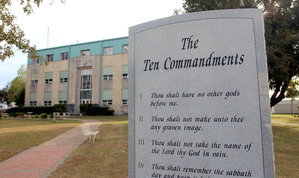 Lynn
said the court made the right call. Lynn
said the court made the right call.
“The display of religious documents like the Ten Commandments
properly belongs to religious leaders, not government officials,” he
said. “I hope county officials have learned an important lesson
about launching ill-considered religious crusades.”
Lynn noted that Oklahoma legislators recently passed a law calling
for a display of the Ten Commandments on the grounds of the state
capitol. In light of this ruling, he said, lawmakers might want to
reconsider the wisdom of that action.
Source:
examiner.com/x-2044-Atheism-Examiner~y2009m6d9-Court-smites-Oklahoma-courthouse-Ten-Commandements-display?cid=examiner-email
LINKS:
JAMES W. GREEN vs.ACLU -- UNITED STATES COURT
OF APPEALS 10th CIRCUIT Case: 06-7098 [.pdf]
Wordpress.com
|
Idiot Yettaw: Suu Kyi visitor tells of 'sorrow'
The man who swam to the lakeside home of Burmese opposition leader Aung San Suu
Kyi has spoken of his sorrow that his action led to her arrest and trial.
John Yettaw told the BBC that he had a dream that Ms Suu Kyi was going to be
murdered, and swam to her home wearing home-made flippers to warn her.
Mr Yettaw was sentenced to seven years in prison but is now back home after US
Senator Jim Webb intervened.
Ms Suu Kyi was sentenced to 18 months' further house arrest.
Mr Yettaw, a devout Mormon from Falcon, Missouri, told the BBC's Newshour
programme that he had had many strong visions or dreams which he called
"impressions" or "camcorder moments".
In one he says he foresaw an official plot to murder Ms Suu Kyi and this
prompted him to swim twice to her home to warn her of the danger.
On the first occasion he says he left some Mormon scriptures for her but did not
enter her home.
As he left he was challenged by an armed guard. He says he shook hands with the
guard who then walked away and he took a taxi away from the scene.
Another dream
But he again swam to her house in May after another dream.
"I had been researching Myanmar (Burma) and researching about the internally
displaced families and about the numbers of people who had been murdered and
then about the numbers of people through the Cyclone (Nargis) and then about
Aung San Suu Kyi's release date and I went to sleep that night and I had a dream
that when she was released she was going to be murdered and I saw a plot," he
said.
He said that he believed the inevitable publicity surrounding his trips would
make it impossible for the Burmese military authorities to carry out their
alleged plan to assassinate her.
"When I was in the water the first
time... I had seen myself returning to the house and being in her house two
days. When I had the dream of the assassination I thought: OK, I'll go back and
I will share with her this message.
"I shared with many people that I had this overwhelming feeling that I was going
to be imprisoned and become a political prisoner. The theme was that the eyes of
the world would be on Aung San Suu Kyi and that this would spare her life, that
the junta (Burma's military government) would not dare try to assassinate her."
Mr Yettaw, 53, said that when he arrived at Ms Suu Kyi's home for the second
time she was "shocked" to see him.
"When i got in to talk to Aung San Suu Kyi I said there's a plot to assassinate
you," he said. "She said: 'If I die I die.' I said no way, Burma needs you."
Both Mr Yettaw and Ms Suu Kyi were arrested and the pro-democracy leader was
charged with breaking the terms of her house arrest by sheltering Mr Yettaw.
Mr Yettaw, who suffered ill health during his detention, spoke of his sorrow
that his actions had led to Ms Su Kyi's arrest.
"I was sorrowful that she was arrested," he said. "I had impressions that I
would be on trial and that Aung San Suu Kyi would either testify for or against
me but not that she would be placed on trial because I think that if I had seen
that I wouldn't have done it."
Source:
news.BBC.co.uk
LINK:
New Charity Scams using Burmese
dissidents
Atheists say NASA is violating separation of
state and church
September 2, 2009 by Trina Hoaks
An Atheist-First Amendment public policy group charged [last week] that NASA is
violating the separation of church and state by permitting a "space missionary"
memento on the latest Discovery Space Shuttle Mission.
On board the shuttle is a piece of an airplane that crashed in Ecuador in 1956
that carried members of the Missionary Aviation Fellowship. One of the shuttle
astronaut contacted the Idaho-based group proposing that the item be taken into
space as part of a government-funded exploration project. The event has
re-ignited enthusiasm by religious groups for "space missionary" proselytizing.
"This is an inappropriate and unconstitutional use of resources, "charged Dr. Ed
Buckner, President of American Atheists. NASA is a scientific and exploratory
agency that is funded by taxpayers. Its
mission should not include religious grandstanding, or efforts to use outer
space as a pulpit for religion."
Coincidentally, Dr. Buckner's late father, Rev. James C. Buckner of St.
Christopher's Episcopal Church in League City, Texas, collaborated with Apollo 8
astronaut Cdr. Frank Borman to insert religion on the first lunar orbital
mission in 1968. That mission included a Christmas Eve religious service as the
spacecraft circled the Moon -- and prompted an unsuccessful lawsuit by American
Atheists founder Madalyn Murray O'Hair. Ed Buckner stressed that "I loved my
father, though I disagreed with him then and of course now. I did not reject my
father when I rejected theism nor became an Atheist out of rebellion. I became
an Atheist because theism ceased to make any sense to me."
Dave Silverman, Vice President and Communications Director for American Atheists
said that in addition to being inappropriate and illegal, using NASA to promote
sectarian religion "could fuel international tensions and resurrect images of
American-sponsored proselytizing in the Middle
East and elsewhere."
"This is supposed to be a 'new era' for international respect and cooperation,"
said Mr. Silverman. How do you think the non-Christian peoples of the world
react when they see Americans pushing Christianity even in outer space?"
Source:
www.examiner.com
AMERICAN ATHEISTS is a nationwide
movement that defends civil rights for Atheists; works for the total separation
of church and state; and addresses issues of First Amendment public policy.
Freedom From Religion Foundation to appeal 'Under
God' decision
The
Freedom From Religion Foundation
and its family of local plaintiffs will appeal the decision last week by U.S.
District Judge Steven J. McAuliffe, District of New Hampshire, to dismiss their
challenge of a state law requiring daily recitation of the religious Pledge of
Allegiance in public schools.
Plaintiffs include a Hanover couple, "Jan and Pat Doe," who are atheist and
agnostic respectively, and are members of the Foundation with three children in
the public schools. The Foundation, on behalf of its New Hampshire members, is a
plaintiff. The suit named Congress, and three local school districts.
Members of Congress intervened, as did the Knights of Columbus and a variety of
individual religionists.
The judge in the case was married to Christa McAuliffe, the teacher who died in
the space shuttle disaster of 1986. The Foundation's attorney, Michael Newdow,
of Sacramento, made international headlines when the 9th U.S. Court of Appeals
ruled in his favor in 2002 that "under God" in school pledges was
unconstitutional. Circuit Judge Alfred T. Goodwin, a 79-year-old Nixon Court
appointee, famously wrote: "A profession that we are a nation 'under God' is
identical to a profession that we are a nation 'under Jesus,' a nation 'under
Vishnu,' a nation 'under Zeus,' or a nation 'under no god.' " That historic
ruling was vacated after the Supreme Court invalidated Newdow's standing.
Newdow, an emergency room doctor who moonlights as a state/church attorney,
relaunched the lawsuit in California, which he won at the district court level.
The appeal of his victory by California schools has sat at the 9th Circuit for
more than two years. The Foundation's New Hampshire case was filed two years ago
in October.
Said Annie Laurie Gaylor, Foundation co-president: "We strongly disagree with
McAuliffe's characterization of 'under God' in the pledge as 'a permissible
acknowledgment of the nation's religious heritage and character.' This ignores
the history of the pledge. It was written in 1892 by a liberal clergyman with no
references to a god. Only in 1954, after lobbying by the Knights of Columbus and
other religious groups, did Congress tamper with the pledge, ruin the rhythm and
divide our previously indivisible nation by inserting 'under God.'
"We further disagree that our founders would not have considered the godly
reference to be an establishment of religion, as the judge claims," Gaylor
added.
"Our founders left god out of the Constitution. Our founders adopted a secular
motto, 'E Pluribus Unum,' and they didn't pray at the constitutional convention,
which shows intent."
Dan Barker, Foundation co-president, criticized the Court's suggestion that the
Pledge of Allegiance has to be considered "as a whole." McAuliffe compared
"under God" in the pledge to nativity displays on public land approved by the
Supreme Court because they include "secular trimmings."
"This is throwing aside 70 years of passionate precedent by the Supreme Court
conferring special protections upon the rights of school children to be free
from government-fostered religion," Barker noted.
The judge agreed a one-time prayer at a public commencement ceremony would be
constitutionally intolerable, yet overlooked the fact that nonreligious children
are subject to a daily religious recitation that ties patriotism to godliness.
Even though the law permits children to abstain, the daily message of government
endorsement of belief in a god cannot be escaped, Barker added.
"We thank Mike Newdow, who is very brilliant and very dedicated, and has
generously undertaken this litigation on a contingency basis, with the
Foundation paying only costs," Gaylor said.
"We are also grateful for the determination and commitment of our New Hampshire
parent plaintiffs, without whom the case could not be taken," added Barker. The
Foundation also thanks the New England donor who has contributed toward legal
costs.
Source:
http://www.examiner.com
FFRF sues IRS, Geithner and California over
'Minister of Gospel' tax benefits
The national Freedom
From Religion Foundation, along with 21 of its California members, has filed a
nationally-significant federal lawsuit in Sacramento, challenging tax benefits
for "ministers of the gospel," commonly known as "the parsonage exemption."
Ministers, who are paid in tax-free dollars, also may deduct their mortgage
interest and property tax payments. Under both Federal and California law,
allowances paid to "ministers of the gospel" are not treated as taxable income,
unlike the situation for other taxpayers. Only "ministers of the gospel" may
claim these benefits, so the statutes convey a governmental message of
endorsement, unconstitutionally favoring religious employees and institutions
over all others, the Foundation maintains.
The lawsuit was filed on Friday, Oct. 16 in California Eastern District Court,
Sacramento office. Judge William B. Shubb will preside over the case. Attorney
Richard Bolton, Madison, Wis., with local counsel Michael Newdow, Sacramento,
represent the Foundation and its plaintiff members. The Madison, Wis.-based
state/church watchdog serves as a national association for freethinkers
(atheists and agnostics), and is the largest such association in the United
States, with more than 14,000 members.
The Foundation seeks a declaration that, on their face and as administered,
provisions allowing tax benefits for "ministers of the gospel," provided for by
the IRS and Treasury Department, violate the Establishment Clause of the First
Amendment to the U.S. Constitution. FFRF requests that the Court enjoin any
allowance or grant of tax benefits for ministers of the gospel under §§107 and
265(a)(6) of the Tax Code. Similarly, the Foundation challenges Sections 17131.6
and 17280(d)(2) of the California Revenue and Taxation Code, which correspond to
the IRS codes, and "have the same constitutional defects and infirmities."
Defendants are Timothy Geithner, Secretary of Treasury, Douglas Shulman,
Commissioner of the Internal Revenue Service, and Selvi Stanislaus, executive
officer of the California Franchise Tax Board, who are all providing tax
benefits only to "ministers of the gospel," rather than to a broad class of
taxpayers.
The exemptions permit clergy to deduct from their taxable income housing
allowances furnished as part of compensation. The unique benefits to clergy date
to 1954, when Congress amended the Tax Code to permit all clergy to exempt their
housing costs from their incomes taxes. U.S. Rep. Peter Mack, author of the
amendment, declared:
"Certainly, in these times when we are being threatened by a godless and
antireligious world movement we should correct this discrimination against
certain ministers of the gospel who are carrying on such a courageous fight
against this foe. Certainly this is not too much to do for these people who are
caring for our spiritual welfare."
Section 107(2) allows ministers to avoid paying taxes on income declared to be a
"housing allowance." The privilege also permits churches to save money on clergy
salaries. Most notorious, clergy may "double-dip": deduct their mortgage
payments and real estate taxes from income tax, even though they paid for these
with tax-exempt dollars, amounting to a government subsidy solely for clergy. In
2002, Congress acted to protect the exemption, after the IRS sued over an
abusive housing allowance taken by Rev. Rick Warren, by limiting deductions in
future to "reasonable rental value."
"All other taxpayers pay more because clergy receive this privileged benefit,
not available to any other class of American," said Annie Laurie Gaylor,
Foundation co-president.
"The income taxation of ministers of the gospel under the general rules that
apply to other individuals would not interfere with the religious mission of
churches or other organizations or the ministers themselves," the legal
Complaint maintains. The statutes are not an accommodation of religion,
therefore, but a subsidy.
The Supreme Court has previously ruled that a tax benefit given only to religion
violates the Establishment Clause
(Texas
Monthly, Inc. v. Bullock, 1989).
The IRS provisions also create an entanglement between government and church,
because they require that a "minister of the gospel" must be "duly ordained,
commissioned, or licensed" in order to be entitled to tax benefits. This
determination requires the IRS and Treasury to "make sensitive, fact-intensive,
intrusive, and subjective determinations dependent on religious criteria and
inquiries." The government must determine whether certain activities constitute
"religious worship" or "sacerdotal functions," whether a member of the clergy is
"duly ordained, commissioned, or licensed," whether a Christian college is
"under the authority" of a church or denomination, etc.
"The actions of all the defendants have the effect each year of excluding
hundreds of millions of dollars from taxation," and this exclusion is valuable
only to ministers of the gospel." These tax preferences "also enable churches
and other religious organizations to reduce their salaries and compensation
costs."
Because employees of secular organizations, such as FFRF, are not allowed these
tax preferences, secular organizations "incur comparatively greater compensation
costs," placing FFRF and other non-eligible groups at a "competitive
disadvantage."
In 2002, a case went before the Ninth Circuit Court of Appeals when the IRS sued
Rev. Rick Warren of Saddleback Valley Community Church, who had claimed all or
nearly all of his housing costs for several years as a tax-free parsonage
allowance. With the Ninth Circuit poised to rule against Warren, Congress
immediately passed the Clergy Housing Allowance Clarification Act of 2002 to
moot the case. From 2002 onward, the act restricted the parsonage exemption to
"reasonable rental value."
"We warmly thank our Sacramento-area members for joining our lawsuit, and making
this litigation possible by serving as state plaintiffs," said Foundation
Co-Presidents Dan Barker and Annie Laurie Gaylor.
Named plaintiffs are: Anthony G. Arlen, Karen Buchanan, Wendy Corby,
Charles and Collette Crannell, Kristi Craven, Paul Ellcessor, Billy
Ferguson, Kathy Fields, Carey Goldstein, Pat Kelley,
Richard Moore, Ken Nahigian, Mike Osborne, Paul Storey,
James Morrow, Joseph Rittell, Susan Robinson, William M.
Shockley, Debora Smith, Elisabeth Steadman.
More
About: Lawsuits · Freedom From Religion Foundation
Source:
Examiner.com/FFRF-sues-IRS-Geithner-and-California-over-Minister-of-Gospel-tax-benefits
2009 - A pictorial
retrospective
2009, marks the beginning of a major push around the globe to encourage atheists
to come out, to be counted, and to be heard. Atheist activists literally took
their campaign to the streets.
This pictorial retrospective highlights some of the billboards, bus ads, and
subway ads that appeared around the world throughout the year that sent a
message out to atheists everywhere - you are not alone.
Source: Trina Hoaks
www.examiner.com
LINKS:
Atheists Billboards, Ads, and Signs of 2009
News from the past:
The Atheist Recruiting Machine
From subway ads to “Blasphemy Day,” nonbelievers are proselytizing louder than
ever. But as they draw more converts, are they in danger of losing their unique
brand of faith?
America
has long dotted its landscape with billboards that advocate a relationship with
God. (A Southern favorite: “If you think it's hot here, imagine hell.”) Ads that
suggest shunning Him, however, are newer territory.
Yet last week, a consortium of atheist groups rolled out an ad campaign doing
just that. Coming a year after London’s city buses were plastered with adverts
that stated flatly, “There’s probably no God. Stop worrying and enjoy your
life,” New York City’s subway trains were plastered with similar ads asking
bleary-eyed commuters, “Are you good without God?”
|
“We’ve been being nice for decades and look where
it’s got us. Now that we’ve been taking the gloves off, we seem to be getting
somewhere.” |
It’s the latest
promotional push by a special interest group that has grown increasingly vocal.
Over the past couple of years, atheists have come to see themselves as a
cohesive demographic that should advocate on its own behalf. And such efforts
seem to be working—the American Religious Identification Survey recently found
that the number of people who claimed “no religion” had nearly doubled recently,
to 15 percent.
“We’ve been being nice for decades and look where it’s got us. Now that we’ve
been taking the gloves off, we seem to be getting somewhere.”
“We've been being nice for decades and look where it’s got us,” says Richard
Dawkins, the author and biologist who has perhaps become atheism’s loudest
activist, and who was behind the London bus ads. ”Now that we've been taking the
gloves off, we seem to be getting somewhere.”
But not all atheists are comfortable preaching the gospel of the nonbeliever.
After all, the New York advertising effort could be seen as something most
atheists consider repugnant: evangelizing. Dawkins admits to his own zealotry in
his fight against what many atheists call irrationalism in his latest book,
The Greatest
Show on Earth,
in which he compares creationists to Holocaust deniers. “I think it’s reasonable
to carry on with a certain amount of zeal when there's evidence that people out
there still don't get it,” he says.
But should atheists proselytize with a passion akin to the loudest bible
thumpers? It’s a question that has divided the atheist community into two
schools of thought. And ironically, it’s a split that somewhat resembles the one
among born-again Christians, between those who advocate a fire-and-brimstone
approach (“Accept Jesus or burn in hell”) and those who want to bring newcomers
into the fold with a gentler message that sells a warmer (and, in the case of
younger Christians, cooler) brand of Christianity. For some atheists, the very
idea of aggressively spreading the word of no-God is practically sinful.
These two philosophies are fracturing organizations at the top of the atheist
activism food chain. Consider the Center for Inquiry, atheism's top think tank
and one of the groups behind New York’s “Good Without God” campaign. The
Center’s founder, Paul Kurtz, one of humanism's eminences grises, preaches
maximum tolerance. His life's aim, he told me, is to “make it so a person can be
a nonbeliever in our society and be respected and accepted.” As such, he thinks
it’s counterproductive to preach against religion. “You can't begin by calling
people names,” says the 85-year-old Kurtz. “It's self-destructive to
nonbelievers.” When Kurtz’s own organization supported international “Blasphemy
Day” in September (a day dedicated to openly criticizing all things God), Kurtz
wrote a column in Free Inquiry magazine, an atheist publication put out by the
Center for Inquiry, comparing the day to “the anti-Semitic cartoons of the Nazi
era.” He continued, “There are some fundamentalist atheists who have resorted to
such vulgar antics to gain press attention.”
Feds move to seize 4 mosques, tower linked to
Iran
NEW YORK – Federal prosecutors took steps Thursday
to seize four U.S. mosques and a Fifth Avenue skyscraper owned by a nonprofit
Muslim organization long suspected of being secretly controlled by the Iranian
government.
In what could prove to be one of the biggest counterterrorism seizures in U.S.
history, prosecutors filed a civil complaint in federal court against the
Alavi Foundation,
seeking the forfeiture of more than $500 million in assets.
The
assets include bank accounts; Islamic centers consisting of schools and mosques
in New York City, Maryland, California and Houston; more than 100 acres in
Virginia; and a 36-story glass office tower in New York.
Confiscating the properties would be a sharp blow against Iran, which has been
accused by the U.S. government of bankrolling terrorism and trying to build a
nuclear bomb.
A telephone call and e-mail to Iran's U.N. Mission seeking comment were not
immediately answered.
John D. Winter, the Alavi Foundation's lawyer, said it intends to litigate the
case and prevail. He said the foundation has been cooperating with the
government's investigation for the better part of a year.
"Obviously the foundation is disappointed that the government has decided to
bring this action," Winter told The Associated Press.
It is extremely rare for U.S. law enforcement authorities to seize a house of
worship, a step fraught with questions about the First Amendment right to
freedom of religion.
The action against the Shiite Muslim mosques is sure to inflame relations
between the U.S. government and American Muslims, many of whom are fearful of a
backlash after last week's Fort Hood shooting rampage, blamed on a Muslim
American major.
"Whatever the details of the government's case against the owners of the
mosques, as a civil rights organization we are concerned that the seizure of
American houses of worship could have a chilling effect on the religious freedom
of citizens of all faiths and may send a negative message to Muslims worldwide,"
said Ibrahim Hooper, spokesman for the Council on American-Islamic Relations.
The mosques and the skyscraper will remain open while the forfeiture case works
its way through court in what could be a long process. What will happen to them
if the government ultimately prevails is unclear. But the government typically
sells properties it has seized through forfeiture, and the proceeds are
sometimes distributed to crime victims.
"No action has been taken against any tenants or occupants of those properties,"
U.S. attorney's office spokeswoman Yusill Scribner said. "The tenants and
occupants remain free to use the properties as they have before today's filing.
There are no allegations of any wrongdoing on the part of any of these tenants
or occupants."
Prosecutors said the Alavi Foundation managed the office tower on behalf of the
Iranian government and, working with a front company known as Assa Corp.,
illegally funneled millions in rental income to Iran's state-owned Bank Melli.
Bank Melli has been accused by a U.S. Treasury official of providing support for
Iran's nuclear program, and it is illegal in the United States to do business
with the bank.
The U.S. has long suspected the foundation was an arm of the Iranian government;
a 97-page complaint details involvement in foundation business by several top
Iranian officials, including the deputy prime minister and ambassadors to the
United Nations.
"For two decades, the Alavi Foundation's affairs have been directed by various
Iranian officials, including Iranian ambassadors to the United Nations, in
violation of a series of American laws," U.S. Attorney Preet Bharara said in a
statement.
There were no raids Thursday as part of the forfeiture action. The government is
simply required to post notices of the civil complaint on the property.
As prosecutors outlined their allegations against Alavi, the Islamic centers and
the schools they run carried on with normal activity. The mosques' leaders had
no immediate comment.
Parents lined up in their cars to pick up their children at the schools within
the Islamic Education Center of Greater Houston and the Islamic Education Center
in Rockville, Md. No notices of the forfeiture action were posted at either
place as of late Thursday.
At the Islamic Institute of New York, a mosque and school in Queens, two U.S.
marshals came to the door and rang the bell repeatedly. The marshals taped a
forfeiture notice to the window and left a large document sitting on the ground.
After they left a group of men came out of the building and took the document.
The fourth Islamic center marked for seizure is in Carmichael, Calif.
The skyscraper, known as the Piaget building, was erected in the 1970s under the
shah of Iran, who was overthrown in 1979. The tenants include law and investment
firms and other businesses.
The sleek, modern building, last valued at $570 million to $650 million in 2007,
has served as an important source of income for the foundation over the past 36
years. The most recent tax records show the foundation earned $4.5 million from
rents in 2007.
Rents collected from the building help fund the centers and other ventures, such
as sending educational literature to imprisoned Muslims in the U.S. The
foundation has also invested in dozens of mosques around the country and
supported Iranian academics at prominent universities.
If federal prosecutors seize the skyscraper, the Alavi Foundation would have
almost no way to continue supporting the Islamic centers, which house schools
and mosques. That could leave a major void in Shiite communities, and hard
feelings toward the FBI, which played a big role in the investigation.
The forfeiture action comes at a tense moment in U.S.-Iranian relations, with
the two sides at odds over Iran's nuclear program and its arrest of three
American hikers.
But Michael Rubin, an expert on Iran at the American Enterprise Institute, said
the timing of the forfeiture action was probably a coincidence, not an effort to
influence Iran on those issues.
"Suspicion about the Alavi Foundation transcends three administrations," Rubin
said. "It's taken ages dealing with the nuts and bolts of the investigation.
It's not the type of investigation which is part of any larger strategy."
Legal scholars said they know of only a few cases in U.S. history in which law
enforcement authorities have seized a house of worship. Marc Stern, a
religious-liberty expert with the American Jewish Congress, called such cases
extremely rare.
The Alavi Foundation is the successor organization to the Pahlavi Foundation, a
nonprofit group used by the shah to advance Iran's charitable interests in
America. But authorities said its agenda changed after the fall of the shah.
In 2007, the United States accused Bank Melli of providing services to Iran's
nuclear and ballistic missile programs and put the bank on its list of companies
whose assets must be frozen. Washington has imposed sanctions against various
other Iranian businesses.
Source:
yahoo.com
Atheist student
groups flower on college campuses
By ERIC GORSKI – Sat Nov 21, 2:05 pm ET
AMES, Iowa – The sign sits propped on a wooden chair, inviting all comers: "Ask
an Atheist."
Whenever a student gets within a few feet, Anastasia Bodnar waves and smiles,
trying to make a good first impression before eyes drift down to a word many
Americans rank down there with "socialist."
Bodnar
is the happy face of atheism at Iowa State University. Once a week at this booth
at a campus community center, the PhD student who spends most of her time
researching the nutritional traits of corn takes questions and occasional abuse
while trying to raise the profile of religious skepticism.
"A lot of people on campus either don't know we exist or are afraid of us or
hate us," says Bodnar, president of the ISU Atheist and Agnostic Society.
"People assume we're rabble-rousing, when we're one of the gentlest groups on
campus."
As the stigma of atheism has diminished, campus atheists and agnostics are
coming out of the closet, fueling a sharp rise in the number of clubs like the
10-year-old group at Iowa State.
Campus affiliates of the Secular Student Alliance, a sort of Godless Campus
Crusade for Christ, have multiplied from 80 in 2007 to 100 in 2008 and 174 this
fall, providing the atheist movement new training grounds for future leaders. In
another sign of growing acceptance, at least three universities, including
Harvard, now have humanist chaplains meeting the needs of the not-so-spiritual.
With the growth has come soul-searching — or the atheist equivalent — about what
secular campus groups should look like. It's part of a broader self-examination
in the atheist movement triggered by the rise of the so-called "new atheists,"
best-selling authors who denigrate religion and blame it for the world's ills.
Should student atheist groups go it alone or build bridges with Christian
groups? Organize political protests or quiet discussion groups? Adopt the
militant posture of the new atheists? Or wave and smile?
As teenagers move into young adulthood, some leave God behind. But not in huge
numbers.
More than three-quarters of young adults taking part in the National Study of
Youth and Religion profess a belief in God. But almost 7 percent fewer believe
in God as young adults (ages 18 to 23) than did as teenagers, according to the
study, which is tracking the same group of young people as they mature.
What young adults are less likely to believe in is religion. The number of those
who describe themselves as "not religious" nearly doubled, to 27 percent, in
young adulthood.
Growing hostility toward religion was found, too. About 1 in 10 young adults are
"irreligious" — or actively against religion — after virtually none of them fit
that description as teenagers.
At Iowa State, most of the club's roughly 30 members are "former" somethings,
mostly Christians. Many stress that their lives are guided not by
anti-religiousness, but belief in science, logic and reason.
"The goal," said Andrew Severin, a post-doctoral researcher in bioinformatics,
"should a PhD student in biophysics, "should be to obtain inner peace for
yourself and do random acts of kindness for strangers."
Severin calls himself a "spiritual atheist." He doesn't believe in God or the
supernatural but thinks experiences like meditation or brushes with nature can
produce biochemical reactions that feel spiritual.
When the ISU club began in 1999, it was mostly a discussion group. But it soon
became clear that young people who leave organized religion miss something: a
sense of community. So the group added movie and board-game nights and, more
recently, twice-monthly Sunday brunches to the calendar.
"It's nice to be around people who aren't going to bash me for believing in
nothing," said Bricelyn Rector, a freshman from Sioux City who, like others,
described community as the club's greatest asset.
Members also seek to engage their peers at Iowa State, a 28,000-student science
and technology school where the student body leans conservative. There's a
"Brews and Views" night at a local coffee house and talks by visiting speakers
common to any college campus.
"This is not a group of angry atheists. It's a group of very exuberant
atheists," said faculty sponsor Hector Avalos, a secular humanist and well-known
Biblical scholar who used to be a Pentecostal preacher. "Their primary aim is
not to destroy the faith of Christians on campus. It's more live and let live."
The "Ask an Atheist" booth is the club's most visible outreach. On a recent
Friday, a handful of members stand ready to intercept students on their way to
eat lunch or withdraw money from a nearby ATM.
Traffic is slow. Scott Moseley, a Bettendorf, Iowa, senior, stops for a polite
conversation.
He explains that he was raised Methodist, has a Buddhist friend and dates a
Wiccan.
"My entire concept of one religion is kind of out the window," Moseley says.
Bodnar, an ex-Catholic married to a Buddhist, recommends the local Unitarian
Universalist congregation, a haven for a grab bag of religious backgrounds and a
few members of the ISU Atheist and Agnostic Society.
The closest thing to a confrontation comes when another student, a baseball cap
pulled tight to his brow, talks briefly about heaven before he mutters, "I can't
listen to you guys," and walks away.
___
On most college campuses, secular groups take shape when non-believing students
arrive and find a couple-dozen Christian groups but no home for them. It isn't
that atheism is necessarily growing among students — surveys show no uptick in
the number of atheist and agnostic young adults over the last 20 years.
But the greater willingness to speak out, paired with the diversity within the
movement, has resulted is a patchwork of clubs across the country united in
disbelief but different in mission.
At Texas State University in San Marcos, a group of freethinkers led by a former
Lutheran organizes rock-climbing outings and has co-sponsored a debate with a
campus Christian group.
The University of South Florida is home to two active clubs: a freethinkers
group that held a back-to-school barbecue and an atheist group that protested an
anti-abortion group's campus visit.
Still other clubs embrace rituals. At the University of Southern Maine, a
secular humanist organization has celebrated HumanLight, a secular alternative
to Christmas and Hanukkah.
Just in the past year, the Iowa State club has evolved in new directions. Some
are things churches have traditionally done — like the club's first foray into
volunteerism, sleeping outside in cardboard boxes to raise money for homeless
youth.
Others get at the heart of tensions within the atheist movement. The club worked
with a Methodist church on a gay rights candlelight vigil, a gesture that would
make some atheists cringe.
"The trouble is, any time you start working with other groups, religion starts
coming in," said Victor Stenger, an adjunct professor of philosophy at the
University of Colorado and author of "The New Atheism: Taking a Stand for
Science and Reason."
"People bring up Jesus, they're trying to proselytize, trying to get people to
go to church," Stenger said. "The atheist groups just can't put up with it. They
have to argue against it."
More recently, the ISU club's non-confrontational philosophy has been tested by
a debate over the fate of a small chapel at Memorial Union on campus.
The club has avoided taking a position because members are divided. Some want
the chapel's religious symbols — including an eight-foot wooden cross — removed
on First Amendment grounds. Others fear repercussions and don't think a fight is
worth it.
"The point of the club is not to make waves or controversy," said Bodnar, adding
that she is uncomfortable with "calling out religion as wrong."
Some club members would like to be more confrontational when circumstances
merit. Junior Brian Gress was interested in participating this fall in a
nationwide "Blasphemy Day," a stick in the eye to religion. But the club passed
and the idea fizzled.
"You should always try to make friends, but there are certain things about
religion that can't be tolerated," Gress said. "Basically, the intolerance of
religion can't be tolerated."
Most affiliates of the Secular Student Alliance fall somewhere between militant
and why-can't-we-all-just-get-along, said Lyz Liddell, senior campus organizer
for the Columbus, Ohio-based group.
"College students can be a little more susceptible to the more reactionary
anti-religion voices, partly because it's so new to them," she said. "My
impression is after a couple of years, they mellow out."
Christian Smith, director of the Center for the Study of Religion and Society at
the University of Notre Dame and a principal investigator on the youth and
religion study, said campus atheist groups are better off without militancy.
Young adults are taught their entire lives to be nonjudgmental, that different
points of views are OK and that there is no one truth, he said.
"Emerging adults are just not into trying to make other people be or do
something," Smith said. "If I were advising atheists and humanists, I would say
their long-term prospects are much better if they can successfully create this
space where people view them as happy, OK, cooperative, nice people."
At Iowa State, what one club member describes as a band of misfits and outcasts
is trying to carve out a space where atheists who raise a fist and atheists who
wave and smile can coexist peacefully.
Source:
news.yahoo.com
Helen Radkey: She is out to "get" the Mormon Church
By Peggy Fletcher Stack The
Salt Lake Tribune 12-04-09
Helen Radkey sits in her tiny Millcreek apartment amid images of Buddha and
Egyptian sun gods, good-luck charms, sacred texts, tarot cards and a makeshift
shrine to a Catholic saint, complete with a relic. Her refrigerator is awash in
photos of children, grandchildren and friends from around the country and across
the globe.
Both bedrooms are piled high with box after box of file folders, evidence of her
decadeslong drive to undermine the LDS Church's temple ritual in which living
Mormons are baptized for a person who has died.
Each folder contains the name and personal information of an individual who has
been posthumously baptized. She found the data through the church's Family
History Library, poring over its genealogical records and looking for those
people she believes ought not be there -- from Catholic saints to offshoot
polygamists to infamous scoundrels such as
Adolph Hitler
and famous people such as President Barack Obama's mother.
Since 1993, she has garnered widespread media attention with every new find. She
traveled to Rome several times to "warn" Vatican officials of the growing warmth
between Utah's Mormon and Catholic leaders, reporting proxy baptisms of dead
Catholics, including martyrs and saints.
"Radkey has become an irritant
to Mormon officials and the church faithful, who wince each
time a newspaper reports her latest find in LDS baptismal records."
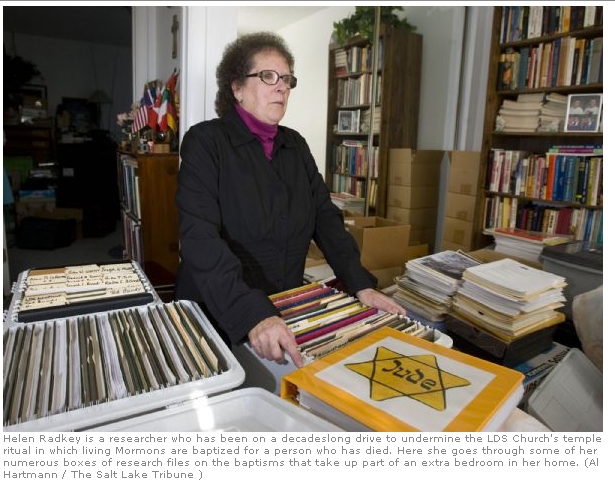
sltrib.com
LINK:
:
Hitler's Mormon baptism
Dean Hovey, a mean little guy...
|
She
alerted Jewish genealogists that
Mormons were not keeping their 1995 agreement
to stop baptizing Holocaust victims.
Radkey has become an irritant to Mormon officials and the church faithful, who
wince every time a newspaper reports her latest find in LDS baptismal records.
"I call her the Erin Brockovich of the Mormon/Jewish controversy," says New
Jersey resident Gary Mokotoff, past president of the International Association
of Jewish Genealogical Societies who signed the agreement and feels indebted to
Radkey for what he considers impeccable research. "You can defame her any way
you want personality-wise, but she's still a whistle-blower."
Righting wrongs
Radkey's quest to eliminate LDS proxy baptisms may seem an odd obsession for a
Catholic-turned-Mormon-turned-New-Ager from Hobart, Australia, but in many ways
it fits neatly with the bulldog for justice she always has been.
Radkey descended from Irish Catholics on her father's side and British convicts
and free settlers on her mother's. Her mom, a Protestant who converted to
Catholicism at her marriage, often took Radkey and her brother to cemeteries,
which is where young Helen first developed an interest in genealogy and a
reverence for the dead.
Radkey attended Catholic schools, but eventually went looking for another faith.
In 1963, two Mormon missionaries knocked on the door where she was a wife and
mother. For eight long years, her husband refused to let her join this
American-born religion, but Radkey was determined. In 1971, she relinquished the
marriage and custody of her son and daughter for a chance to join.
"I gave up everything for the church," she says.
Later that year, Radkey met Stuart Olmstead, an American who was living in
Australia. He also joined the LDS Church; they were wed and later "sealed" in a
Mormon temple. They had identical twin sons after moving to Sydney, hundreds of
miles to the north.
That's where Radkey's sense of fair play kicked in.
In a neighboring LDS congregation, four members were excommunicated after a
disagreement with LDS officials in Sydney. The ouster outraged Radkey, who
complained loudly about the treatment.
As punishment for speaking out, Radkey says, she and her husband were
dis-fellowshipped, a step just short of excommunication, and stopped attending.
Three years later, she condemned blind obedience in a tract called Free Agency
in The Church of Jesus Christ of Latter-day Saints in Australia and distributed
300 to 400 copies to members in the area.
Then it was Radkey's turn to be excommunicated, but she long since had stopped
believing in Mormon doctrine. She ultimately came to see LDS teachings as
"poppycock" and the church as an oppressive institution, even a cult.
"I'd lost a sense of there being one true church," she recalls, "and began to
explore universal principles."
In 2001, Radkey attended the viewing of LDS general authority Loren C. Dunn, a
mission president in Sydney during her falling-out with the faith. Standing over
Dunn's casket, she said, "I forgive you."
Moving to Utah
On a December 1980 visit to Boston, Radkey heard Neil Diamond's "America" and
promptly decided to move here. The family settled in Kentucky, where Olmstead's
family lived, but the marriage didn't last.
In 1984, she moved with her sons to the heart of the LDS Church: Utah.
"I had some unresolved concerns with Mormonism," Radkey says. "I thought I could
help Mormons who had gone through what I had. I felt like I had to finish
something."
She also had a premonition that she would have something to do with Jews.
"The Jewish imprint had been on me for a long time," she says. "I developed a
passion for the Holocaust. I have five crates of Holocaust books, took Israeli
dancing and even took Hebrew classes."
In Utah, she met Anthony Radkey, who worked in a flour mill and installed
windows. Before she would marry him, Radkey insisted the nonpracticing Mormon
have his name removed from LDS Church records. That marriage ended in 1992.
While the twin boys developed their athletic prowess, Radkey spent time doing
psychic readings, studying various spiritual traditions and occasionally
prancing around the house, crooning Diamond's hits.
She applied for and became a minister in the Universal Life Church because, she
says, it didn't have a particular dogma, just promoted justice. Plus, she adds,
"you can never be disbarred or excommunicated."
Radkey did feel that her boys needed a religious identity, so she sent them to
St. Ann Catholic Parish and School in Salt Lake City.
That didn't satisfy her, either. She pulled the twins out of Catholic schools
and sent them to Highland High, where they won tennis titles and earned
scholarships to Gonzaga, a Catholic university in Spokane, Wash.
"It was an interesting childhood," says Matthew Olmstead, one of her 34-year-old
sons and an information-technology-management consultant in Los Angeles. "She
was on a crusade ... to single-handedly take down the Mormon religion. She was
so consumed by that, we had a hard time relating to it."
Today, Olmstead respects his mother's work against proxy baptisms, but doesn't
share her need to fight the practice.
"She sends us e-mails all the time, I feel bad because we can't read it all," he
says. "I couldn't care less what Mormons do behind closed doors in their
temples. I don't see the impact that [proxy baptism] has. It's all based on a
belief system, and, if you don't buy into it, it's not going to move you."
Still, he recognizes it's a cause that keeps his energetic mother going.
"She needs to have a project to keep her busy. If not this, it would have been
something else," says Olmstead, who, like all her children, remains close to
Radkey. "She's very smart but could have done better if she had gone into
business."
Birth of an obsession
In July 1993, just as the twins were graduating from high school, Radkey
traveled to the (Jesuit) Martyrs' Shrine in Ontario, Canada. Moved by what she
saw, she returned to discover that Mormons had performed proxy baptisms for
Gabriel Lalemant and the other martyrs.
Thus began her dogged effort to publicize every posthumous LDS baptism that
might offend others' religious sensibilities, beginning with Roman Catholics. In
the mid-1990s, she remained focused on Catholic names, reporting findings to the
Salt Lake City Diocese's bishop, George H. Niederauer, who dismissed her
concerns.
After 1995, when LDS officials agreed to remove more than 350,000 Jewish
Holocaust names from their records, Radkey explored whether those names were
back on the list. By 2000, she reported some 19,000 names had reappeared.
In September and October 2002, she met with Family History Library officials to
offer them her research for a price -- $30,000 and a continuing fee of $18 an
hour, according to the Jewish magazine Forward -- but the LDS Church declined.
Instead, the Jewish Holocaust group compensated her for the hours and hours she
had spent scrutinizing LDS genealogical records for Jewish-sounding names of
people who died in Europe between 1942 and 1945.
Today, when she uncovers in those temple records any names she considers
inappropriate or outrageous -- such as Anne Frank, Sen. Edward Kennedy or the
recently canonized Catholic saint Father Damien -- she often alerts the press.
"I don't think it's right to impose [LDS] rituals on those who didn't share
their beliefs when they were alive," she says. "We should be letting souls rest
in peace and let them be who they were."
Mormons believe they have a spiritual mandate to offer the faith to those
throughout human history who didn't have a chance to embrace it while they were
alive. They see proxy baptisms as invitations, not compulsions. Those who have
passed on can either accept or reject the ordinance.
This doctrine - offering salvation to as many as possible - drives the church's
genealogical mission.
If Radkey succeeded in scuttling the practice, the church no longer would feel
compelled to collect and maintain all those records -- a loss to Mormons and
non-Mormons alike.
Those most harmed by last year's Vatican edict to stop allowing LDS researchers
to copy parish records were, ironically, Catholics.
"Most parishes can't or don't answer letters because they are understaffed and
their highest priority is the living, as it should be," Kathy Kirkpatrick, a
Quaker and past president of Salt Lake City's professional genealogist
association, said at the time. "Most folks don't have the resources to visit a
parish in person ... and sometimes even a personal visit doesn't get access to
the records."
Anti-Mormon allies
Not surprisingly, Radkey has defenders and critics -- in and out of the LDS
Church. She declines to name any Mormon friends for fear of reprisals against
them. But she gladly claims career anti-Mormons Sandra Tanner and Michael
Marquardt among her admirers.
Neither of them is as consumed by the proxy-baptism issue, but both support her
efforts.
Tanner, who, with her late husband, Jerald, created Utah Lighthouse Ministry to
"document problems with the claims of Mormonism and compare LDS doctrines with
Christianity," calls Radkey an "indefatigable researcher" who "has done a
phenomenal job."
Marquardt, a researcher of early Mormon history, helped Radkey assemble the
materials she took to Rome. He praises her work ethic. "She spends hours doing
this, looking up names and locations. As far as I know, it's always checked
out."
In recent years, Radkey talked about her work at the annual meeting of American
Atheists and posted her research findings on
mormoncurtain.com, a
site for ex-Mormons to share their stories and "recovery."
Radkey's longtime Salt Lake City friend Lynda Marsh sees a softer, gentler side
to this genealogical pit bull.
"Helen can come across as looking like a hard woman, but don't be fooled, she's
not," Marsh says. "She has a lot of compassion as well. She'll go the extra mile
for a person. She did it for me when my husband was sick."
Marsh acknowledges Radkey's persistence can be annoying.
Once she starts talking about one of her pet issues, it's hard for her to stop.
She frequently goes on tangents, piling detail upon detail from her encyclopedic
mind, often dropping name after name she has discovered in the LDS library
system. She cannot resist writing letters of complaint to newspapers on
everything from prayer at public meetings and school choirs singing at religious
services to the Catholic stance on gay marriage.
"Helen is a very dedicated person, not only to her research projects but to
everything she undertakes," says Marsh, a former Mormon who shares Radkey's
concerns about proxy baptisms. "Whether working on a job or with mentally
disabled people, she gives her all to it. She's very dedicated to detail. What
can you say when she's so passionate about it?"
Negative energy
Critics see it differently.
Rabbi Benny Zippel of Salt Lake City's Congregation Bais Menachem is equally
distressed by the posthumous baptism of Holocaust victims, believing that a
conversion requires a full-fledged, conscious willingness. Any kind of proxy
baptism "is morally offensive and deeply hurtful to both the survivors of the
Holocaust," he says, "as well as to the souls of those who died and laid down
their lives for their faith."
Still, when Radkey came to him for support, he wanted nothing to do with her
efforts.
"I don't like nurturing or enhancing negative energy," Zippel says. "I have been
here for 18 years, enjoyed a very positive, enriching experience interaction
with the LDS Church, with [former] President [Gordon B.] Hinckley and now with
President [Thomas S.] Monson. I don't want to get involved with anything that is
damaging to other people."
Gordon Remington, a Protestant professional genealogist, appreciates the use of
the LDS Family History Library. He is fully aware of the theological reason
Mormons gather the data and is not offended by it.
But Remington is offended by any individuals who use the Family History Library
for personal and/or professional research yet seek to criticize or undermine the
purpose for which the library exists.
"From the standpoint of a professional genealogist," Remington says, "I find
that unethical."
Radkey says she is finished digging up questionable proxy baptisms. After
completing a writing course at Salt Lake Community College, she plans to pen a
screenplay about serial killer Ted Bundy, aka Theodore Robert Cowell.
Although Bundy joined the LDS Church when he was alive, he nonetheless was
posthumously baptized in a Mormon temple.
Who discovered this? Helen Radkey.
pstack@sltrib.com
Source:
sltrib.com
HUNDREDS
JOIN PROTEST AT TEXAS CAPITOL: BOARD
MEMBER RENEWS EFFORT AGAINST TEACHING SEPARATION!
An enthusiastic crowd estimated at nearly 300 people turned out
for a rally this morning in front of the state capitol building in
Austin, Texas to protest proposed changes in how subjects ranging
from history to science will be taught in public schools.
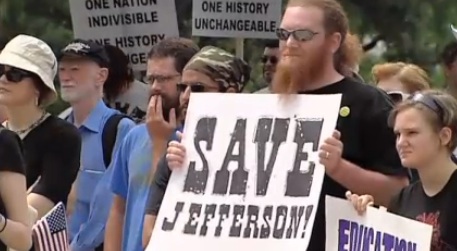
A religious-right faction on the board last month recommended
sweeping changes in the content of textbooks. Proposals called
for downplaying secularism, the Enlightenment and even Founders
like Thomas Jefferson in favor of a renewed emphasis on religion
as a positive force in American history. In place of the "Sage of
Monticello," one member suggested that students learn more about
religious leaders like John Calvin.
Several speakers addressed today's event including Dr. Ed Buckner
President of American Atheists. A message of support from author
and Atheist Christopher Hitchens was also read. More details will
follow in the next edition of AANEWS.
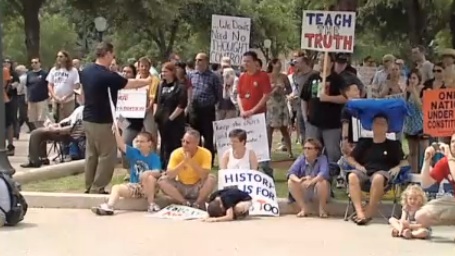
While Texas citizens were mobilizing against the new guidelines,
however, on of the most strident members of the Board of Education
announced that he will propose even more radical changes before
the Board meets again this week.
Ed Buckner of American Atheists |
Member Don McLeroy (R. - College Station)
told reporters that that
he will attempt to
mandate that eighth-graders study the issue of
state-church separation from what the Dallas
Morning News described
as "a different
perspective." The paper is reporting that
students
would "contrast the Founders' intent
relative to the wording of
the First Amendment's Establishment
Clause and Free Exercise Clause
with the popular term 'Separation
of state
and
church.' "
Story:
dallasnews.com
A MESSAGE FROM CHRISTOPHER HITCHENS
READ AT TODAY'S "TEXANS FOR TRUTHFUL
TEXTBOOKS" RALLY
We know of no spectacle more ridiculous - or more contemptible - than
that of the religious reactionaries who dare to re-write the history
of our republic. Or who try to do so. Is it possible that, in their
vanity and stupidity, they suppose that they can erase the name of
Thomas Jefferson and replace it with the name of some faith-based
mediocrity whose name is already obscure? If so, we cheerfully
resolve to mock them, and to give them the lie in their teeth.
Without Thomas Jefferson and his Declaration of Independence,
there would have been no American revolution that announced universal
principles of liberty. Without his participation by the side of
the unforgettable Marquis de Lafayette, there would have been no
French proclamation of The Rights of Man. Without his brilliant
negotiation of the Louisiana treaty, there would be no United States
of America. Without Thomas Jefferson and James Madison, there would
have been no Virginia Statute on Religious Freedom, and no basis
for the most precious clause of our most prized element of our
imperishable Bill of Rights - the First Amendment to the United
States Constitution.
|
God Is Not
Great: How Religion
Poisons
Everything
by Christopher Hitchens
|
A page from this book -- on
Masturbation, Islamic style
TIMES ONLINE review
This
noted British-American author, journalist and literary critic,
has been a columnist at Vanity Fair, The Atlantic, The Nation, Slate, and a
variety of other publications. Hitchens is also an outspoken atheist and
antitheist. His bestselling book, God is Not Great: How Religion Poisons
Everything explores how religion has impacted and influenced the world in a
negative way. Writes Booknotes:
“Hence, he (Hitchens)
believes that religion is manmade, and an ethical life can be lived without
its stamp of approval.”
--
Booknotes |
|
We make no saint of Thomas Jefferson - we leave the mindless
business of canonization and the worship of humans to the fanatics
-but aware as we are of his many crimes and contradictions we say
with confidence that his memory and example will endure long after
the moral pygmies who try to blot out his name have been forgotten.
As Abraham Lincoln died, after a cowardly shot in the back from
a racist traitor, Secretary of War Edwin Stanton sighed and said:
"Now he belongs to the ages". Or did he say "Now he belongs to
the angels"? In a roomful of highly literate and educated officers
and physicians, in an age of photography and stenography, and with
newspaper presses around the corner on Pennsylvania Avenue, there
was no agreement among eye-and-ear witnesses as to what Stanton
had actually said.
Those of us who write and study history are accustomed to its
approximations and ambiguities. This is why we do not take literally
the tenth-hand reports of frightened and illiterate peasants who
claim to have seen miracles or to have had encounters with messiahs
and prophets and redeemers who were, like them, mere humans. And
this is also why we will never submit to dictation from those who
display a fanatical belief in certainty and revelation. They try to
tell us that to do otherwise is to collapse into "relativism". But it
is they who wish to promote the life and work of Jefferson Davis -
an advocate of slavery, backwardness, treason and disunion - to an
equality with Lincoln, who suffered agonies of doubt, who never
joined a church, who was born on the same day as Charles Darwin
and who introduced his colleagues to the work of Thomas Paine -
and who was the last brave casualty of a war: a war begun by
devout and fanatical Christians, that preserved our Union and in
the end led to the striking of the shackles from every slave. It
was inscribed in the documents of the Confederacy that the private
ownership of human beings had a divine warrant. And so it did -
to the everlasting shame of those who take the Bible as god's word.
It is notorious that the news of the Emancipation Proclamation
was kept from the people of Texas and not celebrated until
"Juneteenth". There may be those in Texas now who believe they can
insulate their state - a state that had its own courageous revolution
- from the news of evolution and from the writing in 1786 of a
Constitution that refuses to mention religion except when demarcating
and limiting its role in the public square. But we promise them today
that they will join their fore-runners in the flat-earth community,
and in the mad clerical clique of those who believed that the sun
revolved around the earth. Yes, they will be in schoolbooks -as a
joke on the epic scale of William Jennings Bryan. We shall be fair,
and take care to ensure that their tale is told.
As President, Thomas Jefferson received a letter from a
concerned group of Baptists in Danbury, Connecticut. These people
were the objects of persecution and the victims of discrimination,
and they beseeched Jefferson to uphold their liberties. Of whom were
they afraid? It should be remembered, and taught in our schools,
that these poor Baptists were afraid of the Congregationalists of
Connecticut, who subjected their fellow-Christians to insult and
insecurity. Thus it was the secular and unbelieving Jefferson who
insisted that, by means of a "wall of separation" between religion
and government, all faiths and communities could take shelter under
the great roof of the godless Constitution. From that day to this,
the only guarantee of religious pluralism has been the secular law.
We inherited these principles and these freedoms and we here
highly resolve that we shall pass them on, as we will pass
on an undivided Republic purged of racism and slavery, to our
descendants. The popgun discharges of a few pathetic sectarians
and crackpot revisionists are negligible, and will be drowned
by the mounting chorus that demands: "Mr Jefferson! BUILD UP
THAT WALL".
-- Christopher Hitchens
MOJAVE DESERT CHRISTIAN
CROSS CASE versus
UTAH HIGHWAY PATROL CROSS CASE
by Brian Barnard, Esq.
(Utah
Legal Clinic)
Salt Lake city, May 2, 2010 --
This weeks' decision by
the United States Supreme Court dealing with the Roman Cross
in the California Mojave Desert does not directly effect our
pending case and appeal dealing with the Utah Highway Patrol
Crosses. The Supreme Court reversed the 9th Circuit Court of
Appeals and told that lower Court to reconsider its
decision. That early decision had determined that Congress'
enactment transferring one (1) acre of land containing the
cross to the private group, the VFW, violated a prior
injunction prohibiting the cross on federal land. The
Supreme Court told the 9th Circuit that it had not properly
considered the context and the significance of Congress'
reasons and the underlying facts for enacting that land
transfer.
The Supreme Court decision did not directly address whether
a Roman / Latin cross is or is not exclusively a religious
symbol. The decision did not say whether a cross can be
displayed on government property nor under what
circumstances. Several of the justices made asides about
those questions but those comments (called dicta) were not
determinative of the limited issue actually before the Court
and thus carry no weight. Therefore, the Supreme Court
decision does not give the 10th Circuit any mandate as to
how it should decide our pending appeal.
Our appeal was argued in Denver on March 9, 2009. I believe
the 10th Circuit has been waiting on the Supreme Court to
decide the Mojave Cross case before deciding our Utah
Highway Patrol Cross Case. The 10th Circuit did not get much
actual guidance.
There are significant differences between the Mojave cross
case and our case. I remain optimistic that the 10th Circuit
Court of Appeals will rule in our favor.
The differences include:
The Utah Highway Patrol
crosses have the official logo of the UHP prominently
displayed on them.
There is no disclaimer indicating they are a private
project.
The majority of them are unquestionably on government
property.
The crosses on prominent display (not in the middle of a
barren desert).
Two of the crosses are on the lawn in front of a
government office building.
The program is of recent origin.
The crosses were protested immediately upon the
program's commencement.
I anticipate a decision very
soon from the 10th Circuit in our appeal. I also anticipate
requests for reconsideration and further appeals after that.
If you have questions, please let me know.
Brian B.
Updte: Brian Barnard explains his recent victory in the
Tenth Circuit Court The Utah Highway
Patrolmen's cross case.
 Listen to the speech
here. Listen to the speech
here.
Vatican
excludes Richard Dawkins and Christopher Hitchens from atheist debate guest
list
May 2010 Atheism Examiner by
Trina Hoaks
In an effort to improve relations between non-believers and the Catholic Church,
the Vatican has decided to host a series of debates in Paris. The pope ordered
that a foundation be established to facilitate open dialogue between atheists
and agnostics and top Catholic theologians.
The foundation, Courtyard of Gentiles, which was set up by the Pontifical
Council for Culture, hopes to host the debates next year. Even though the church
is opening its doors to atheists, they are being selective about which atheists
will be allowed to participate. According to a report on The Independent Web
site, "militant" atheists, especially those who have "high public profiles such
as Richard Dawkins and Christopher Hitchens will not be invited."
The president of the Pontifical Council for Culture, Archbishop Gianfranco
Ravasi, told the National Catholic Register earlier this month that they were
prepared to host non-believers who were of the "noble atheism or agnosticism"
persuasion. He said that "polemic" non-believers like Piergiorgio Odifreddi,
Michel Onfray, Richard Dawkins, and Christopher Hitchens would not
be invited. He added that those kind of atheists meet the truth with "irony and
sarcasm."
Source:
examiner.com
 |
 |
Lawyers battle over
definition of religion
C h a r l e s Le w i s, N a t i o n a l P o s t
· Thursday, Jun. 17, 2010
A
strong selling point of the Church of the Universe is the use of marijuana as a
sacrament -- so assuming someone is inclined to indulge, the church is a
godsend.
That
link to the divine, however, did not stop police three years ago from charging
two of the brethren with possession of marijuana for the purpose of trafficking.
Now the
case, which began in April, is in one of the more unusual phases to ever take
place in a Canadian court room: A debate over what exactly constitutes a
religion and even whether such a definition is even possible.
Brother
Peter Styrsky and Brother Sharooz Kharaghani -- two bearded, gnome-like men who
sport funky wool caps to court and whose supporters in the gallery smell vaguely
of something illegal -- believe their freedom of religion, under the Charter of
Rights and Freedoms, had been violated.
The two
men are ministers at the "G13 Mission" in Toronto, which is a church, an organic
plant store and allegedly an illegal source of marijuana.
"This
is an inside joke among people who like to smoke marijuana," suggested Crown
attorney Nicholas Devlin during cross-examination of a senior member of the
Church of the Universe, in April.
On
Monday, Mr. Devlin called to the witness stand Katherine Young, a professor of
religion at McGill University, to articulate what a religion is and then to show
why the Church of the Universe is more of a club to smoke pot than a real faith.
Prof.
Young herself warned that trying to come up with a definition is an enormous
problem for scholars because of the complexity of religious beliefs. Indeed,
defence lawyer George Filipovic attacked Prof. Young's theories under
cross-examination, charging that her definition was arbitrary, too specific and
her research into the Church of the Universe would be "laughed at by fellow
academics and would never have been written by a respectable scholar."
Prof.
Young looked at the characteristics of major and minor religions and then
compared those characteristics with the Church of the Universe. She studied
major and minor religions and created a list of 10 common denominators that she
said all faiths had: a supernatural dimension, whether it be God, gods, ghosts
or spirits, or an ultimate experience; a way to help people to live with such
paradoxes as life and death, good and evil, and order and disorder; a source of
authority from a scripture or ancestral teachings or a magisterial structure
like the Catholic Church; a system of symbols; sacred times, such as holy days,
and sacred places, such as temples or pilgrimage routes; a series of repeatable
rituals; an ethical system and taboos; a comprehensive way of life; the ability
to sustain a group, not just individuals; and an identity or tradition that can
be passed from one generation to the next.
Prof.
Young said she could not see anything that resembled ritual, sacred spaces or
symbols, or helped its members deal with life's paradoxes in the Church of the
Universe.
The
only "scripture" or other literature she could find was from Cannabis Culture
magazine, a secular journal, and some information on a web site. "The group
raises a lot of suspicions," she said. "It's not clear if it's a religion or a
front [for protection against marijuana laws]."
She
also said the group did not require obligations from its adherents and the
general teaching was "do anything you want to do" -- a characteristic she had
not found in any other accepted religion.
"If
there are no obligations then you are left with anything you want it to be," she
said.
Mr.
Filipovic said Prof. Young's definition of religion was far too specific and
many notable scholars have put forth definitions that were far broader. He
quoted William James, the philosopher who authored The Varieties of Religious
Experience, who wrote: "[R]eligion shall mean for us the feelings, acts, and
experiences of individual men in their solitude, so far as they apprehend
themselves to stand in relation to whatever they may consider divine."
Mr.
Devlin mentioned Sir Edward Tylor, an a renowned anthropologist, who thought
religion could be boiled down to just a belief in a spiritual being.
Mr.
Filipovic added that at least two established religions, the Quakers and
Unitarians, forego creeds, use little or no symbols, and will often meld
traditions of other faiths into their worship. He also challenged the idea of
endurance. Fifteen years ago, he said, Falun Gong had not a single member.
Within six years the movement had grown to an estimaged 70 million members, far
surpassingmany religions that are hundreds or thousands of years old.
The
trial will continue later this summer.
Source:
nationalpost.com
Chaplain "protected" By God—and by an
Atheist--at War
SANGIN, Afghanistan—They say there are no atheists in foxholes. There's one on
the front lines here, though, and the chaplain isn't thrilled about it.
|
Finding
Happiness at Work
|
Navy Chaplain Terry Moran is steeped in the Bible
and believes all of it. His assistant, Religious Programs Specialist
2nd Class Philip Chute, is steeped in the Bible and having none of
it.
Together they roam this town in Taliban country, comforting the
grunts while crossing swords with each other over everything from the power of
angels to the wisdom of standing in clear view of enemy snipers. Lt. Moran, 48
years old, preaches about divine protection while 25-year-old RP2 Chute covers
the chaplain's back and wishes he were more attentive to the dangers of the here
and now.
It's a match made in, well, the Pentagon. "He trusts God
to keep him safe," says RP2 Chute. "And I'm here just in case that doesn't work
out."
The 460 Army, Navy and Air Force chaplains deployed to Iraq and
Afghanistan are prohibited from carrying weapons, counting on their assistants
and the troops around them for protection. It can be a perilous calling. On
Monday, Chaplain Dale Goetz, 43, of White, S.D., and four other soldiers were
killed by a roadside bomb near Kandahar. Capt. Goetz is the first Army chaplain
killed in action since the Vietnam War.
Army chaplains represent 130 religions and denominations,
including Catholicism, Judaism, Islam and Buddhism. The military says it's
common for assistants to be of different faiths from the chaplains they support,
or of no faith at all.
"They don't have to be religious," says retired Navy Capt. Randy
Cash, who served 30 years in the Chaplain Corps and now is its historian. "They
have to be able to shoot straight."
Source:
current.com/news

Atheists Billboard: It's "Like They're Poking
A Finger In Your Eye"
OKLAHOMA CITY - Atheists have erected a billboard seeking fellow non-believers,
drawing criticism from ministers in a state where more than 8 out of 10 people
say they are Christians.
More
Mormon
Prophecy Behind Glenn Beck's Message
b y D a n a
M i l b a n k
In one of his first appearances on Fox News, Glenn Beck sent a coded message to
the nation's six million
Mormons -- or at least those Mormons who believe in
what the Latter-day Saints call "the White Horse Prophecy."
 "We
are at the place where the Constitution hangs in the balance," Beck told Bill
O'Reilly on November 14, 2008, just after President Obama's election. "I feel
the Constitution is hanging in the balance right now, hanging by a thread unless
the good Americans wake up." "We
are at the place where the Constitution hangs in the balance," Beck told Bill
O'Reilly on November 14, 2008, just after President Obama's election. "I feel
the Constitution is hanging in the balance right now, hanging by a thread unless
the good Americans wake up."
The Constitution is hanging by a thread.
Most Americans would have heard this as just another bit of overblown commentary
and thought nothing more of it. But to those familiar with the White Horse
Prophecy, it was an unmistakable signal.
The phrase is often attributed to the Prophet Joseph Smith, founder of the
Church of Jesus Christ of Latter-day Saints, or Mormon Church. Smith is believed
to have said in 1840 that when the Constitution hangs by a thread, elders of the
Mormon Church will step in -- on the proverbial white horse -- to save the
country.
"When the Constitution of the United States hangs, as it were, upon a single
thread, they will have to call for the 'Mormon' Elders to save it from utter
destruction; and they will step forth and do it," Brigham Young, Smith's
successor as head of the church, wrote in 1855.
Was it just a coincidence in wording, or was Beck, a 1999 Mormon convert,
speaking in coded language about the need to fulfill the Mormon prophecy? A
conversation on Beck's radio show ten days earlier would seem to rule out
coincidence. Beck was interviewing Senator Orrin Hatch of Utah, also a Mormon,
when he said: "I heard Barack Obama talk about the Constitution and I thought,
we are at the point or we are very near the point where our Constitution is
hanging by a thread."
"Well, let me tell you something," Hatch responded. "I believe the Constitution
is hanging by a thread."
Days after Beck's Fox show started in January 2009, he had Hatch on, and again
prompted him: "I believe our Constitution hangs by a thread."
Large numbers of Mormons watch Beck, but likely an even larger number of his
viewers and radio listeners are evangelical Protestants who have no idea that
Beck is preaching to them an obscure prophecy of the Latter-day Saints -- a
faith many conservative Christians malign as a cult. In addition to the coded
allusions to the White Horse Prophecy, he often brings Mormon theology into his
broadcasts (he touts the thinking of late church president Ezra Taft Benson and
he frequently promotes the work Mormon conspiracy theorist Cleon Skousen) but
without identifying them with the LDS church.
Before the Mormons went west, Smith traveled to Washington seeking help for his
oppressed followers and received nothing but frustration. Rather than turning on
the government, however, "They considered themselves the last Real Americans,
the legitimate heirs of the pilgrims and Founding Fathers," Pat Bagley wrote in
the Salt Lake Tribune. "And, they believed, the very survival of the
Constitution depended on the Saints. From Smith on, LDS leaders prophesied the
Constitution would one day hang by a thread, only to be saved by Mormons."
A compilation of church leaders' statements over the years by the journal BYU
Studies shows this strain of thinking. Though there are doubts about whether
Smith actually wrote the phrase "hang by a thread," his successors left no doubt
about the theology behind it. Orson Hyde, a Smith contemporary, wrote that Smith
believed that "the time would come when the Constitution and the country would
be in danger of an overthrow; and said [Smith]: 'If the Constitution be saved at
all, it will be by the elders of this Church.'"
The church's fifth leader, Charles Nibley, believed that "the day would come
when there would be so much of disorder, of secret combinations taking the law
into their own hands, tramping upon Constitutional rights and the liberties of
the people, that the Constitution would hang as by a thread. Yes, but it will
still hang, and there will be enough of good people, many who may not belong to
our Church at all, people who have respect for law and for order, and for
Constitutional rights, who will rally around with us and save the Constitution."
The prophecy was renewed with each generation of church leadership. "The prophet
Joseph Smith said the time will come when, through secret organizations taking
the law into their own hands . . . the Constitution of the United States would
be so torn and rent asunder, and life and property and peace and security would
be held of so little value, that the Constitution would, as it were, hang by a
thread," church apostle Melvin Ballard said in 1928. "This Constitution will be
preserved, but it will be preserved very largely in consequence of what the Lord
has revealed and what this people, through listening to the Lord and being
obedient, will help to bring about, to stabilize and give permanency and effect
to the Constitution itself. That also is our mission."
And now it is Beck's mission. Secret organizations? Tramping on liberties?
Breakdown of law and order? Shredding the Constitution? Betraying the Founders?
This is the core of Beck's message, in his own words: "Some people in the
government seem to have a problem, you know, shredding the Constitution." And:
"You're trying to protect and defend the Constitution of the United States,
friends. It's in trouble." And: "He" -- that would be Obama -- "is going to
bring us to the verge of shredding the Constitution, of massive socialism."
But there is a Beckian twist in his version of the prophecy. Unlike the church
leaders' versions, Beck's vision carries the possibility of a bloody end. On the
night of Feb. 24, 2009, Beck outlined this prospect for his viewers. People who
"don't trust the government," he said, would "see the government as violating
the Constitution, and they will see themselves as defenders of the Constitution.
Not a good mix. Then they take matters into their own hands."
It was Glenn Beck in a nutshell: White Horse Prophecy meets horsemen of the
apocalypse.
Adapted from Tears of a Clown: Glenn Beck and the Tea Bagging of America,
released October 5, 2010 by Doubleday.
Source:
HuffingtonPost.com
FBI files shed light on
Ezra Taft Benson, Ike and the John Birch Society
By L e e D a v i d s o n Nov 14,
2010
Link to the full story
here - The Salt Lake Tribune
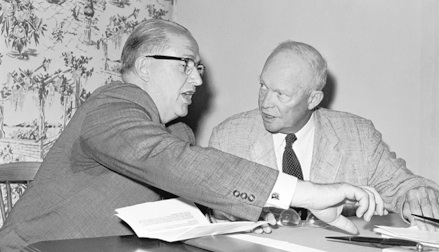
Ezra Taft Benson, left, Secretary of Agriculture, reaches over to
get some
papers as he meets with President Dwight D. Eisenhower in the
president's
temporary offices in the Gettysburg Hotel, Aug. 19, 1959. |
His letter to FBI Director J. Edgar
Hoover was packed with political dynamite, so Ezra Taft Benson marked it
“personal-confidential.”
Benson --- the only man to serve in a presidential Cabinet and later lead a
worldwide church, the
Mormons --- was attempting to convince Hoover that the
John Birch Society [Wikipedia] was a clear-thinking anti-communist group. So he wrote how it
had convinced him that a friend of theirs had been a tool of the worldwide
communist conspiracy.
That friend was none other than former President Dwight D. Eisenhower, for whom
Benson had served as secretary of Agriculture from beginning to end of his
eight-year presidency.
“In my study of the [communist] conspiracy, which I am sure is weak compared
with your own, the consequences of Mr. Eisenhower’s actions in dealing with the
communists have been tragic,” Benson wrote.
He argued to Hoover, whom he viewed as a friend and fellow fighter of communism,
that Eisenhower helped communism’s spread more than he hurt it, perhaps because
it had been the expedient thing to do for an ambitious politician.
That and other letters in Benson’s thick FBI file, obtained through a Freedom of
Information Act request, suggest that Benson was an early
tea partyer --- one
who would become an inspiration 50 years later for that modern movement.
Like the current tea partyers, Benson worried about threats to freedom and the
Constitution. He feared that too many powerful officeholders --- up to and
including the U.S. president --- were not standing up for the Constitution, and
instead aided its enemies, out of ambition, expediency or other, more sinister
motives.
The New Yorker magazine, in its Oct. 18 issue, included Benson as one of the tea
party’s ideological founding fathers --- which it called its “confounding
fathers” ---noting how Benson’s public writing and speeches are quoted and
admired by commentator Glenn Beck, an icon of the movement.
(It also noted how Beck, who is LDS, actively promotes the works of the late
Utah author/activist Cleon Skousen, who denounced communist corruption in the
U.S. government while defending the John Birch Society.)
The FBI files on Benson show a behind-the-scenes battle in which he sought to
persuade the bureau not to condemn the John Birch Society, formed in 1958 by
Robert Welch and named for a missionary-turned-soldier killed by Chinese
communists after World War II.
Interestingly, files also show that Hoover’s FBI twice spied on Benson ---
possibly for Eisenhower --- to determine whether he might resign from the
Cabinet during times of widespread criticism. Files also show that Hoover lied
in later years to avoid Benson, seeking to distance himself from Benson’s
support of the Birch Society.
---
Looking back -- Benson’s son, Reed, and Reed’s wife, May Hinckley Benson, said
in a recent Salt Lake Tribune interview in their Provo home that they are not
surprised about the views contained in the FBI files.
They watched up close as Ezra Benson formed a hatred of communism because it
destroyed personal and religious liberty. He sometimes expressed frustration to
them that Eisenhower and America were not doing more against it.
Friends and allies -- Amid the spying by Hoover, the FBI director managed to
leave the impression with Benson that they were friends and fellow fighters
against communism.
Files show they exchanged copies of books and speeches. Hoover sent messages of
encouragement when Benson was sick and when his stepmother died. He wrote a note
of thanks for Benson’s service when he left the Cabinet. He also once invited
Benson to have his son, Reed, apply to become an FBI agent.
In turn, Benson invited Hoover to speak at an LDS Church general conference
(which Hoover declined), to attend a concert by the Mormon Tabernacle Choir with
Benson’s wife, to allow the LDS Church’s Deseret Book Co. to print a compilation
of Hoover’s speeches (which did not happen), and even to attend a song recital
by one of Benson’s daughters.
“I realize that only in the next life will we fully appreciate all you have done
to preserve freedom in this country,” Benson wrote Hoover in 1965. “I am most
grateful for your exposure of the communist conspiracy and for the wonderful
organization you have established in the FBI.”
---
Frustrations -- But Benson was not so happy with others in the Eisenhower
administration.
Reed Benson said his father tried to persuade the State Department, for example,
to rethink its support of Fidel Castro in Cuba after Agriculture attachés warned
Benson that supporting him could lead that country to communism.
He was also upset at Eisenhower’s orders for Benson to take Soviet Premier
Nikita Khrushchev to an agricultural experiment center near Washington in 1959.
Benson said in a 1967 speech, “I opposed his coming then, and I still feel it
was a mistake to welcome this atheistic murderer as a state visitor.”
With such frustrations, Benson became involved with the John Birch Society once
he had left office. After Reed Benson lost a run for Congress in 1962, he said
the society approached him, and they found they shared beliefs.
“The John Birch Society believed in less government, more individual
responsibility and a better world,” Reed Benson told The Tribune.
When the society offered Reed a job as its Utah coordinator, FBI logs show that
his father made a phone call wanting to know what the bureau felt about the
group. It was the beginning of Benson’s defense of the society.
An agent wrote, “I informed him off the record … that to my knowledge the FBI
has not investigated the John Birch Society.”
The agent added in summary of the conversation, “Benson has reached the
conclusion the society is doing a lot of good in combating communism and feels
that it is patriotic in its motives.”
Benson also told the agent that he hoped to soon meet with Hoover in Washington
“to confer with him about the menace of communism and the role of the Birch
Society.”
Because of that, officials at FBI headquarters wrote a briefing paper to prepare
Hoover in case Benson called.
Calling the society “probably the most publicized right-wing extremist group in
the country,” they recommended keeping Benson away from Hoover --- including
lying, if necessary, to say that Hoover was unavailable to talk to Benson.
---
Godless communism -- On May 17, 1965, Ezra Taft Benson wrote to Hoover with a
plea. “Word has come to me, not yet fully confirmed, that some of our liberal
‘soft-on-communist’ groups are planning to put pressure on you to come out with
a statement against the John Birch Society.” He urged Hoover not to do so.
“It is my conviction that this organization is the most effective non-church
group in America against creeping socialism and godless communism,” Benson
wrote.
Hoover, however, in response to a question at a news conference soon thereafter,
said he had little respect for the society or its founder, Robert Welch.
After Hoover’s disavowal of Welch, Benson decided to meet with Hoover to explain
his support of the society and how Welch’s writings had convinced him that
Eisenhower aided communism.
Files show that Hoover’s aides twice told Benson that he was unavailable for
such a meeting --- as memos had advised them to do. So Benson wrote Hoover the
sensitive “personal-confidential” letter of May 28, 1965, outlining his
conclusions about Eisenhower.
Benson also soon sent a book by Welch titled The Politician, noting it was what
led him to his conclusions about Eisenhower.
In the book, Welch argues that Eisenhower was either ignorant, a politician
blinded by opportunism or was “consciously aiding the communist conspiracy” ---
and said it really didn’t matter because “they all come to the same end … namely
tragedy.”
Benson wrote Hoover that he inscribed the following words on the flyleaf of the
book after he first read it:
“Have just finished this shocking volume. ... While I do not agree with all or
the extent of some of the author’s conclusions, one must agree that the
documented record makes the thesis of the book most convincing.
“How can a man [Eisenhower] who seems to be so strong for Christian principles
and base American concepts be so effectively used as a tool to serve the
communist conspiracy?
“I believe the answer is found in the fact that these godless communist
conspirators and their fellow travelers are masters of deceit --- who deceived
the very elect. How our people need to be alerted and informed.”
Benson added that he hoped the $1 book would be made available widely.
“This story must be told even at the risk of destroying the influence of men who
are widely respected and loved by the American people. The stakes are high.
Freedom and survival are the issues,” he had written in his copy of the book.
Benson also wrote of Eisenhower: “I presume I will never know in this life why
he did some of the things he did which gave help to the [communist] conspiracy.
It is not my divine prerogative to know the motives of men. It is easier,
however, to judge the consequences of man’s actions.”
---
Noncommittal -- Hoover sent back only a short note: “It was indeed thoughtful of
you to furnish me your views regarding the John Birch Society and its head.” He
concluded simply, “I have taken note of your impressions.”
Such impressions would lead Hoover to take the advice of aides and largely cut
contact with his friend.
That included declining an offer to have the LDS Church-owned Deseret Book Co.
publish a compilation of Hoover’s speeches. Aides warned that because of
Benson’s letters, “If we were to go along with this project, it could in some
way be used to the advantage of the John Birch Society.”
Still, Benson kept up cordial correspondence with Hoover over the following
years --- and sent him John Birch Society materials on several occasions. In
1971, he again requested a meeting with Hoover while Benson was in Washington
for a few days for a church conference.
FBI headquarters staff also frowned upon that request.
“It is not believed that the director should take time from his busy schedule to
meet with Mr. Benson, as it is very possible that he would bring his son Reed
Benson with him for that meeting,” who, the memo said, was then the national
director of public relations for the John Birch Society.
When Reed Benson called to check on the availability of Hoover to meet with him
and his father, FBI memos say, “The director indicated at the time he was booked
solidly” --- as memos from staff had suggested he should say.
Hoover died only a few months after that last requested meeting. Benson would
live another 22 years --- enough time to ascend to the presidency of his church
and to see the fall of communism in Eastern Europe. He spoke little of that
fall, however, focusing on more spiritual matters of his church, including
urging LDS members to constantly read the Book of Mormon. Benson died at age 94
in 1994.
T h e H u f f i n g t o
n P o s t
Bill O'Reilly Doubles Down On God Controlling The Tides:
How Did The Moon Get There?
By N i c h o l a s G r a h a m Posted: 02/
2/11
The Fox News host took a lot of heat for claiming that science cannot explain
why the tides occur in such a regular fashion when in fact the tides are the
combined effects of the gravitational forces exerted by the Moon and the Sun and
the rotation of the Earth.
O'Reilly remains unimpressed: "Okay, how did the Moon get there? How'd the
Moon get there? Look, you pinheads who attacked me for this, you guys are just
desperate. How'd the Moon get there? How'd the Sun get there? How'd it get
there? Can you explain that to me? How come we have that and Mars doesn't have
it? Venus doesn't have it. How come? Why not? How'd it get here?"
In fact, prevailing scientific theory is that the Moon formed as the result
of a massive impact with Earth; Mars has a Sun and two moons; etc, etc. Bad Astronomy
has an exceedingly thorough examination of just how wrong O'Reilly is for
those interested in the gory details.
Thus the score remains O'Reilly - Zero, Science - Infinity.
Source:
HuffingtonPost.com
Washington
Post
Jehovah's Witnesses case in Puerto Rico
B
y D A N I C A C O T O W a s h i n g t o n P o s t
Feb. 9, 2011
SAN JUAN, Puerto Rico -- A federal appeals court in the United States has
ordered gated communities across Puerto Rico to grant access to Jehovah's
Witnesses so they can engage in their First Amendment right to proselytize.
The ruling comes nearly seven years after two religious corporations filed a
lawsuit against the government of the U.S. Caribbean territory arguing that
Jehovah's Witnesses were being denied several rights, including freedom of
speech, religion and travel.
Unlike in the U.S., where streets inside gated communities are private, they are
considered public thoroughfares in Puerto Rico even though gates are allowed to
be erected to control a neighborhood's entrances.
William Ramirez, director of the American Civil Liberties Union chapter in
Puerto Rico, praised the ruling.
"Door-to-door communication is a vital means of dissemination for small groups
with limited resources to spread their message," he said Wednesday.
A three-judge panel in the 1st U.S. Circuit Court of Appeal in Boston called the
case "novel and difficult" in its nearly 30-page decision issued Monday.
The panel ruled Puerto Rican gated neighborhoods cannot have locked and unmanned
gates that bar access to public streets. It said they have to hire guards,
unless the community can provide a substantial justification for not doing so.
"Conceivably, a controlled access area might be very small, its residents'
resources very limited, or both," the ruling said.
The panel ordered Puerto Rico's district court to enforce its ruling and review
any objections that communities might file.
While ruling for the rights of Jehovah's Witnesses to be given access, the
appeals panel upheld a 2005 district court ruling that found constitutional a
Puerto Rico law allowing neighborhoods with controlled access and giving guards
the right to request names and identifications of any visitors.
"Compared to an airport search, a few questions about identity and purpose for
entering an urbanization seem tame indeed," the ruling stated.
The ruling also technically applies to Maine, Massachusetts, New Hampshire and
Rhode Island because they are covered by the 1st Circuit. But it is unlikely to
have any impact there since U.S. law considers streets inside gated communities
to be private, said Paul Polidoro, assistant general counsel for the Watchtower
Bible and Tract Society of New York Inc., which oversees administrative issues
for Jehovah's Witnesses.
Luis Pabon Roca, a lawyer who represented the northern municipality of Caguas,
said he considered the ruling a victory because the law allowing for gated
communities was upheld as constitutional.
"In my opinion, the lawsuit was not needed," he said. "Jehovah's Witnesses have
access just like any other citizen in Puerto Rico."
Several attorneys representing other municipalities in the case did not return
calls for comment.
The appeal was filed by the Christian Congregation of Jehovah's Witnesses in
Puerto Rico and the Watchtower Bible and Tract Society of New York Inc.
They estimate that Jehovah's Witnesses in Puerto Rico have been barred from
entering 587 gated communities in 57 municipalities, representing a total of
more than 67,000 residences. They say only about half of Puerto Rico's gated
communities have guards.
Puerto Rico has 318 Jehovah's Witnesses congregations, for a total of about
25,000 members.
Source
Washington Post
Faith-based Groups get Stimulus Millions
F r e e t h o u g h t T o d a y, Dec. 2010, p. 15
A December 3 story in Politico said faith-based groups have received
about $140 million from the $787 billion American Recovery and
Reinvestment Act. Politico searched the database at Recovery.gov and
found that Catholic groups got the most ($90 million), followed by
Protestants ($45 million) and Jewish groups ($6 million).
Castleton United Methodist Church in Indianapolis bought a heating
and cooling system. St. Laurence O'Toole Catholic Church in Laramie,
Wyoming, installed new windows in its school. Christian Churches
United of the Tri-County Area, Harrisburg, Pennsylvania, spent its
$120,000 on food and shelter for homeless people.
"It kind of fell from the sky, and it was unbelievable that we had
this much extra money," said Jackie Rucker, Christian Churches
executive director.
Obama "took what President Bush did and has expanded it," said Rev.
Larry Snyder, Catholic Charities USA president.
Are
religious people easy targets for scams?
D a l l a s
B a p t i s t S t a n d a r d
By N i c o l e N e r o u l i a s, R e l i g
i o n N e w s S e r v i c e Feb. 24, 2011
WASHINGTON (RNS)—Major frauds exposed
by federal investigators in recent years have targeted Jehovah’s Witnesses,
Baptists and other religious groups, from $190 million lost in a three-year scam
promoted by a Christian radio host in Minnesota to an estimated $1.4 billion
conned from thousands of Utah
Mormons.
Is it simply too easy
for con artists to prey on people of faith?
“We’ve seen where
it’s an outsider who has come into the fold, and we’ve seen some where it’s a
person who has been a member of the community for decades,” said Lori Schock,
director of investment education and advocacy for the U.S. Securities and
Exchange Commission.
“We’ve had cases
where people quote Scripture, that the Lord wants you to make money. And when
the house of cards comes crashing down, the victims sometimes lose more than
just their money. Sometimes, they lose their faith, and it’s extremely sad.”
Why do religious groups make such
easy targets? For one, a swindler who professes the same faith, or belongs to
the same congregation, has an easy time earning trust, however misplaced. Duped
investors, meanwhile, also hesitate to suspect or report on one of their own,
Schock added.
Although the FBI’s Utah Securities Fraud Task Force has issued a warning to
members of the Latter-day Saints, the SEC hasn’t examined whether religious
groups are more susceptible to “affinity fraud”—scams that target specific
demographics, whether evangelical Christians or the elderly. But researchers say
it’s a question worth considering.
Harvard scholar Robert D. Putnam and Notre Dame’s David E. Campbell found a
connection between religiosity and trust in others in working on their book,
American Grace: How Religion Unites and Divides Us. Based on Harvard’s 2006
Faith Matters Survey, Putnam and Campbell conclude religious people are viewed
as more trustworthy by both religious and nonreligious Americans, and they also
tend to be more trusting of others.
“The underlying issue, I think, is the question of mutual trust,” agreed Nancy
Ammerman, a Boston University professor of religion and sociology. “These
schemes rely on and exploit that trust, and people within religious communities
tend to have high levels of trust for others within their community."
There’s also ease of access, Ammerman said.
“Conversations are easy to strike up, and everybody’s got a directory or an
e-mail list or at least people they talk to at coffee hour. The social
connections are there, and that makes it easier for someone with something to
sell to get new customers."
Anson Shupe, an Indiana University sociologist and author of several books on
faith-based fraud, said his own research indicates evangelicals,
Mormons and black churches are most susceptible,
while Catholics are relatively protected by a dense, hierarchical network of
clergy supervision.
“Protestants and Mormons tend to believe that there is a sort of straightforward
relationship between keeping the tenets of the faith and contributing
financially to it, and then reaping rewards in the here and now,” he explained.
“Some pastors preach a one-to-one relationship between worldly prosperity and
attendance to matters of faith."
But Earl Grinols, a Baylor University economics professor, believes any
correlation between faith and fraud stems from a “mistaken” perception that
religious people as easily misled. That prompts con artists to
disproportionately target them, along with the elderly and the newly affluent.
“It’s the ease of identifying and finding people in the group to scam, and that
the perpetrators have a misperception that these members are more naive,” he
said. “They may tend to view (Christians) as more simple, maybe more easily
led."
Schock urged potential investors to check with the regional SEC office before
handing money over to potential con artists, whether it’s a longtime congregant
in good standing, a religious leader who has been endorsed by fellow clergy, or
someone who promotes an investment that appears faith-friendly, such as church
bonds.
“Trust, but verify,” she said. “If something sounds too good to be true, it
probably is.”
Source:
BaptistStandard
A deity diverse and divisive
New Zealand Herald
B y G r e g A n s l e y
Mar 26, 2011
In the wide, red land led by an
atheist and where evolution has prevailed in its political war with creationism,
God has not died. But Australia's almighty has become a far more diverse and
divisive deity, still influencing laws and values and maintaining the potential
to undermine social cohesion.
The complexity of beliefs haunts policies and legislators. Christians fear
suffocation by political correctness and attack from opposing fundamentalism;
Muslims, Hindus and Buddhists complain of bias; pagans rail against marriage
laws and the ban on pagan chaplains in the military.
Indigenous Australians say their spirituality has been bundled with paganism and
dismissed as a valid belief system, further undermining their ability to manage
their affairs, and damaging the fragile process of reconciliation.
Laws and customs lodged in traditional Christianity are seen as discriminatory
and insulting by other religions. Anti-terror legislation amassed after the
September 11, 2001 attacks are regarded by Muslims as an assault on Islam,
potentially increasing the alienation that security agencies fear will fuel
home-grown jihadists. The impact of religion is felt in federal and state
Parliaments, by planning authorities, in schools and workplaces, and in the
streets.
This week, Prime Minister Julia Gillard, raised in a Methodist home but now an
atheist, repeated her belief in the nation's basic Christian cultural
foundation, again rejecting same-sex marriage and euthanasia, endorsing the
views of both Parliament's religious right and the nation's wider social
conservatism.
Laws, policies and practices remain a highway strewn with landmines: passions
and difficulties have grown with a rapidly changing nation, presenting what the
Human Rights Commission says is a "vastly more complex religious landscape" than
even a decade ago.
The commission's new report on freedom of religion and beliefs was not released
until after politicians were briefed in Canberra. Researchers spoke to 274
religious and secularist groups, with Governments, human rights groups and
ethnic and city councils, and received more than 2000 submissions.
Their study included Christian denominations from Anglicans and Catholics to
Jehovah's Witnesses, Mormons, Christadelphians and Orthodox churches; and to
Jews, Buddhists, Hindus, Muslims, Sikhs, atheists, humanists, skeptics,
rationalists and pagans.
"The research shows there is a need for education about religions, if we are to
reduce ignorance and fear, while promoting inter-group respect," Human Rights
Commissioner Graeme Innes said.
Belief in some form of deity remains strong. A 2009 Australian National
University survey of social attitudes found 45 per cent of Australians agreed
"there is something beyond this life that makes sense of it all", while a third
were not sure and 22 per cent disagreed.
But this is a country where Chinese has replaced Italian as the second language
and Buddhism is the second-largest religion after Christianity. Even so, the
report's findings supported Gillard's instincts: many Australians believe
strongly that the nation's values and culture are based on Christian teachings,
and these values are reflected in its public ethos and institutions, legal
system, and its social and political structures.
"The Christian heritage was seen as critical to how Australia or the Australian
Government deals with immigration, legislation, social norms and practices," the
report said. "It was seen as crucial to the way Australia understands and
identifies itself as a nation."
The report found changes wrought by migration had been too rapid and too
diverse, and that new religious diversity challenged, even threatened, the
nation's traditional values and social cohesion. It also found widespread
concern that too much deference was accorded religious minorities - especially
Muslims - at the expense of mainstream values, and that appeasing minority
groups threatened core social values.
But minority communities were "acutely aware" of difficulties in making their
voices heard and in practising their religion, especially in the face of
concerted local opposition, and through reactions to their clothes and
appearance.
And while there was broad agreement in the need for education about religion,
huge gulfs separate views on how this should be achieved.
Many believed faith-based education was needed to offset the failure of
government schools to instill core values, and upheld the right and
responsibility of parents to raise their children with these values.
Others argued that faith-based schooling undermined multi-culturalism and
tolerance by locking children into their parents' faith, encouraging
indoctrination.
Non-Christians were also angered by the expectation that people should swear
oaths on the Bible, that Parliaments were opened only by Christian prayers, and
that no provision was made for non-Christian holy days in the workplace.
Buddhists complained that visiting monks and nuns under vows of poverty had
problems gaining visas and, like Hindus, Muslims and pagans, faced difficulties
with burial laws and practices.
Orthodox Christians worried that anti-noise bylaws could prevent midnight
bellringing at Easter, Seventh Day Adventists had problems in observing the
Sabbath on Saturdays, and Jehovah's Witnesses and Christian Brethren sought
recognition of their beliefs against voting, which is compulsory in Australia.
Humanists complained of exclusion and bias in Governments, Jews' institutions
and organisations continued to be targets for violent attacks or vandalism.
Pagans said they were incorrectly associated with Satanism, faced restrictions
on advertising, and were often refused the use of scout or church halls for
events.
Muslims reported discrimination against women wearing the traditional hijab head
covering, problems in obtaining permission or raising funds to build mosques,
schools, and community centres, and workplace difficulties with prayer, dress
and fasting during Ramadan.
The report found widespread and deep-seated concern about Islam among other
Australians, including perceived intolerance of criticism, punishment for
apostates, gender inequality, and the threat of fundamentalist Islam, heightened
by a sense that Governments appeased Muslim communities, and that Islam received
preferential treatment.
The report also noted arguments that the Muslim community's belief that it was
being targeted by security laws had contributed to a climate of fear. Sikhs also
felt threatened by harsh anti-terror laws.
"Counter-terrorism legislation has had an enormous impact on ethnic and minority
communities, and the effects have been particularly disproportionate on Muslim
communities," the Australian Muslim Civil Rights and Advocacy Network told
researchers.
"The breadth of the laws, their discretionary or selective application and the
way in which the police and security agencies use their extended powers,
constrain basic freedom of association, speech and belief."
Source:
NZHerald.co.nz
How to become an exorcist
To become
an exorcist you must be a Roman Catholic priest and have permission from
your bishop to join the International Association of Exorcists.
T E L E G R A P H . C O . U K
by H e n r y S a m u e l i n P a r i s
30 Mar 2011
The body, which meets in secret every two years was founded in 1993 by Father
Gabriele Amorth, the official exorcist of Vatican City in the Diocese of Rome,
with the aim of increasing the number of official exorcists worldwide.
Since 2005, Catholic priests can sign up to learn how to cast away evil spirits
from the possessed at the Vatican-backed college, the Athenaeum Pontificium
Regina Apostolorum in Rome.
 It
runs a two-month course to teach the "spiritual, liturgical and pastoral work
involved in being an exorcist." It
runs a two-month course to teach the "spiritual, liturgical and pastoral work
involved in being an exorcist."
According to Father Giulio Savoldi, Milan's official exorcist, requirements
include "the supernatural force – the presence of God – and then suggest that
the man picked to do this kind of work be wise and that he should know how to
gather strength not just from within himself but from God." The Roman Catholic's
new Exorcism Rite, which was updated in 1999 for the first time since 1614,
stresses the importance of distinguishing who is really in need of an exorcism.
Father Savoldi said: "Those studying to become exorcists should also study
psychology and know how to distinguish between a mental illness and a
possession. And, finally, they need to be very patient." He said the priest who
undertakes the office should be himself a holy man, of a blameless life,
intelligent, courageous, humble. He should avoid in the course of the rite
anything resembling superstition and he should leave the medical aspects of the
case to qualified physicians.
The exorcism should take place in the church or some other sacred place, but can
be done in a private house with witnesses.
All idle and curious questioning of the demon should be avoided, and the prayers
and aspirations should be read with great faith, humility and fervour, and with
a consciousness of power and authority.
The crucifix, holy water, and, where available, relics of the saints are to be
employed during exorcism. If expulsion of the evil spirit is not obtained at
once, the rite should be repeated, if need be, several times.
The exorcist should be vested in cassock, surplice, and a violet stole.
Source:
telegraph.co.uk
Pakistan's blasphemy vigilantes kill exonerated man
B y N i c k
P a t o n W a l s h, C N N, A p r i l
1 4, 2 0 1 1
|
Despite being cleared of blasphemy, Mohamed Imran
was killed by vigilantes |
Talahore, Pakistan (CNN) -- Mohamed
Imran had been accused, jailed, tried and cleared: if anything, society owed him
a debt as a man wrongfully accused.
But his crime was blasphemy. He was
meant to have said something derogatory about the prophet Mohammed, so in
Pakistan justice worked a little differently.
Two weeks after he returned to his
small patch of farmland on the rustic outskirts of Islamabad, his alleged crime
caught up with him.
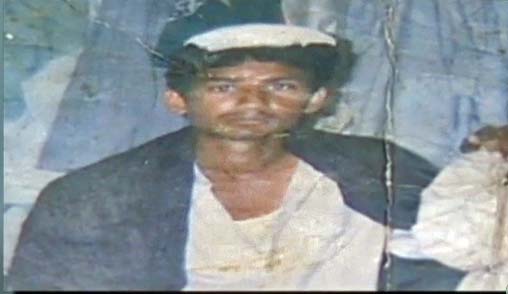 Two gunmen burst into the shoe shop
where he sat talking to a friend. Imran tried to duck, to seek cover behind
the man next to him -- terrified so greatly for his own life that he perhaps
forgot about those around him. Two gunmen burst into the shoe shop
where he sat talking to a friend. Imran tried to duck, to seek cover behind
the man next to him -- terrified so greatly for his own life that he perhaps
forgot about those around him.
But the gunmen found their target and
Pakistan's controversial blasphemy laws claimed another victim.
His brother Ikram told CNN: "When I saw him lying there, I felt the blood leave
my body, and that I was now alone."
Now Ikram has only his brother's unmarked grave to visit, next to the plot of
land close to what was once the source of Mohamed Imran's livelihood. This
farmland no longer feeds his family, who have moved away to live under the
charity of a friend. The threats remained.
We found his daughter, four-year old
Kazma who knew her father was dead but somehow felt he would come back. His wife
was in tears, but remarkably maintained that the blasphemy laws were important
as they protect the Muslim faith. It was hard to tell whether she believed that
or was speaking out of self-preservation.
Two high-profile politicians have
this year been assassinated for their criticism of the blasphemy laws: Punjab
governor Salman Taseer and minorities minister (and Christian) Shahbaz Bhatti.
Some observers see their deaths and the climate of rage around the blasphemy
laws as symptomatic of a broader rise in fundamentalist tendencies in Pakistan.
Others say that religion is all many
people have, given the levels of poverty and state dysfunction, and that they
don't like it being insulted. It's reported that more than 30 of the hundreds of
people convicted under the blasphemy laws have been killed by vigilantes. The
state has yet to execute anyone for this crime.
The curious part about this blasphemy case -- and many other such convictions
and allegations under the controversial law -- is that they do not specify what
the accused is meant to have said.
The first complaint delivered to the
police in 2009 refers to a conversation Imran allegedly had with another man in
a cafe, but says the exact blasphemous phrase cannot be repeated as that too
would be an act of blasphemy.
By the time we get to the court
appearance earlier this year, the charge is clearer (but we won't repeat it
here, given the sensitivity of the matter). You are left wondering whether by
this stage of the case many had already found reason to damn Imran.
All the same, this level of evidence
was not enough for the judge, who released Imran. But it was enough for the
gunmen.
We went into the nearby town to talk
to clerics at the local mosque. Some accused these holy men of fueling the anger
against Imran. Incidentally, Imran was a Shia, and hence a minority often
targeted in Pakistan.
As soon as we got out of the car near
the mosque and showed our cameras, tempers frayed. They didn't care why we were
there, they just saw us as outsiders, perhaps American spies.
We left promptly, ever more aware of
the growing rage on Pakistan's ordinary streets, fueled by generations of
poverty, decades of what many see as government ineptitude and years of foreign
intervention.
Source:
CNN
Happy
International Blasphemy Day!
Appeals court hears case of
Jehovah’s Witness in need of transplant
By B R A D C O O P
E R Wed, Apr. 20,
2011
The Kansas City Star
TOPEKA | A Kansas appeals court poked and prodded Wednesday, but kept returning
to the same question.
What compelling reason did Kansas have for refusing to pay for a woman’s request
— based on her religious faith — to undergo a bloodless liver transplant that
could be done only outside the state?
The answer could decide whether 64-year-old Mary Stinemetz, a Jehovah’s Witness
from Hill City, Kan., can replace her failing liver that has left her near death
after 20 years of illness.
“Don’t you have some type of compelling state interest to deny this, and what is
that compelling interest?” Judge Stephen D. Hill asked the state’s lawyer, Brian
Vazquez.
Hill’s comments came during a nearly hourlong session of the Kansas Court of
Appeals, which generally allots about 30 minutes to hearings.
Stinemetz contends the state is violating her religious freedom under the U.S.
Constitution and the Kansas Bill of Rights, which guarantee the right to worship
“according to the dictates of conscience.”;
The state is willing to allow Stinemetz to get a liver transplant, paid for by
Medicaid, at the University of Kansas Hospital. But she would have to compromise
her Jehovah’s Witness principles, because she would receive a blood transfusion,
which she believes violates God’s law.
Stinemetz could undergo bloodless transplant surgery in Omaha, Neb., but Kansas
is refusing to pay for the out-of-state procedure when a transplant is readily
available at KU.
Stinemetz’s case rests partly on U.S. Supreme Court precedent from 1963, which
holds the government needs a compelling state interest to justify infringing on
someone’s right to freely exercise religion.
Vazquez acknowledged there was little, if anything, in the court record to show
a compelling state interest. However, he contended that a 1990 Supreme Court
decision from Oregon eliminated the need to show a compelling interest.
In that case, the court ruled that government could adopt laws that might burden
someone’s religion as long as the law was neutral and didn’t target a specific
religious faith.
The court is expected to issue a ruling later.m.
Source:
Kansascity.com.html
Who picks which religions are sacred?
National Post by J
o h n M o o r e May 26, 2011
This newspaper roundly condemned the province of Quebec’s religious studies
curriculum in an editorial published May 24, “Moral relativism in the
classroom.” The program, known as Ethics and Religious Culture, dares teach
children that all religions are worthy of respect. The editors wrote: “Normative
pluralism is moral relativism, the notion that there is no single truth and that
all religions are of equal merit and equal worthiness of admiration.”;
By scoffing at the idea that all faiths are equal, the editorial board leaves
unanswered the question of which are better or more truthful than others (it
might also be asked why an editorial board that favours small government would
want the state to make such a decision, but I digress). By what measure shall we
establish the relative merits of religions? Shall it be by seniority? Sheer
numbers? Heaven forbid that we anoint one or the other based on reason or
evidence.
It makes perfect sense to many that Christianity outranks, say, Scientology, by
virtue of the fact that one has been around for 2,000 years while the other was
cooked up a mere half-century ago. But by this measure do we throw Mormonism
into question for having existed only slightly longer than L. Ron Hubbard’s
mischievous invention? With Mormons running for president of the United States,
am I at risk of a Human Rights Tribunal complaint if I point out that the faith
has something in common with Scientology in that both were founded by men who
might easily be described as self-aggrandizing cranks?
And if we are to defer to faiths on the basis of longevity, then surely the
National Post should accord more respect to druids and pantheists.
If we rank faiths by sheer numbers is Christianity 20% more important or
truthful than Islam? Is Rastafarianism a lark by virtue of the fact that it has
a mere 500,000 adherents? Never mind that all of the major faiths are riven with
schisms that further reduce their collective numbers. The Russian Orthodox
Church was in spasms for years over how many fingers one should use to cross
oneself. Sunni and Shia Muslims are similarly obsessed with prayerful gestures.
Nor can one religion be compared to another on the basis of theological rigour.
Just because two men with PhDs can debate the immaculate conception of Mary
doesn’t make the event more believable than the notion that Jesus appeared to
Sun Myung Moon in 1935.
The Post’s editors complain that religious parents “do not want their children
to learn that Christianity and pagan Animism and tinfoil hat science fiction are
equally true.” And why not? Are their faiths so weak that they fear without the
silo and blinkers of Sunday school or the temple that their children will be
lured away from such self-evidently superior creeds? The truly faithful need not
fear exposure to the faith of others.
The real problem is that if one or several religions are deemed sacred while the
others are dismissed as cults, obsessive compulsive disorders and curiosities,
then the door is thrown open to the incoherence of all faiths. Why should the
origin tale of the Old Testament be regarded as any more significant than the
notion that the world was created on the back of a turtle? The real fear of the
faithful is that when religions are held up to rational scrutiny each is as
irrational as the next. Atheists have everything to gain from the idea that
there is some normative means of comparing one faith to another.
Religious and moral instruction is the role of parents. They are free to teach
their children than the world is 10,000 years old or that if they whirl in
circles they will achieve ecstasy. In school, children will learn that their
classmates hold many other things sacred and that stubborn righteousness does
not mean that one tenet automatically bests another.
National Post
John Moore is host of Moore in the Morning on NewsTalk 1010 AM Toronto. He was
raised on the Bible and thinks it is an excellent book.
Source:
FullCommentNationalPost
Day of prayer
violates separation of state & church
Houston Chronicle Op-Ed, June 17,
2011
As Houston clergy, we write to express our deep concern over Gov. Rick Perry's
proclamation of a day of prayer and fasting at Houston's Reliant Stadium on Aug.
6. In our role as faith leaders, we encourage and support prayer, meditation and
spiritual practice. Yet our governor's religious event gives us pause for a
number of reasons.
We believe in a healthy boundary between church and state. Out of respect for
the state, we believe that it should represent all citizens equally and without
preference for religious or philosophical tradition. Out of respect for
religious communities, we believe that they should foster faithful ways of
living without favoring one political party over another. Keeping the church and
state separate allows each to thrive and upholds our proud national tradition of
empowering citizens to worship freely and vote conscientiously. We are concerned
that our governor has crossed the line by organizing a religious event rather
than focusing on the people's business in Austin.
We also express concern that the day of prayer and fasting at Reliant Stadium is
not an inclusive event. As clergy leaders in the nation's fourth-largest city,
we take pride in Houston's vibrant and diverse religious landscape. Our
religious communities include Bahais, Buddhists, Christians, Hindus, Jews,
Muslims, Sikhs, Unitarian Universalists and many other faith traditions. Our
city is also home to committed agnostics and atheists, with whom we share common
cause as fellow Houstonians. Houston has long been known as a live-and-let-live
city where all are respected and welcomed. It troubles us that the governor's
prayer event is not open to everyone. In the publicized materials, the governor
has made it clear that only Christians of a particular kind are welcome to pray
in a certain way. We feel that such an exclusive event does not reflect the rich
tapestry of our city. Our deepest concern, however, lies in the fact that
funding for this event appears to come from the American Family Association, an
organization labeled a hate group by the Southern Poverty Law Center. The
American Family Association and its leadership have a long track record of
anti-gay speech and have actively worked to discriminate against the gay,
lesbian, bisexual and transgender community. The American Family Association and
its leadership have also been stridently anti-Muslim, going so far as to
question the rights of Muslim-Americans to freely organize and practice their
faith. We believe it is inappropriate for our governor to organize a religious
event funded by a group known for its discriminatory stances.
As religious leaders, we commit to join with all Houstonians in working to make
our city a better place. We will lead our communities in prayer, meditation and
spiritual practice. We ask that Gov. Perry leave the ministry to us and refocus
his energy on the work of governing our state.
This article was submitted by Rev. Dr. Jeremy Rutledge, minister, Covenant
Church, Alliance of Baptists/American Baptist Churches; Rev. Douglas Anders,
conference minister, South Central Conference of the United Church of Christ;
Rev. Paul Beedle, Unitarian Universalist; Rev. Dr. Ginny Brown Daniel, minister,
Plymouth United Church, UCC; Rev. Beth Ellen Cooper-Davis, minister, Northwoods
Unitarian Universalist Church; Rev. Michael Diaz, director of connections,
Resurrection Metropolitan Community Church; Rev. Pat Farnan, Resurrection
Metropolitan Community Church; Rev. Lura Groen, pastor, Grace Evangelical
Lutheran Church; Rev. Teddy Hardy, minister, St. John United Church of Christ;
Rev. Lori Keaton, United Church of Christ; Rev. Harry Knox, senior pastor,
Resurrection Metropolitan Community Church; Rev. Janice Ladd, executive pastor,
Resurrection Metropolitan Community Church; Rev. Dr. Becky Edmiston-Lange,
co-minister, Emerson Unitarian Universalist Church; Rev. Mark Edmiston-Lange,
co-minister, Emerson Unitarian Universalist Church; Rev. Mona Lopez, volunteer
staff clergy, Resurrection Metropolitan Community Church; Rev. Laura Mayo,
minister, Covenant Church, Alliance of Baptists/American Baptist Churches; Rev.
Dr. Daniel O'Connell, senior minister, First Unitarian Universalist Church; Rev.
David Pantermuehl, Grace United Church of Christ; Rev. Adam Robinson, assistant
minister, First Unitarian Universalist Church; Rev. Ken Richter, senior
minister, First Congregational Church, UCC; Rev. Bill Royster, United Church of
Christ; Rev. Sam Schaal, transition minister, Bay Area Unitarian Universalist
Church; Rev. Robert Tucker, executive director, Foundation for Contemporary
Theology; Rev. Ernie Turney, pastor, Bering United Methodist Church; Rev. Bonnie
Vegiard, Unitarian Universalist.
Source: Read more:
www.chron.com
Minority Rules: Scientists Discover Tipping Point
for the Spread of Ideas
|

In this visualization, we see the
tipping point where minority opinion (shown in red) quickly becomes
majority opinion. Over time, the minority opinion grows. Once the
minority opinion reached 10 percent of the population, the network
quickly changes as the minority opinion takes over the original
majority opinion (shown in green). (Credit: SCNARC/Rensselaer
Polytechnic Institute) |
ScienceDaily (July 26, 2011) — Scientists at Rensselaer Polytechnic Institute
have found that when just 10 percent of the population holds an unshakable
belief, their belief will always be adopted by the majority of the society. The
scientists, who are members of the Social Cognitive Networks Academic Research
Center (SCNARC) at Rensselaer, used computational and analytical methods to
discover the tipping point where a minority belief becomes the majority opinion.
The finding has implications for the study and influence of societal
interactions ranging from the spread of innovations to the movement of political
ideals.
"When the number of committed opinion holders is below 10 percent, there is
no visible progress in the spread of ideas. It would literally take the amount
of time comparable to the age of the universe for this size group to reach the
majority," said SCNARC Director Boleslaw Szymanski, the Claire and Roland
Schmitt Distinguished Professor at Rensselaer. "Once that number grows above 10
percent, the idea spreads like flame."
As an example, the ongoing events in Tunisia and Egypt appear to exhibit a
similar process, according to Szymanski. "In those countries, dictators who were
in power for decades were suddenly overthrown in just a few weeks."
The findings were published in the July 22, 2011, early online edition of the
journal Physical Review E in an article titled "Social consensus through the
influence of committed minorities."
An important aspect of the finding is that the percent of committed opinion
holders required to shift majority opinion does not change significantly
regardless of the type of network in which the opinion holders are working. In
other words, the percentage of committed opinion holders required to influence a
society remains at approximately 10 percent, regardless of how or where that
opinion starts and spreads in the society.
To reach their conclusion, the scientists developed computer models of
various types of social networks. One of the networks had each person connect to
every other person in the network. The second model included certain individuals
who were connected to a large number of people, making them opinion hubs or
leaders. The final model gave every person in the model roughly the same number
of connections. The initial state of each of the models was a sea of
traditional-view holders. Each of these individuals held a view, but were also,
importantly, open minded to other views.
Once the networks were built, the scientists then "sprinkled" in some true
believers throughout each of the networks. These people were completely set in
their views and unflappable in modifying those beliefs. As those true believers
began to converse with those who held the traditional belief system, the tides
gradually and then very abruptly began to shift.
"In general, people do not like to have an unpopular opinion and are always
seeking to try locally to come to consensus. We set up this dynamic in each of
our models," said SCNARC Research Associate and corresponding paper author
Sameet Sreenivasan. To accomplish this, each of the individuals in the models
"talked" to each other about their opinion. If the listener held the same
opinions as the speaker, it reinforced the listener's belief. If the opinion was
different, the listener considered it and moved on to talk to another person. If
that person also held this new belief, the listener then adopted that belief.
"As agents of change start to convince more and more people, the situation
begins to change," Sreenivasan said. "People begin to question their own views
at first and then completely adopt the new view to spread it even further. If
the true believers just influenced their neighbors, that wouldn't change
anything within the larger system, as we saw with percentages less than 10."
The research has broad implications for understanding how opinion spreads.
"There are clearly situations in which it helps to know how to efficiently
spread some opinion or how to suppress a developing opinion," said Associate
Professor of Physics and co-author of the paper Gyorgy Korniss. "Some examples
might be the need to quickly convince a town to move before a hurricane or
spread new information on the prevention of disease in a rural village."
The researchers are now looking for partners within the social sciences and
other fields to compare their computational models to historical examples. They
are also looking to study how the percentage might change when input into a
model where the society is polarized. Instead of simply holding one traditional
view, the society would instead hold two opposing viewpoints. An example of this
polarization would be Democrat versus Republican.
The research was funded by the Army Research Laboratory (ARL) through SCNARC,
part of the Network Science Collaborative Technology Alliance (NS-CTA), the Army
Research Office (ARO), and the Office of Naval Research (ONR).
The research is part of a much larger body of work taking place under SCNARC
at Rensselaer. The center joins researchers from a broad spectrum of fields --
including sociology, physics, computer science, and engineering -- in exploring
social cognitive networks. The center studies the fundamentals of network
structures and how those structures are altered by technology. The goal of the
center is to develop a deeper understanding of networks and a firm scientific
basis for the newly arising field of network science. More information on the
launch of SCNARC can be found at http://news.rpi.edu/update.do?artcenterkey=2721&setappvar=page(1)
Szymanski, Sreenivasan, and
Korniss were joined in the research by Professor of Mathematics Chjan Lim, and
graduate students Jierui Xie (first author) and Weituo Zhang.
Source:
ScienceDaily.com
|
Jurors cover their mouths and cry as graphic
sex tape is played in court
A jury has found polygamist religious leader Warren Jeffs guilty
of child rape.
The leader of a polygamist sect of Mormonism known as the
Fundamentalist Church of Jesus Christ of the Latter Day Saints (FLDS),
was found guilty of forcing two teenage girls into "spiritual
marriage," and fathering a child with one of them when she was
15.
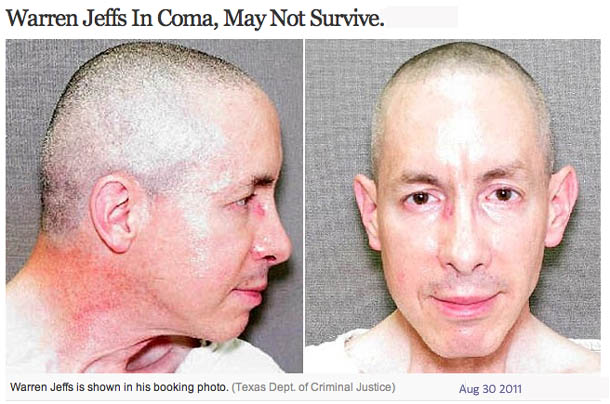 |
 Jeffs says he does not need to be near
death for his wives to have sex with him. (54 sec.)
Jeffs says he does not need to be near
death for his wives to have sex with him. (54 sec.) |
More... |
|


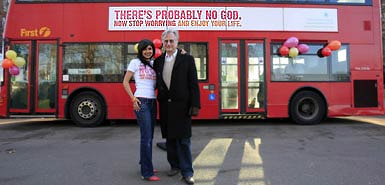
 Larry
Waggoner – In regard to the opening ceremony and prayer issue, Mr.
Waggoner stated hiring a City Chaplain would not work. He said the City would
still need to allow anyone that wanted to say a prayer to do so. To answer
Councilmember Fryer’s questions about nondenominational prayer, he explained a
nondenominational prayer is where you do not make reference to God as he or she
or make reference to Jesus Christ. It could be considered partially religious.
Councilmember Fryer said she didn’t know how to give a prayer like that. Mr.
Waggoner said he didn’t either. Councilmember Fryer asked if the word
“non-denominational” had to stay in the resolution or if it could be re-worded.
Mayor Waggoner said it could be reworded. Larry Waggoner said it would have to
be non-denominational because that’s the requirement. Councilmember Fryer
pointed out she was not against having a prayer. Larry Waggoner said his
suggestion right from the beginning was to not have a prayer. He further
explained the reason why prayer was discontinued from Council Meetings at the
beginning of this year was because he recommended removing prayer because by
keeping it on, it would invite trouble. He advised those people who are
religious to have their own personal prayer before coming to Council Meeting. He
expressed about holding a non-denominational prayer in the opening ceremony, it
would open up the possibility of a lawsuit or for someone to come and make a
mockery of prayer. In referring to the prayer that the West Valley City man
wanted to give (the man who brought this whole issue up), Mr. Waggoner commented
it was nothing but a big farce; however, the Supreme Court would support it more
than likely. Councilmember Anderson questioned if a moment of silence would be a
viable option after the reciting of the Pledge of Allegiance. Larry Waggoner
responded that would be a possibility. Mayor Waggoner stated if a moment of
silence were held, it would still be open to anyone. Councilmember Anderson
replied that anyone would have to be silent too. Larry Waggoner said just about
any type of observance opens up the potential for problems. Larry Waggoner
suggested the reference to God in the Pledge of Allegiance is about as far as
the City should go. He added to the Council that nevertheless, they could choose
what to do because they are the elected officials. Mr. Waggoner noted he prays
all the time but not in public. Mayor Waggoner asked the Council if they would
like to bring this matter back again to a future agenda. Councilmember Barlow
said he would like to postpone it for a while because he will be out of town for
the next Council Meeting.
Larry
Waggoner – In regard to the opening ceremony and prayer issue, Mr.
Waggoner stated hiring a City Chaplain would not work. He said the City would
still need to allow anyone that wanted to say a prayer to do so. To answer
Councilmember Fryer’s questions about nondenominational prayer, he explained a
nondenominational prayer is where you do not make reference to God as he or she
or make reference to Jesus Christ. It could be considered partially religious.
Councilmember Fryer said she didn’t know how to give a prayer like that. Mr.
Waggoner said he didn’t either. Councilmember Fryer asked if the word
“non-denominational” had to stay in the resolution or if it could be re-worded.
Mayor Waggoner said it could be reworded. Larry Waggoner said it would have to
be non-denominational because that’s the requirement. Councilmember Fryer
pointed out she was not against having a prayer. Larry Waggoner said his
suggestion right from the beginning was to not have a prayer. He further
explained the reason why prayer was discontinued from Council Meetings at the
beginning of this year was because he recommended removing prayer because by
keeping it on, it would invite trouble. He advised those people who are
religious to have their own personal prayer before coming to Council Meeting. He
expressed about holding a non-denominational prayer in the opening ceremony, it
would open up the possibility of a lawsuit or for someone to come and make a
mockery of prayer. In referring to the prayer that the West Valley City man
wanted to give (the man who brought this whole issue up), Mr. Waggoner commented
it was nothing but a big farce; however, the Supreme Court would support it more
than likely. Councilmember Anderson questioned if a moment of silence would be a
viable option after the reciting of the Pledge of Allegiance. Larry Waggoner
responded that would be a possibility. Mayor Waggoner stated if a moment of
silence were held, it would still be open to anyone. Councilmember Anderson
replied that anyone would have to be silent too. Larry Waggoner said just about
any type of observance opens up the potential for problems. Larry Waggoner
suggested the reference to God in the Pledge of Allegiance is about as far as
the City should go. He added to the Council that nevertheless, they could choose
what to do because they are the elected officials. Mr. Waggoner noted he prays
all the time but not in public. Mayor Waggoner asked the Council if they would
like to bring this matter back again to a future agenda. Councilmember Barlow
said he would like to postpone it for a while because he will be out of town for
the next Council Meeting. 
 One
lawmaker referred to
One
lawmaker referred to

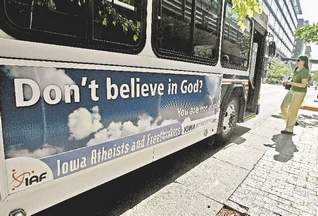




 The
foundation promotes separation of church and state and its membership consists
of "atheists, agnostics and skeptics," according to its website.
The
foundation promotes separation of church and state and its membership consists
of "atheists, agnostics and skeptics," according to its website.